


Home › Guides
Guides section
Facelift in Korea Guides: Planning, Safety and Recovery
Use this page as a checklist. The guides are grouped in the order most patients need them, from choosing a surgeon to follow-up care after you fly home.
By the Facelift in Korea Editorial Desk · Last reviewed October 24, 2026 · How we report
The short answer
Planning a facelift in Korea involves five stages: verifying a qualified plastic surgeon, preparing for consultation, arranging entry, travel and roughly two weeks of accommodation, recovering safely in Seoul, and organizing aftercare once you are home. These guides cover each stage in plain English, including the risks to watch for and the questions to ask before you commit.
Where to start
How should you use these guides?
Where you start depends on how far along you are.
- Just exploring: read Surgical vs Non-Surgical Facelift , the best age for a facelift and how long results last to decide whether surgery is right for you.
- Shortlisting clinics: focus on the surgeon and clinic guides. Verifying credentials and making sure the named surgeon operates matter more than price or marketing.
- Booked a consultation: prepare with the consultation questions, photo guide and medication list.
- Booking travel: check entry requirements, how long to stay and where to recover.
- After surgery: use the recovery and aftercare guides, and know the warning signs of complications such as hematoma.
For a single end-to-end checklist, start with Booking a Facelift in Korea Step by Step . Pair these guides with the cost guides for budgeting and the facelift types hub for technique details.
The section index
Every guide, in the order you will need it
Choosing a surgeon and clinic
How to Choose a Facelift Surgeon in Korea
The criteria that matter most.
How to Verify a Board-Certified Plastic Surgeon in Korea
Checking specialist credentials.
Ghost Surgery in Korea and How to Avoid It
Making sure your surgeon operates.
Registered Foreign-Patient Clinics in Korea
What registration means.
How to Read Before-and-After Photos
Spotting misleading images.
Using a Medical Tourism Agency in Korea: Pros and Risks
Commissions and conflicts.
Consultation and preparation
Questions to Ask at a Facelift Consultation
A printable list.
How to Prepare Photos for an Online Consultation
Angles and lighting.
Medications and Supplements to Stop Before a Facelift
Bleeding-risk items to discuss.
Smoking, Vaping and Facelift Safety
Why nicotine matters for healing.
Anesthesia Options for Facelift Surgery
General anesthesia, sedation and local.
Planning your trip
Booking a Facelift in Korea Step by Step
The full process in order.
Korea Medical Visa (C-3-3) Explained
Who may need one.
K-ETA and Visa-Free Entry for Medical Tourists
Short-stay entry basics.
Best Time of Year for a Facelift in Korea
Seasons, holidays and recovery comfort.
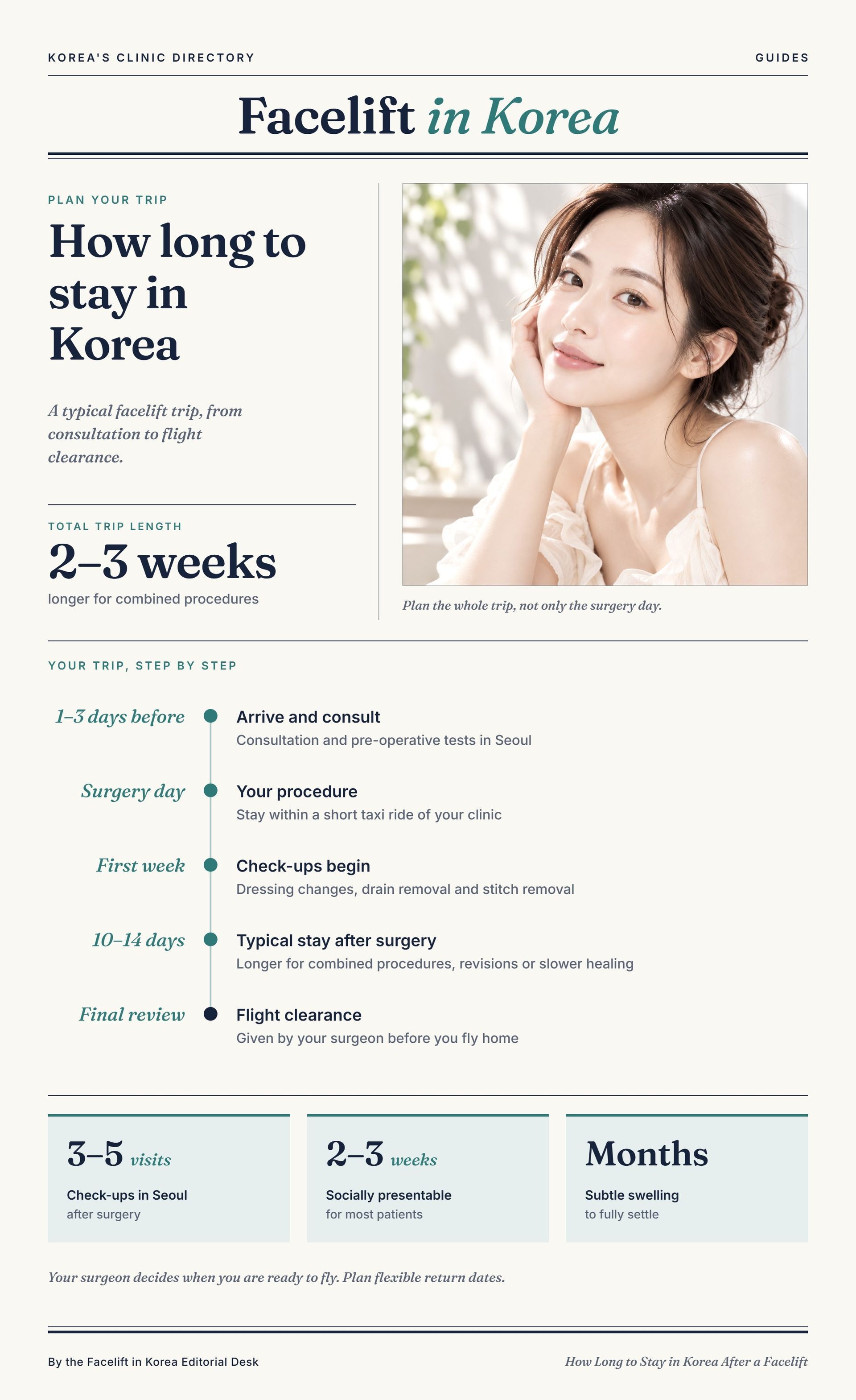
How Long to Stay in Korea After a Facelift
Planning your return flight.
Medical Interpreters in Korea
When and how to use one.
Where to Stay While Recovering in Gangnam
Hotels, serviced apartments and recovery houses.
What to Pack for a Facelift Trip to Korea
A practical packing list.
Travel Insurance for Cosmetic Surgery Abroad
What standard policies exclude.
Recovery and aftercare
Facelift Recovery Timeline
Week-by-week expectations.
Facelift Recovery Day by Day
The first two weeks in detail.
Swelling and Bruising After a Facelift
What is normal and what is not.
Compression Garments After Facelift
How long and how tight.
Facelift Scar Care
Caring for incisions as they mature.
What to Eat After a Facelift
Soft foods and salt.
Flying Home After a Facelift
Timing and comfort on the plane.
Aftercare After Returning Home
Arranging a local doctor.
Remote Follow-Up With a Korean Clinic
Staying in touch after you leave.
Risks and safety
Facelift Risks and Complications
An overview of what can go wrong.
Hematoma After Facelift
The most common early complication.
Facial Nerve Injury After Facelift
Risk, signs and recovery.
If Something Goes Wrong: Medical Disputes in Korea
Options for foreign patients.
Deciding and setting expectations
Surgical vs Non-Surgical Facelift: Which Do You Need?
Matching treatment to the degree of sagging.
What Is the Best Age for a Facelift?
Why anatomy matters more than age.
How Long Facelift Results Last
Realistic longevity.
Combining Other Procedures With a Facelift
Benefits and trade-offs.
Facelift Guide for Men
Male-specific planning.
Facelift Scarring and Asian Skin
Pigmentation and thick-scar risk.
The Natural Korean Facelift Aesthetic
How Seoul surgeons tend to define a natural result.
Reader questions
Planning and recovery FAQs
What is the first step in planning a facelift in Korea?
Shortlist qualified plastic surgeons, then request online consultations with clear photos. Compare their assessments and written quotes before you book flights. See Booking a Facelift in Korea Step by Step.
How long should I stay in Korea after a facelift?
Most surgeons advise roughly 10 to 14 days so stitches can be removed and early checks done before flying. Combined procedures may require longer. See How Long to Stay in Korea.
What is ghost surgery?
Ghost surgery is when a different doctor from the one you consulted performs your operation without your consent. Ask in writing who will operate and whether the clinic records surgery. See Ghost Surgery in Korea.
Do I need a translator at a Korean clinic?
Many Gangnam clinics have English-speaking coordinators, but medical consent should be fully understood. If you are unsure, use an independent interpreter. See Medical Interpreters in Korea.
What should I do if there is a problem after I return home?
Contact your Korean clinic and see a local doctor promptly. Arrange a local doctor before you travel if possible. Seek emergency care for sudden swelling, breathing difficulty or signs of infection. See Aftercare After Returning Home.
Elsewhere in the journal
Explore other sections
Surgical Facelift Types
Every facelift technique explained.
Lifting Concerns
Start from the problem you want to fix.
Non-Surgical Lifting
Devices, threads and injectables.
Facelift Costs
Indicative price ranges and budgets.
Comparisons
Techniques and destinations side by side.
Clinic Directory and Surgeon Directory
Seoul Areas, Patients by Country and the Glossary
Facelift in Korea is an independent information directory. We do not perform procedures and listings are not endorsements. Content is reviewed for accuracy but is not medical advice — see our editorial policy and medical disclaimer.