


Home › Lifting Concerns
Concerns section
Facial Sagging and Lifting Concerns: Treatment Options in Korea
Start here if you know what bothers you but not which procedure fixes it. Each concern page explains the likely causes, the surgical and non-surgical options used in Seoul, and what results are realistic.
By the Facelift in Korea Editorial Desk · Last reviewed October 24, 2026 · How we report
The short answer
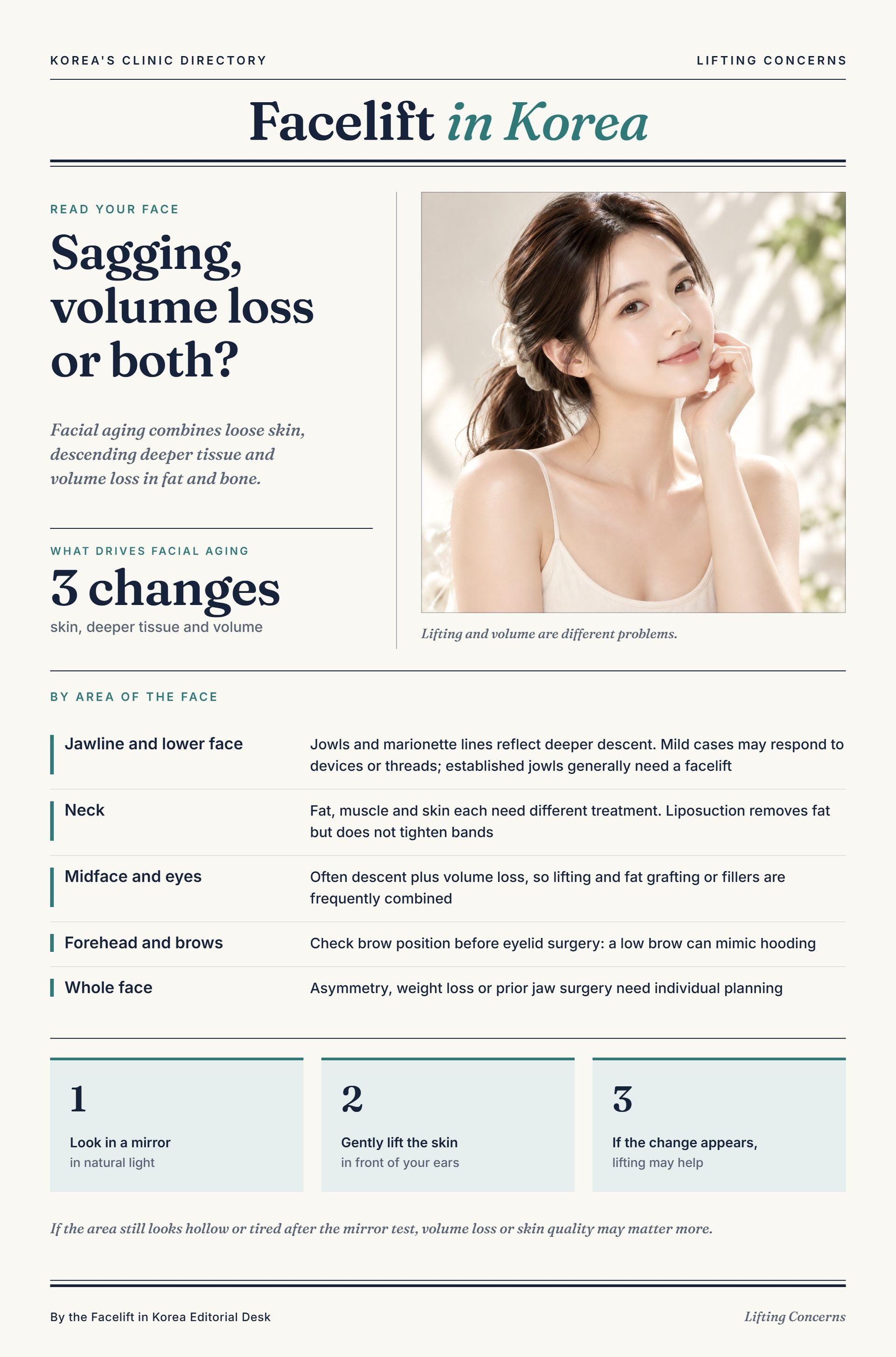
Facial aging usually combines three changes: skin loosening, deeper tissue descending, and volume loss in fat and bone. The right treatment depends on which of these is driving your concern. Mild laxity may respond to energy devices or threads, while jowls, neck bands and heavy folds usually need surgery. Korean clinics often combine lifting with volume restoration for a natural result.

How to read your face
How do you match a concern to a treatment?
Look in a mirror in natural light, then gently lift the skin in front of your ears upward and backward. If the change you want appears, sagging tissue is a major factor and lifting may help. If the area still looks hollow or tired, volume loss or skin quality may matter more.
- Lower face and jawline (jowls, marionette lines, prejowl hollows): these usually reflect deeper tissue descent. Mild cases may respond to devices or threads; established jowls generally need a facelift.
- Neck (bands, turkey neck, double chin, crepey skin): fat, muscle and skin each need different treatment. Liposuction removes fat but does not tighten bands.
- Midface and eyes (flat cheeks, nasolabial folds, eye bags, tear troughs): often a mix of descent and volume loss, so lifting and fat grafting or fillers are frequently combined.
- Upper face (drooping brows, hooded lids, forehead lines): brow position should be checked before eyelid surgery, because a low brow can mimic eyelid hooding.
- Whole-face or special situations : asymmetry, weight loss or prior jaw surgery need individual planning.
For the procedures themselves, browse surgical facelift types and non-surgical lifting . If you are weighing both, read Surgical vs Non-Surgical Facelift . A good surgeon will examine you in person and may suggest a different plan from the one you expected.
The section index
Every concern we cover, by area of the face
Where to start
Facial Sagging: Where to Start
An overview of why faces sag and how treatment is chosen.
Full Face Lifting
When sagging affects the whole face rather than one area.
Facial Volume Loss
Hollowness from fat and bone changes, and how it differs from sagging.
Asymmetric Facial Sagging
When one side droops more than the other.
Jawline and lower face
Jowl Lifting
Options for heavy tissue along the jawline.
Jawline Lifting
Restoring a clean jaw contour.
V-Line Lifting
Slimming and lifting the lower face without bone surgery.
Marionette Line Lifting
Lines running down from the mouth corners.
Lip Corner Lifting
Down-turned mouth corners.
Prejowl Sulcus
The hollow in front of the jowl.
Witch's Chin
A sagging, creased chin pad.
Loose Skin After Jaw Surgery
Soft-tissue sagging after V-line or jaw reduction.
Neck
Neck Band Lifting
Vertical platysma bands.
Turkey Neck
Loose skin and bands hanging under the chin.
Double Chin Lifting
Fullness under the chin from fat or laxity.
Crepey Neck Skin
Thin, finely wrinkled neck skin.
Accordion Lines
Stacked lines that appear when smiling, on the cheeks and neck.
Midface and cheeks
Cheek Lifting
Restoring cheek position and fullness.
Flat or Descended Midface
When the cheek has slid downward.
Hollow Cheeks
Gaunt areas below the cheekbone.
Nasolabial Fold Lifting
The folds from nose to mouth.
Smile Line Lifting
Deepening smile lines around the mouth.
Eyes
Under-Eye Lifting
Tired, sagging lower lids.
Under-Eye Bags
Bulging fat under the eyes.
Tear Trough Hollows
The groove between the lower lid and cheek.
Hooded Upper Eyelids
Excess upper lid skin, and when the brow is the real cause.
Forehead, brows and temples
Forehead Lifting
A heavy or lined forehead.
Drooping Brows
Low brows that make the eyes look heavy.
Deep Forehead Wrinkles
Horizontal lines that remain at rest.
Frown Lines (Glabellar Lines)
The "11" lines between the brows.
Temple Lift
Lifting the outer brow and upper cheek from the temple.
Reader questions
Lifting concerns FAQs
What causes facial sagging?
Sagging comes from several changes at once: skin loses collagen and elasticity, the ligaments that hold tissue in place loosen, fat pads shrink or descend, and facial bone gradually resorbs. Sun exposure, smoking and weight changes can speed this up. See Facial Sagging: Where to Start.
Can jowls be fixed without surgery?
Early, mild jowling may improve with energy-based devices, thread lifts or carefully placed fillers, but results are usually modest and temporary. Established jowls with heavy tissue generally need a facelift. Read Jowl Lifting.
Why does my neck look older than my face?
Neck skin is thinner than facial skin, and the platysma muscle can separate into visible bands with age. A face-only treatment often leaves the neck unchanged. See Neck Band Lifting and Turkey Neck.
Is it sagging or volume loss?
Often both. If gently lifting the skin near your ears improves the area, sagging is a major factor. If the area still looks hollow, volume loss is significant. Many Seoul surgeons combine a lift with fat grafting. See Facial Volume Loss.
Should I treat one area or the whole face?
Treating one area in isolation can make neighboring areas look older by contrast. A surgeon should assess the face as a whole and explain which areas would benefit most. See Full Face Lifting.
Elsewhere in the journal
Explore other sections
Surgical Facelift Types
Every facelift technique explained.
Non-Surgical Lifting
Devices, threads and injectables.
Facelift Costs
Indicative price ranges and budgets.
Planning and Recovery Guides
Surgeon checks, visas and aftercare.
Comparisons
Techniques and destinations side by side.
Clinic Directory and Surgeon Directory
Seoul Areas, Patients by Country and the Glossary
Facelift in Korea is an independent information directory. We do not perform procedures and listings are not endorsements. Content is reviewed for accuracy but is not medical advice — see our editorial policy and medical disclaimer.