


Home › Patient Guides › Facial Nerve Injury After Facelift
Patient Guides
Facial Nerve Injury After a Facelift: What to Know
By the Facelift in Korea Editorial Desk · Independent · How we report

The short answer
Quick answer: Facial nerve injury after a facelift means damage to nerve branches that move the face, causing weakness in the smile, lower lip or brow. It is uncommon, and most cases are temporary, improving over weeks to months. Permanent motor injury is rare in experienced hands. Numbness from sensory nerves is far more common and usually improves gradually.

Which nerves can a facelift affect?
Two types of nerves matter. Motor nerves move the facial muscles. The facial nerve leaves the skull just below the ear, enters the parotid gland and divides into branches that fan out across the face. Sensory nerves carry feeling from the skin. During a facelift, the surgeon works in layers close to some of these structures. Our glossary entry on the facial nerve and the page on the SMAS explain the anatomy simply.
What does motor nerve weakness look like?
- Marginal mandibular branch: weakness of the lower lip on one side, which shows as an uneven smile. It is one of the more commonly affected branches.
- Frontal (temporal) branch: difficulty raising one eyebrow or wrinkling the forehead on that side.
- Buccal and zygomatic branches: subtle changes in smiling or upper lip movement. These branches have many connections, so weakness tends to recover well.
Some apparent weakness after surgery has nothing to do with a cut nerve. Swelling, local anesthetic, bruising and stretching (called neuropraxia) can temporarily stop a nerve working. A separate condition, "pseudoparalysis" of the lower lip, can occur after neck work when a neck nerve is stretched.
How common is facial nerve injury, and does it recover?
Medical studies report that temporary motor weakness occurs in a small minority of facelift patients, and that permanent motor injury is rare. Most temporary weakness improves within weeks to a few months as swelling settles and the nerve recovers. Some cases take longer, up to a year or more. Your surgeon should explain their own experience and how they manage these cases.
What about numbness?
Numbness is expected. When the skin is lifted, tiny sensory nerve endings are divided. Most people have numb patches in the cheeks, in front of the ears and on the neck, which gradually return over months. The great auricular nerve, which supplies feeling to the earlobe and part of the ear, is the most commonly injured named nerve in facelift surgery. Injury can cause lasting numbness of the earlobe or, rarely, painful sensitivity.
Is the risk higher with deep plane techniques?
Techniques that work beneath the SMAS layer, such as the deep plane facelift, operate closer to some nerve branches. In experienced hands, published results suggest the risk is not necessarily higher, because surgeons work in well-defined anatomical planes. Experience matters more than the name of the technique. Compare techniques in deep plane vs SMAS facelift. Revision facelifts carry more risk because of scar tissue.
What should international patients in Seoul ask?
- How often do you see temporary nerve weakness, and how long does it usually last?
- Have you had permanent nerve injuries, and what did you do?
- If I have weakness after flying home, how will you follow up?
- Will you provide a written operation note describing the technique and planes used?
Nerve symptoms often become clearer after you have returned home, so arrange remote check-ins with photos and short videos of facial movements. Our guide on facelift consultation questions helps you prepare.
Can anything else look like nerve weakness?
Yes. In the first weeks, uneven swelling, tight areas under the skin and local numbness can make the smile look slightly lopsided even when the nerves work normally. Lumps of swelling along the jaw can also limit lip movement for a while. These changes usually settle as swelling resolves. This is why surgeons often prefer to assess movement again after a few weeks before drawing conclusions.
What should I do if I notice weakness?
Do not panic; most weakness improves. Contact your surgeon, describe exactly which movements are affected, and send photos or videos of smiling, raising eyebrows and showing teeth. Protect your eye if eyelid closure is affected, which is very rare after facelift surgery but needs prompt care. Your surgeon may recommend observation, facial exercises or, in some cases, specialist referral. Botulinum toxin on the unaffected side can sometimes balance asymmetry while recovery happens. For the wider picture, see facelift risks and complications.
This page is general information, not medical advice. Decisions about surgery should be made with a qualified, board-certified plastic surgeon after an in-person examination.
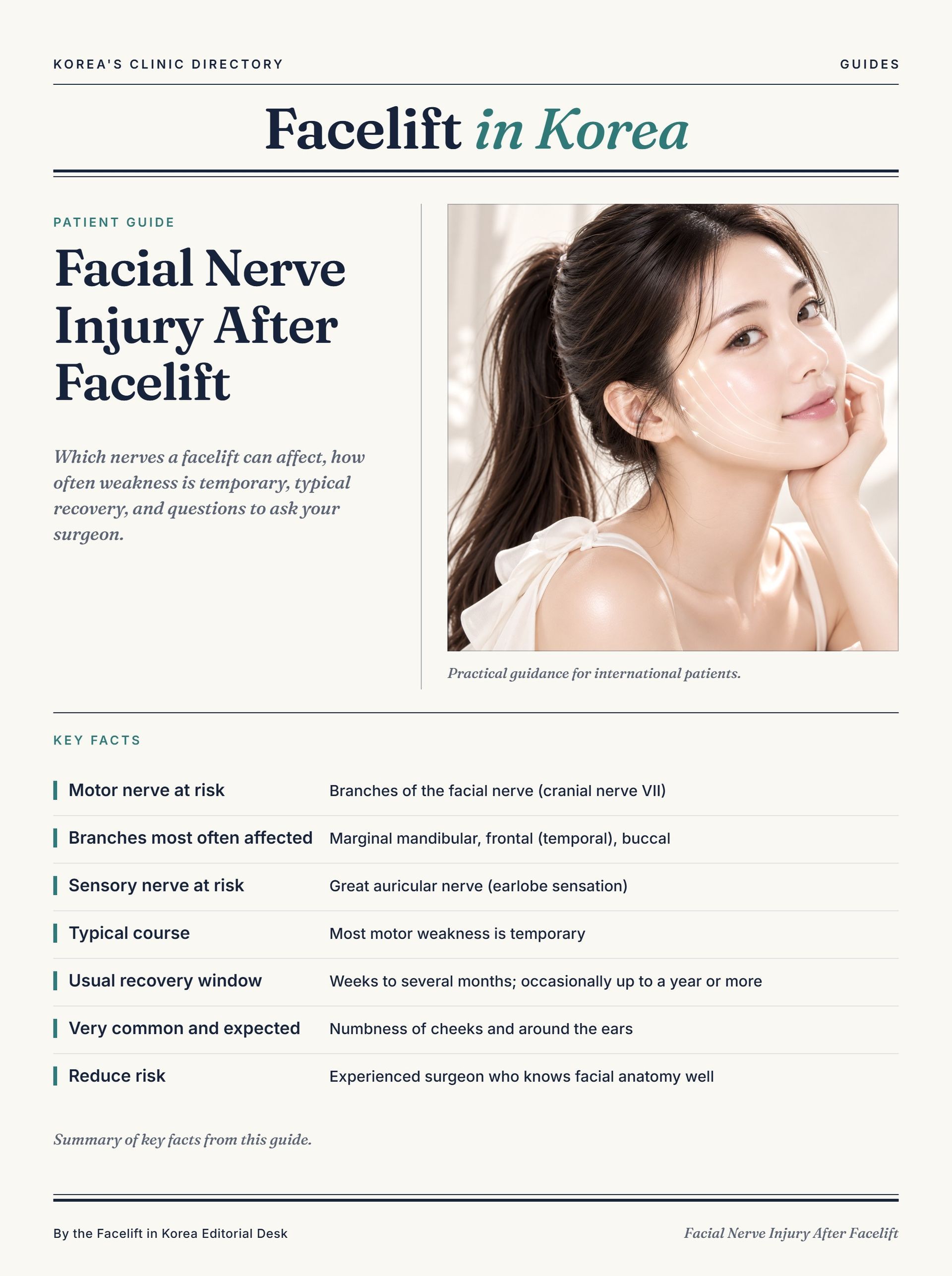
Key facts
| Motor nerve at risk | Branches of the facial nerve (cranial nerve VII) |
|---|---|
| Branches most often affected | Marginal mandibular, frontal (temporal), buccal |
| Sensory nerve at risk | Great auricular nerve (earlobe sensation) |
| Typical course | Most motor weakness is temporary |
| Usual recovery window | Weeks to several months; occasionally up to a year or more |
| Very common and expected | Numbness of cheeks and around the ears |
| Reduce risk | Experienced surgeon who knows facial anatomy well |
Read next
Reader questions
Frequently asked questions
Can a facelift cause facial paralysis?
Temporary weakness of one part of the face can occur, usually recovering over weeks to months. Permanent paralysis is rare in experienced hands.
How long does facial nerve weakness last after a facelift?
Most cases improve within weeks to a few months. Some take longer, occasionally up to a year or more.
Why is my lower lip uneven after a facelift?
This can be caused by temporary weakness of the marginal mandibular branch or by stretching of a neck nerve. Most cases recover. Tell your surgeon.
Is numbness the same as nerve damage?
Numbness comes from sensory nerves and is expected after a facelift. It usually improves over months. Motor weakness affects movement and is much less common.
Is a deep plane facelift riskier for nerves?
It works closer to some nerve branches, but in experienced hands, published results suggest the risk is not necessarily higher. Surgeon experience is the key factor.
Next steps
Planning a facelift in Korea?
Compare clinics, check surgeon credentials and estimate your full trip budget before you book a consultation.
Facelift in Korea is an independent information directory. We do not perform procedures, and listings are not endorsements. This page is general information, not medical advice.