


Home › Patient Guides › If Something Goes Wrong: Medical Disputes in Korea
Patient Guides
If Something Goes Wrong: Medical Disputes in Korea for Foreign Patients
By the Facelift in Korea Editorial Desk · Independent · How we report

The short answer
Quick answer: If a facelift in Korea goes wrong, get medical care first, then collect records and raise the issue with the clinic in writing. If you cannot agree, the Korea Medical Dispute Mediation and Arbitration Agency (KMDMAA) offers mediation and arbitration, and the Medical Korea support center helps foreign patients with complaints. Civil court is the last option. A Korean lawyer can advise on deadlines.

What should you do first if something goes wrong?
Your health comes first. If you have urgent symptoms such as rapid swelling, heavy bleeding, fever, breathing trouble or skin turning dark, contact the clinic's emergency number or go to a hospital emergency department straight away. Disputes can wait. Complications often cannot. Read facelift risks and complications for warning signs.
It also helps to separate two kinds of problems:
- A known complication that can happen even with good care, such as a hematoma or temporary nerve weakness.
- A possible error or failure of care, such as a different procedure from the one agreed, or a surgeon other than the one you were promised.
Not every disappointing result is negligence. Swelling can hide the final result for six to twelve months. Many disputes are settled once the clinic offers treatment or a revision.
How do you raise a concern with the clinic?
- Write to the clinic calmly and clearly, by email or message. Describe the problem, dates and what you are asking for.
- Ask for a copy of your medical records, including the operation record, anesthesia record and consent forms. Patients in Korea generally have a right to request copies of their records.
- Ask to speak with the operating surgeon, not only the coordinator.
- Keep every message, receipt and photo. Take dated photos of the problem.
- If you are still in Korea, consider a second opinion from another surgeon or a university hospital.
What is the Korea Medical Dispute Mediation and Arbitration Agency?
The Korea Medical Dispute Mediation and Arbitration Agency (KMDMAA, sometimes called K-medi) is a government-backed body under the Ministry of Health and Welfare. It handles disputes between patients and medical providers out of court. Key points:
- It offers consultation, mediation and arbitration for medical disputes, including those involving foreign patients.
- Medical experts and legal experts review the case.
- A mediated settlement is binding only if both sides accept it. If mediation fails, you can still go to court.
- Arbitration requires both sides to agree in advance to accept the decision.
- Reporting has noted that the agency aims to resolve cases within about 90 days, with a possible extension.
Foreign-language support is limited and may depend on the language. You may need a translator or representative. Contact the agency for current procedures, fees and deadlines. The phone number published by Korean hospitals is +82-1670-2545.
Who else can help foreign patients in Korea?
- Medical Korea support center. Run by the Korea Health Industry Development Institute (KHIDI), it provides information, interpretation help and assistance with complaints from foreign patients. Hospitals list its number as +82-1577-7129.
- Your embassy or consulate. Embassies cannot give legal advice or take sides, but they can usually provide lists of local lawyers and interpreters.
- A Korean lawyer. A lawyer who handles medical cases can advise on evidence, time limits and your options. Some firms work in English.
If an unregistered broker or agency arranged your surgery, mention this. Unregistered brokers that solicit foreign patients are illegal in Korea. See using a medical tourism agency.
What are the practical challenges for foreigners?
- Time in Korea. Visa-free stays and medical visas have limits. Cases can outlast your stay, and you may need to return or act through a representative.
- Language. Legal documents and hearings are in Korean. Professional translation adds cost.
- Cost. Lawyers, translations and travel add up. Weigh these against the likely outcome.
- Evidence. Records and photos taken early are more persuasive than recollections.
How can you reduce the chance of a dispute?
- Choose a qualified, verified surgeon. See verifying a board-certified plastic surgeon and ghost surgery in Korea.
- Get the procedure, surgeon name, price and revision policy in writing before paying.
- Read consent forms in a language you understand. Ask for an interpreter if needed.
- Consider asking for operating-room CCTV recording, which Korean rules allow patients to request.
- Check what your insurance covers. See travel insurance for cosmetic surgery.
This page is not legal advice. Laws and procedures change, so confirm details with the agencies or a qualified Korean lawyer.
This page is general information, not medical advice. Decisions about surgery should be made with a qualified, board-certified plastic surgeon after an in-person examination.
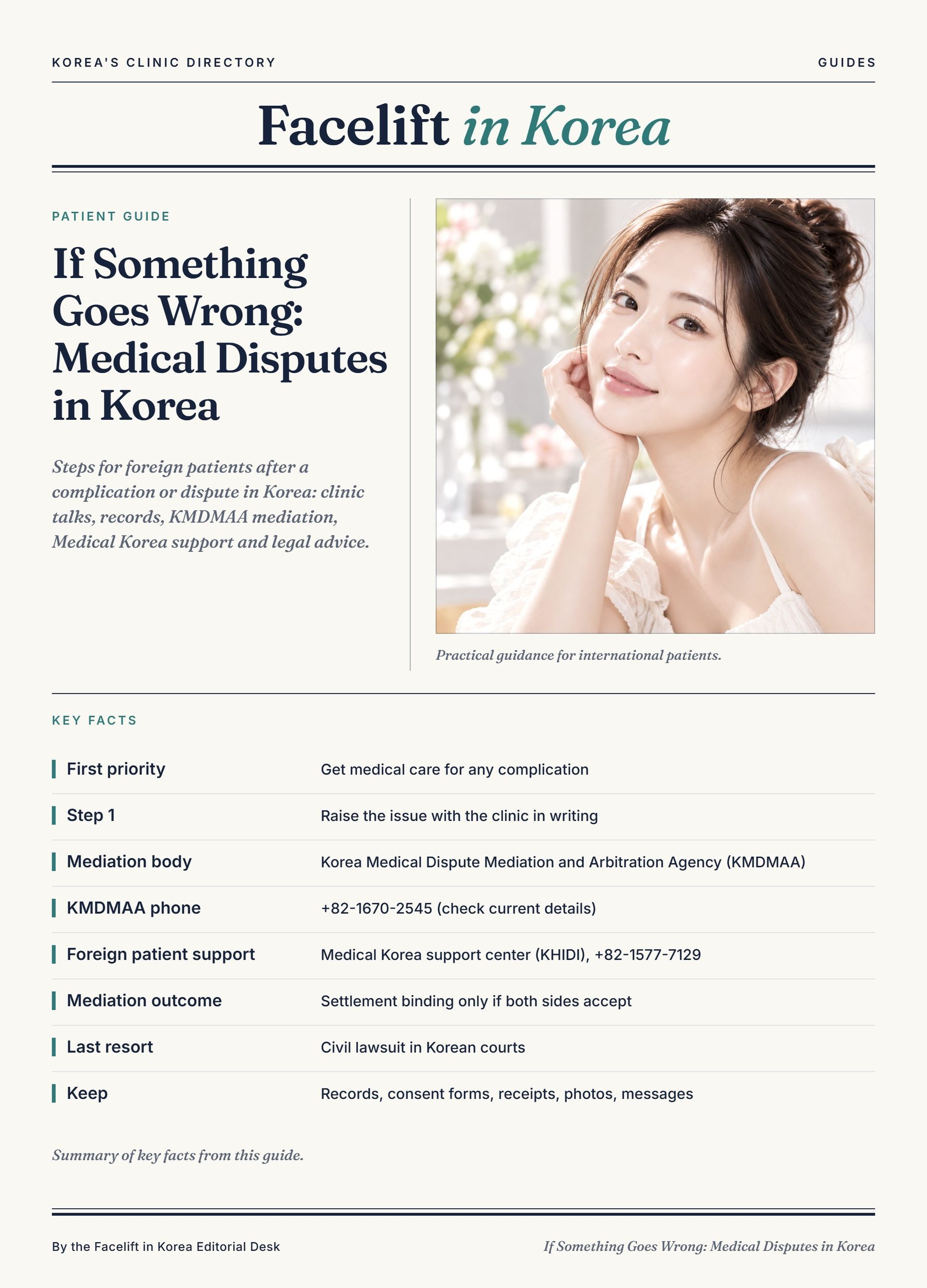
Key facts
| First priority | Get medical care for any complication |
|---|---|
| Step 1 | Raise the issue with the clinic in writing |
| Mediation body | Korea Medical Dispute Mediation and Arbitration Agency (KMDMAA) |
| KMDMAA phone | +82-1670-2545 (check current details) |
| Foreign patient support | Medical Korea support center (KHIDI), +82-1577-7129 |
| Mediation outcome | Settlement binding only if both sides accept |
| Last resort | Civil lawsuit in Korean courts |
| Keep | Records, consent forms, receipts, photos, messages |
Read next
Reader questions
Frequently asked questions
What can I do if my facelift in Korea went wrong?
Get medical care first, then raise the issue with the clinic in writing and request your records. If you cannot agree, the Korea Medical Dispute Mediation and Arbitration Agency offers out-of-court mediation, and a Korean lawyer can advise on legal options.
Can foreigners use the Korea Medical Dispute Mediation and Arbitration Agency?
Yes, the agency handles consultations and cases from foreign patients. Language support is limited, so you may need a translator or representative.
Is KMDMAA mediation binding?
A mediated settlement becomes binding only if both sides accept it. If mediation fails, you can still take the case to court. Arbitration is binding when both sides agree to it in advance.
Can I get my medical records from a Korean clinic?
Patients can generally request copies of their medical records. Ask in writing for the operation, anesthesia and consent records, and request English translations if available.
Who helps foreign patients with complaints in Korea?
The Medical Korea support center run by KHIDI assists foreign patients with information, interpretation and complaints. Your embassy can provide lists of local lawyers and interpreters.
Next steps
Planning a facelift in Korea?
Compare clinics, check surgeon credentials and estimate your full trip budget before you book a consultation.
Facelift in Korea is an independent information directory. We do not perform procedures, and listings are not endorsements. This page is general information, not medical advice.