


Home › Patient Guides › Aftercare After Returning Home
Patient Guides
Facelift Aftercare After Returning Home From Korea
By the Facelift in Korea Editorial Desk · Independent · How we report
The short answer
Quick answer: After a facelift in Korea, most healing happens after you fly home. Arrange a local doctor before surgery, bring home a written English summary of your operation and medicines, keep following your Korean surgeon's wound and activity instructions, and send progress photos at agreed times. Seek local help urgently for sudden swelling, fever, spreading redness or breathing problems.
Why does aftercare at home matter so much?
Most international patients stay in Korea for about 10 to 14 days. Swelling, numbness and scar maturation continue for months after that. Your result depends partly on how well you follow instructions during this long phase at home. You will also be far from the surgeon who knows your case best. Good planning closes that gap.
What should you arrange before you leave for Korea?
- A local doctor. Tell your family doctor about your plans. Ask if they will remove any remaining stitches, check wounds and refer you if needed. Some local plastic surgeons charge a fee to see patients treated abroad. Ask in advance.
- Time off. Plan at least one to two more weeks of quiet time after you get home before full work or social activity.
- Help at home. Someone to drive, shop and carry heavy items for the first week back.
- Insurance. Check what your policy covers after cosmetic surgery abroad. See travel insurance for cosmetic surgery.
Which documents should you bring home from the clinic?
Ask for these in English before your last appointment:
- An operative summary: procedure name, technique, date, surgeon, anesthesia type and any implants or fat grafting.
- A list of medicines given and prescribed, with doses and end dates.
- Written aftercare instructions, including garment wear, washing and activity limits.
- Direct contact details: a messaging app account, email and phone number for the coordinator or nurse.
Keep paper and digital copies. A local doctor will find a clear summary much more useful than a verbal description.
How do you care for wounds and scars at home?
Follow your surgeon's sheet first. General habits surgeons commonly recommend include:
- Keep incisions clean and gently dried. Do not pick at crusts.
- Protect scars from sun. Use a hat and, once wounds have closed, sunscreen.
- Start scar products such as silicone gel only when your surgeon says the wound is ready.
- Avoid hair dye, perms and strong facial treatments until cleared.
Read more in our facelift scar care guide.
What is normal in the weeks after you get home?
- Swelling that rises and falls, often worse in the morning or after salty food.
- Numbness or tingling around the ears and cheeks, which usually improves over months.
- Firm or lumpy areas under the skin that soften over time.
- Tightness when turning your head or opening your mouth wide.
Our facelift recovery timeline shows what typically happens week by week.
When should you get urgent local help?
Do not wait for a reply from Korea if you have:
- Rapid, painful swelling on one side of the face or neck.
- Fever, pus, a bad smell or spreading redness around a wound.
- Skin that turns dark, dusky or black.
- New weakness when smiling or closing an eye.
- Chest pain, shortness of breath or a swollen calf.
Go to urgent care or an emergency department. Then message your Korean clinic with photos and the local doctor's findings. Background on these problems is in facelift risks and complications.
What should international patients know about Korean clinics' aftercare?
Many clinics that serve foreign patients in Seoul offer remote follow-up by messaging app or video. Policies differ. Ask before surgery:
- How long does remote follow-up continue, and is it free?
- Who answers messages, and how fast? Is it a coordinator or the surgeon?
- What happens if you need a revision? Is there a policy, and who pays for travel?
- Will the clinic send records to your local doctor on request?
Get the answers in writing. A clinic that is vague about aftercare before surgery is unlikely to be clearer afterward. Our consultation questions page has a fuller checklist.
When can you return to normal activities?
Timelines vary. Many patients return to desk work about two weeks after surgery. Strenuous exercise, heavy lifting and contact sports are often delayed for four to six weeks or longer. Saunas, hot yoga and swimming are usually delayed until wounds are fully healed. Ask your surgeon for specific dates.
This page is general information, not medical advice. Decisions about surgery should be made with a qualified, board-certified plastic surgeon after an in-person examination.
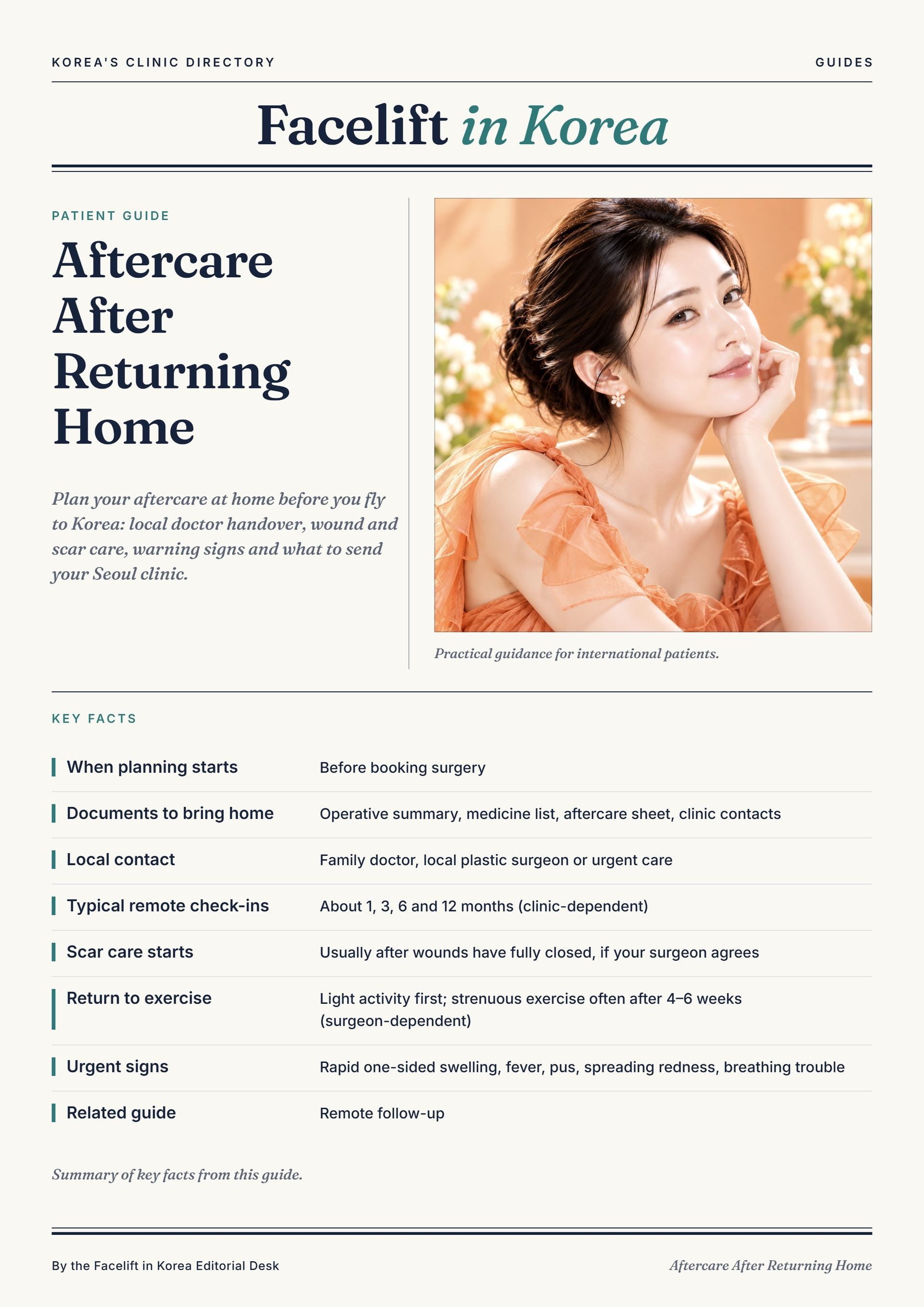
Key facts
| When planning starts | Before booking surgery |
|---|---|
| Documents to bring home | Operative summary, medicine list, aftercare sheet, clinic contacts |
| Local contact | Family doctor, local plastic surgeon or urgent care |
| Typical remote check-ins | About 1, 3, 6 and 12 months (clinic-dependent) |
| Scar care starts | Usually after wounds have fully closed, if your surgeon agrees |
| Return to exercise | Light activity first; strenuous exercise often after 4–6 weeks (surgeon-dependent) |
| Urgent signs | Rapid one-sided swelling, fever, pus, spreading redness, breathing trouble |
| Related guide | Remote follow-up |
Read next
Reader questions
Frequently asked questions
Who removes my stitches if I fly home early?
Most clinics remove stitches before you leave Korea, usually at about 5 to 10 days. If some remain, ask your surgeon for written instructions and arrange for a local doctor or nurse to remove them.
Will a doctor at home treat complications from surgery in Korea?
Emergency services will treat urgent problems wherever surgery was done. For non-urgent issues, some local surgeons see patients treated abroad, often for a fee. Arranging this before you travel is best.
How long does swelling last after I get home?
Most visible swelling settles over several weeks, but subtle swelling can last three to six months or more. Follow your surgeon's advice on head elevation, salt and activity.
When can I exercise after a facelift?
Many surgeons allow walking early and light exercise after a few weeks. Strenuous workouts are often delayed for four to six weeks or longer. Ask your own surgeon.
What photos should I send my Korean clinic?
Clear front, side and three-quarter views in good natural light, without makeup, plus close-ups of any area of concern. Send them at the times the clinic requests.
Next steps
Planning a facelift in Korea?
Compare clinics, check surgeon credentials and estimate your full trip budget before you book a consultation.
Facelift in Korea is an independent information directory. We do not perform procedures, and listings are not endorsements. This page is general information, not medical advice.