


Home › Patient Guides › Swelling and Bruising After a Facelift
Patient Guides
Swelling and Bruising After a Facelift: What Is Normal
By the Facelift in Korea Editorial Desk · Independent · How we report

The short answer
Quick answer: Swelling and bruising usually peak two to three days after a facelift, then fade over two to three weeks, with bruises often drifting down to the neck. Mild swelling and firmness can last two to three months. Head elevation, cool compresses as advised, rest, a low-salt diet and your compression garment help. Rapid one-sided swelling with pain is not normal.
Why does a facelift cause swelling and bruising?
A facelift lifts and repositions skin and deeper tissues. This disturbs small blood vessels and lymph channels, which carry fluid away from tissues. Fluid and small amounts of blood collect in the tissues, producing swelling and bruises. This is a normal part of healing and does not mean anything has gone wrong.
What does a normal timeline look like?
- Days 1–3: swelling increases, peaking around day two or three. The face may look puffy, the eyes partly closed, and the neck full.
- Days 4–7: swelling starts to settle. Bruises change from purple to green and yellow and move down the neck toward the chest.
- Weeks 2–3: most visible bruising fades, and many people look presentable with makeup.
- Months 1–3: mild swelling, lumpiness or firmness along the jaw and in front of the ears gradually resolves. Mornings are often puffier.
- Months 3–12: subtle refinement continues as tissues soften.
Combined procedures, such as fat grafting, eyelid surgery or neck work, often increase early swelling. See the full facelift recovery timeline and the day-by-day guide.
What helps reduce swelling and bruising?
- Head elevation: sleep with your head raised on two or three pillows or in a recliner for the first one to two weeks.
- Cool compresses: gentle cold packs in the first 48–72 hours can help, if your surgeon agrees. Never place ice directly on numb skin.
- Compression: wear your garment as instructed; see compression garment after facelift.
- Low salt and good hydration: salty food increases fluid retention. Read eating after a facelift.
- Gentle walking: helps circulation, while avoiding heavy exercise and bending.
- Avoid heat and alcohol: saunas, hot baths and drinking increase swelling.
- Check supplements: some supplements increase bruising. Ask your surgeon before using arnica or bromelain, which some patients try.
How do Seoul clinics help with swelling?
Many clinics in Seoul offer post-operative care sessions, such as lymphatic drainage massage, LED light therapy, ultrasound or high-frequency treatments aimed at reducing swelling and bruising. Some include a few sessions in the facelift package; others charge extra. Evidence for these treatments varies, but many patients find them comfortable. Ask what is included, who performs it, and whether it is suitable at your stage of healing. Avoid any aggressive massage that your surgeon has not approved.
- Masks and hats are a normal sight in Seoul, so covering bruises outdoors draws little attention.
- Choose air-conditioned accommodation in summer, since heat worsens swelling; see the best time of year for a facelift.
- Expect some swelling on the flight home; walking in the aisle and drinking water helps.
When is swelling a warning sign?
Call your surgeon immediately if you notice:
- Sudden, rapidly increasing swelling, especially on one side, with tightness and worsening pain. This can be a hematoma.
- Redness, heat, fever or discharge, which can signal infection.
- Swelling in the neck with difficulty breathing or swallowing, which is an emergency.
- Swelling and pain in one calf, or chest pain, especially after a flight, which may signal a blood clot.
Can I wear makeup to cover bruising?
Most surgeons allow makeup on bruised areas away from the incisions within the first week or two, once any open wounds have closed. Green-tinted concealer helps neutralize red and purple tones, and yellow-tinted products help with fading green bruises. Keep makeup away from incision lines until your surgeon says they are fully healed, and remove it gently without rubbing. Use clean brushes or sponges to reduce the risk of irritation.
Is it normal for one side to look different?
Mild asymmetry in swelling is common in the first weeks, because each side heals at its own pace and you may sleep more on one side. It should even out gradually. Marked or worsening differences, or swelling with pain, should be checked. Avoid judging your result until swelling has settled, usually after about three months.
This page is general information, not medical advice. Decisions about surgery should be made with a qualified, board-certified plastic surgeon after an in-person examination.
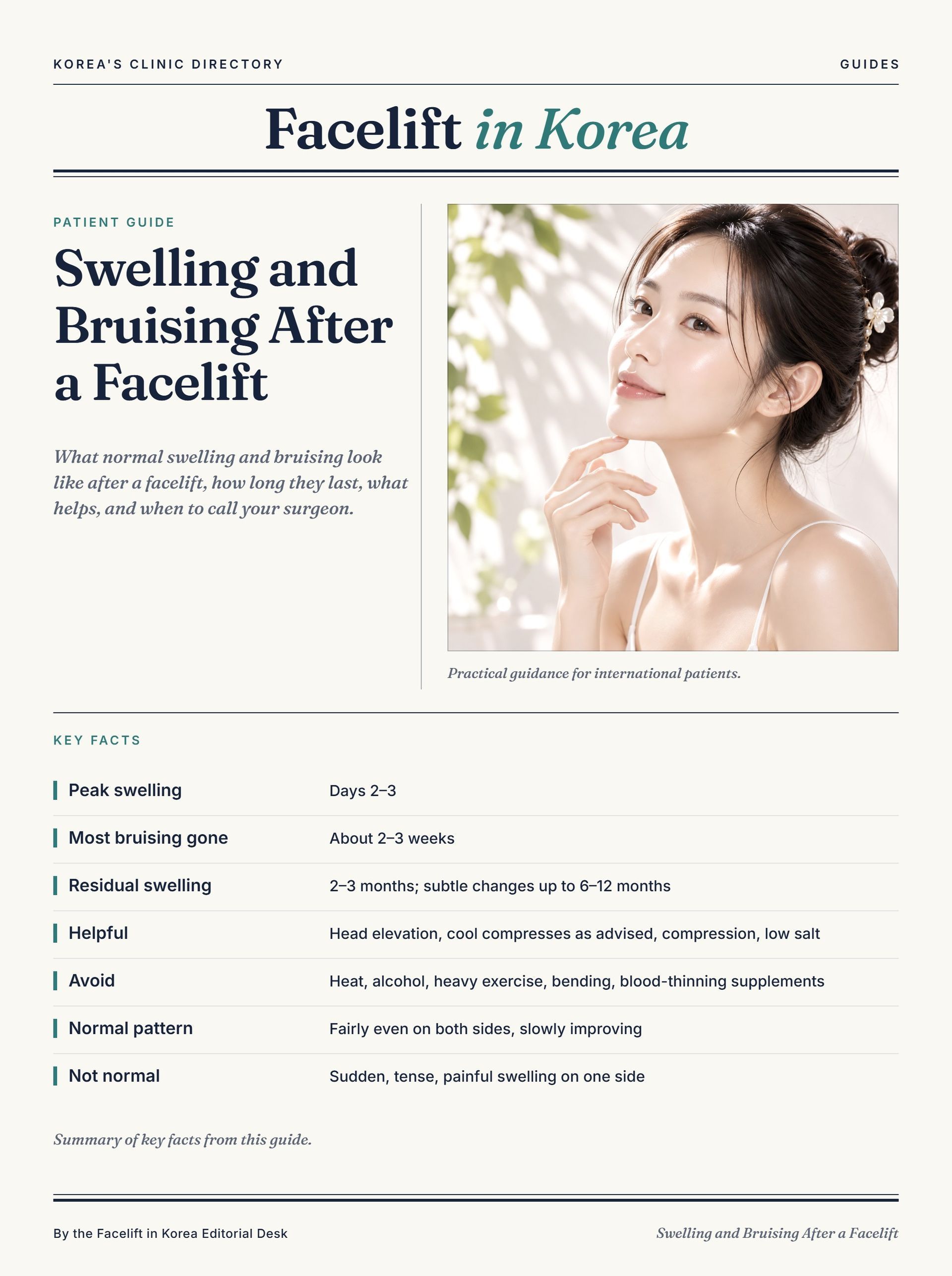
Key facts
| Peak swelling | Days 2–3 |
|---|---|
| Most bruising gone | About 2–3 weeks |
| Residual swelling | 2–3 months; subtle changes up to 6–12 months |
| Helpful | Head elevation, cool compresses as advised, compression, low salt |
| Avoid | Heat, alcohol, heavy exercise, bending, blood-thinning supplements |
| Normal pattern | Fairly even on both sides, slowly improving |
| Not normal | Sudden, tense, painful swelling on one side |
Read next
Reader questions
Frequently asked questions
How long does swelling last after a facelift?
Visible swelling peaks around days 2–3 and mostly settles over 2–3 weeks. Mild swelling and firmness can last 2–3 months.
Why is the bruising moving down my neck?
Gravity pulls blood from the face toward the neck and chest over the first week. This is normal and fades over time.
Can I use ice after a facelift?
Gentle cool compresses in the first 48–72 hours often help, if your surgeon agrees. Avoid placing ice directly on numb skin.
Does arnica help bruising after a facelift?
Some patients use it, but evidence is mixed. Ask your surgeon before taking any supplement after surgery.
When should I worry about swelling?
Call your surgeon immediately for sudden one-sided, tense, painful swelling, signs of infection, or any difficulty breathing.
Next steps
Planning a facelift in Korea?
Compare clinics, check surgeon credentials and estimate your full trip budget before you book a consultation.
Facelift in Korea is an independent information directory. We do not perform procedures, and listings are not endorsements. This page is general information, not medical advice.