


Home › Patient Guides › Medical Interpreters in Korea
Patient Guides
Medical Interpreters in Korea: How Language Support Works for Facelift Patients
By the Facelift in Korea Editorial Desk · Independent · How we report
The short answer
Quick answer: Most Seoul clinics that treat foreign patients have in-house coordinators who interpret in English, Chinese, Japanese, Russian, Arabic or other languages, usually at no extra charge. Independent medical interpreters can be hired if you want someone who works only for you. For consent, risks and aftercare, insist on direct conversation with the surgeon and written instructions in your language.
How do clinics in Korea provide interpreters?
Clinics that actively welcome international patients usually employ international coordinators. These staff members greet you, explain prices, book appointments, and interpret during the consultation and check-ups. English, Mandarin, Japanese, Russian, Mongolian, Vietnamese, Thai and Arabic are common. Large clinics in Gangnam may have whole teams for each language. Smaller clinics may rely on one bilingual staff member or a contracted interpreter.
Coordinators are valuable, but remember who employs them. Their role includes helping the clinic sell services. Most are professional and honest, yet it is reasonable to ask questions directly to the surgeon and expect complete answers.
What qualifications do medical interpreters have in Korea?
There is no single license that every hospital interpreter must hold. Korea does have a national qualification called International Medical Tourism Coordinator, which covers medical terminology, patient services and communication. Some coordinators also have nursing backgrounds or medical interpreting training. The city of Seoul has invested in training medical tourism interpreter-coordinators and has announced plans to expand its pool to about 1,000. You can ask a clinic what training its coordinators have.
When should I hire an independent interpreter?
Many patients manage well with clinic staff. Consider an independent interpreter if:
- Your language is less common and the clinic's coverage is limited.
- You are having complex or revision surgery and want detailed discussion.
- You want someone who represents only your interests, especially if a dispute is possible.
- You are comparing several clinics and want consistent interpretation.
Independent interpreters charge their own fees, often by the hour or half day. If an interpreter also introduces you to clinics, they may be acting as a facilitator, which must be officially registered in Korea. Our guide to medical tourism agencies in Korea explains the rules and risks.
What must be interpreted clearly?
- Consent: what operation you are having, who performs it, the main risks and alternatives.
- Anesthesia: type, fasting times and what to tell the anesthesiologist about your health.
- Medicines: doses, timing and which pain relievers or supplements to avoid.
- Warning signs: what symptoms need an urgent call, such as one-sided swelling. See hematoma after facelift.
- Follow-up: appointment times in Seoul and how remote check-ins work.
Ask for the consent form and aftercare sheet in your language, or at least in English. Korean law requires the surgeon to explain the operation, expected side effects and the participating doctors before surgery, and that explanation is only meaningful if you understand it.
What free language help is available in Korea?
The Korea Tourism Organization's 1330 Korea Travel Hotline offers free interpretation and travel help by phone in several languages, which is useful for taxis, pharmacies and everyday questions. Medical Korea, the government-backed program for international patients, provides information services and has run a support center at Incheon Airport. In an emergency, 119 connects to ambulance services and can arrange interpretation.
What should international patients know about language in Seoul clinics?
Many Korean plastic surgeons read medical English well and some trained abroad, but spoken fluency varies. Do not judge skill by English level. A surgeon with limited English may be excellent, while a fluent one may have less facelift experience. What matters is that you understand each other clearly through whatever support is used.
- Bring your questions in writing; see facelift consultation questions.
- Repeat key points back to the interpreter to confirm understanding.
- Ask for a contact who speaks your language for nights and weekends.
- Translation apps help with daily life but are not reliable for consent or medical decisions.
Country guides such as patients from China and patients from the UAE cover language support commonly offered to those groups. When choosing a clinic, language support is one part of the picture; see how to choose a facelift surgeon in Korea.
This page is general information, not medical advice. Decisions about surgery should be made with a qualified, board-certified plastic surgeon after an in-person examination.
Key facts
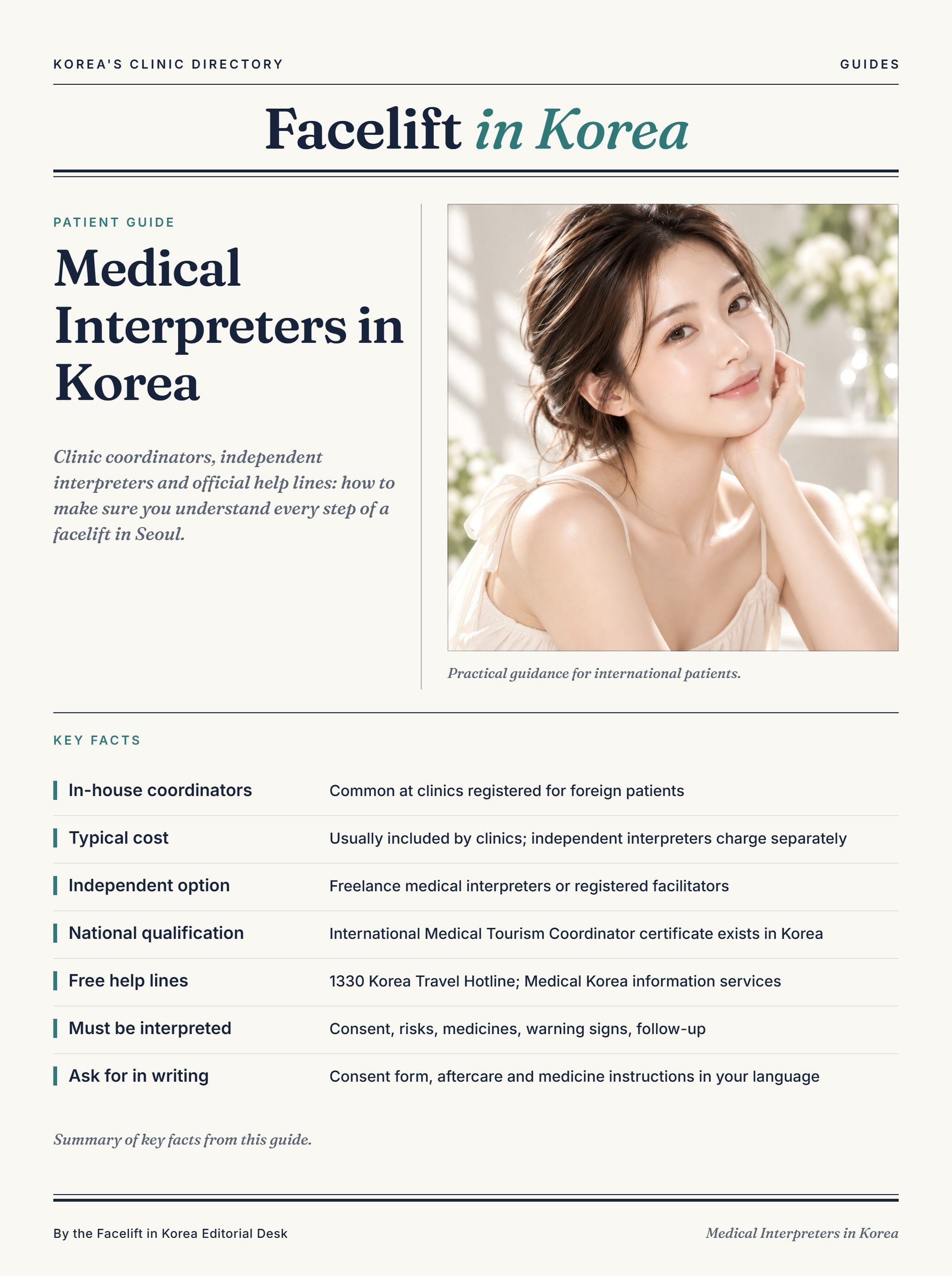
| In-house coordinators | Common at clinics registered for foreign patients |
|---|---|
| Typical cost | Usually included by clinics; independent interpreters charge separately |
| Independent option | Freelance medical interpreters or registered facilitators |
| National qualification | International Medical Tourism Coordinator certificate exists in Korea |
| Free help lines | 1330 Korea Travel Hotline; Medical Korea information services |
| Must be interpreted | Consent, risks, medicines, warning signs, follow-up |
| Ask for in writing | Consent form, aftercare and medicine instructions in your language |
Read next
Reader questions
Frequently asked questions
Do Seoul plastic surgery clinics provide English interpreters?
Most clinics that treat foreign patients have English-speaking coordinators, usually at no extra charge. Confirm in advance that an interpreter will be present for the consultation and surgery day.
Is the interpreter fee included in the facelift price?
At most clinics with international departments, yes. Independent interpreters you hire yourself charge separately.
Can I bring my own interpreter to a Korean clinic?
Generally yes. Tell the clinic in advance. A friend or family member can help with daily life, but a trained medical interpreter is better for consent.
Is there a free interpretation service in Korea?
The 1330 Korea Travel Hotline offers free phone interpretation for travelers in several languages, which helps with everyday situations.
Do Korean surgeons speak English?
Many read medical English well and some speak it fluently, but it varies. Clear communication, with interpretation if needed, matters more than fluency.
Next steps
Planning a facelift in Korea?
Compare clinics, check surgeon credentials and estimate your full trip budget before you book a consultation.
Facelift in Korea is an independent information directory. We do not perform procedures, and listings are not endorsements. This page is general information, not medical advice.