


Home › Patient Guides › Facelift Risks and Complications
Patient Guides
Facelift Risks and Complications: What Patients Should Know
By the Facelift in Korea Editorial Desk · Independent · How we report
The short answer
Quick answer: Facelift complications include hematoma (a blood collection under the skin, the most common serious early problem), facial nerve weakness, visible or widened scars, skin loss, infection, hair loss near incisions, asymmetry and anesthesia risks. Most are uncommon and many are temporary. Risk is lower with a qualified surgeon, good blood pressure control, no smoking and careful aftercare.

How risky is a facelift?
A facelift is a major operation, but it is generally considered safe for healthy people when performed by a trained plastic surgeon in a properly equipped facility. Most patients recover without serious problems. Still, every surgery carries risks, and understanding them helps you make an informed choice, prepare well and recognize warning signs early.
What are the main complications?
- Hematoma: a collection of blood under the skin, usually in the first day or two. It is the most common significant early complication and may need drainage. See hematoma after facelift.
- Facial nerve injury: damage to branches that move the face, causing weakness of the smile, lip or brow. Most cases are temporary and recover over weeks to months. Permanent injury is uncommon. See facial nerve injury after facelift.
- Numbness: very common in the cheeks and around the ears because small sensory nerves are cut when skin is lifted. It usually improves over months. The great auricular nerve, which supplies the earlobe, can occasionally be injured.
- Scarring: scars may widen, thicken or shift the hairline. Earlobe distortion can occur. See facelift scar care.
- Skin loss (necrosis): areas of skin may not get enough blood supply, most often behind the ear. Smoking greatly increases this risk.
- Infection: uncommon on the face, which has a rich blood supply, but possible.
- Hair loss: temporary or occasionally permanent thinning near temple incisions.
- Asymmetry or contour problems: uneven sides, visible pulling or a "wind-swept" look; some cases need revision surgery later, once tissues have fully settled.
- Anesthesia and general risks: reactions, blood clots in the legs or lungs, and heart or breathing problems are rare but serious.
Who is at higher risk?
Factors that tend to raise complication risk include smoking or nicotine use, poorly controlled high blood pressure, blood-thinning medicines and some supplements, diabetes, obesity, previous facial surgery and certain skin conditions. Studies have also found that men have a higher rate of hematoma, partly because the beard area has a richer blood supply. Be completely honest with your surgeon about your health. Read smoking and facelift and medications to stop before a facelift.
How do surgeons reduce risk?
- Careful pre-operative assessment, blood tests and an ECG where needed.
- Strict blood pressure control before, during and after surgery.
- Gentle technique that respects nerve anatomy, and careful closure without tension.
- Close monitoring in the first 24 hours, often with an overnight stay.
- Clear instructions on rest, head elevation and activity.
What should international patients in Korea consider?
Being far from home adds practical risk. Problems that arise after you fly back must be managed by local doctors, who may not know your surgeon's technique. That is why surgeons in Seoul usually ask you to stay 10–14 days. Plan for this, and ask the clinic in writing how late complications and revisions are handled and paid for.
- Ask how often the surgeon sees each complication and what they do about it.
- Confirm the facility has emergency equipment and a hospital transfer plan.
- Consider travel insurance that covers cosmetic surgery complications.
- Request your operation note in English to show doctors at home.
- Agree a plan for remote check-ins with photos at set points after you return.
Most patients who choose carefully and follow instructions never need these plans, but having them ready brings peace of mind.
Korean law also gives patients protections around consent and who operates; see ghost surgery in Korea.
What warning signs need urgent attention?
Seek help immediately for rapidly increasing swelling or pain on one side, difficulty breathing or swallowing, chest pain, calf pain or swelling, fever with spreading redness, dark or blackening skin, or sudden facial weakness. Knowing what is normal also helps; most swelling and bruising is expected, as explained in swelling and bruising after a facelift.
This page is general information, not medical advice. Decisions about surgery should be made with a qualified, board-certified plastic surgeon after an in-person examination.
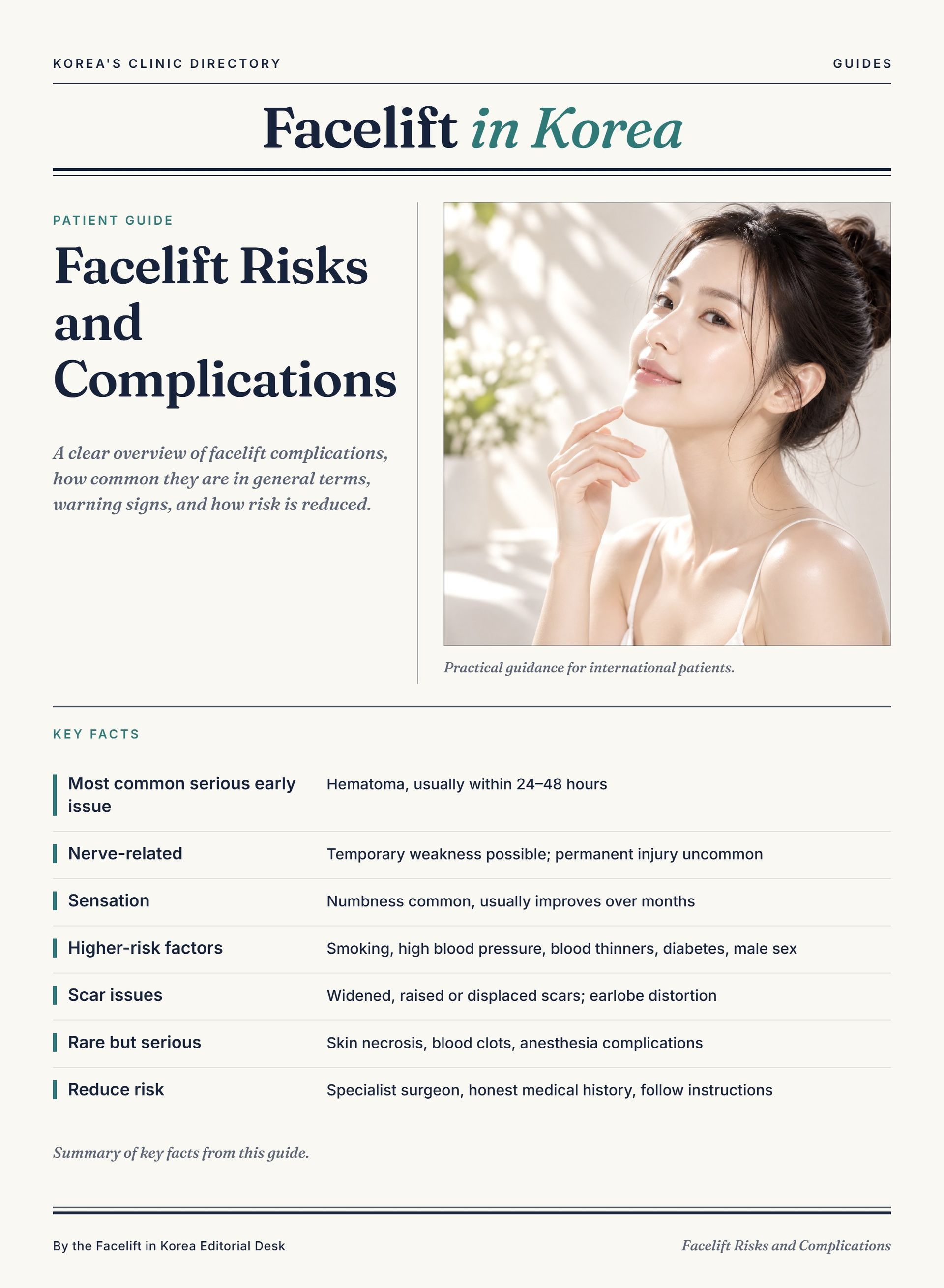
Key facts
| Most common serious early issue | Hematoma, usually within 24–48 hours |
|---|---|
| Nerve-related | Temporary weakness possible; permanent injury uncommon |
| Sensation | Numbness common, usually improves over months |
| Higher-risk factors | Smoking, high blood pressure, blood thinners, diabetes, male sex |
| Scar issues | Widened, raised or displaced scars; earlobe distortion |
| Rare but serious | Skin necrosis, blood clots, anesthesia complications |
| Reduce risk | Specialist surgeon, honest medical history, follow instructions |
Read next
Reader questions
Frequently asked questions
What is the most common facelift complication?
Hematoma, a collection of blood under the skin, is the most common significant early complication. It usually appears within 24–48 hours.
Can a facelift cause facial paralysis?
Temporary weakness of some facial movements can occur and usually recovers. Permanent nerve injury is uncommon in experienced hands.
Is numbness after a facelift permanent?
Usually not. Numbness in the cheeks and ears is common and generally improves over several months.
Does smoking really increase facelift risks?
Yes. Smoking and nicotine reduce blood flow to the skin and greatly increase the risk of skin loss and poor healing.
Are complications more common in Korea?
There is no reliable evidence that facelift complications are more common in Korea. Risk depends mainly on the surgeon, facility, your health and aftercare.
Next steps
Planning a facelift in Korea?
Compare clinics, check surgeon credentials and estimate your full trip budget before you book a consultation.
Facelift in Korea is an independent information directory. We do not perform procedures, and listings are not endorsements. This page is general information, not medical advice.