


Home › Patient Guides › How to Read Before-and-After Photos
Patient Guides
How to Read Facelift Before-and-After Photos
By the Facelift in Korea Editorial Desk · Independent · How we report
The short answer
Quick answer: To read facelift before-and-after photos, check that lighting, angle, expression, distance and background match in both images, with no makeup or filters in either. Look at the jawline, neck, earlobes and incision areas, not just overall glow. Ask how long after surgery the after photo was taken, and judge a surgeon on many consistent cases, not one dramatic result.
Why are before-and-after photos so persuasive?
Photos are the most powerful marketing tool for cosmetic clinics. They also vary hugely in honesty. Small changes in light, angle or expression can make a face look years younger without any surgery. Learning to read photos critically protects you from unrealistic expectations and helps you compare surgeons fairly.
What should match between the two photos?
- Lighting: overhead light deepens folds and jowls; soft front light smooths them. Both photos should use the same light.
- Angle: a chin tilted slightly upward tightens the neck. A head turned a few degrees changes the jawline.
- Distance and lens: closer shots distort features. The face should be the same size in both frames.
- Expression: a relaxed face in one and a slight smile in the other is not a fair comparison.
- Makeup and hair: makeup, styled hair or a tan only in the after photo adds a strong illusion.
- Background and clothing: a darker background and dark collar can sharpen the jawline visually.
Which parts of the face tell you most?
Look past the overall impression and study specific areas:
- Jawline and jowls: is the line smooth from chin to ear without a pulled look?
- Neck: has the angle under the chin improved, and are bands reduced? See deep neck lift for what neck work can do.
- Earlobes: a natural lobe should hang freely, not be stretched downward (the "pixie ear" sign).
- Hairline and sideburns: they should not be shifted unnaturally high or back.
- Mouth corners and cheeks: watch for a wide, wind-swept look or flattened cheeks.
- Scars: side views should show incisions that follow the ear's natural contours.
Why does timing matter?
A facelift looks different at three weeks than at a year. Early after photos may still show swelling that temporarily fills hollows and tightens the skin. Ask when each after photo was taken. Results at six to twelve months show the settled outcome, and photos at several years show durability. See the facelift recovery timeline and how long facelift results last.
How can I spot edited photos?
- Skin that looks airbrushed or poreless, especially in the after photo only.
- Warped backgrounds or lines near the jaw and neck.
- Different image quality or color between the two photos.
- Identical-looking results across many different patients.
Asking to see photos during the consultation, on the clinic's own system, can be more reliable than social media posts.
What should international patients know about photos from Seoul clinics?
Korean law regulates medical advertising, and misleading or exaggerated claims are prohibited. Even so, clinic social media, influencer posts and agency galleries vary in reliability. Many Seoul clinics show results mostly on East Asian patients. If your face shape, skin thickness or ethnicity differs, ask to see results on patients more like you. Facial structure affects how lifts look; see facelift for Asian faces for why.
- Ask for photos of patients of similar age and sagging pattern.
- Ask whether the photographed patient was operated on by your surgeon, not another doctor at the clinic.
- Ask about cases where the result was less than ideal and how it was managed.
Are videos more reliable than photos?
Short videos showing the face turning and talking can reveal more than still images, because they show how the result moves. A natural facelift should look relaxed when the person smiles or speaks, without tight lines toward the ears. Videos can also be edited or filtered, though, so apply the same critical eye. Ask whether the clinic can show you unedited follow-up videos during your consultation.
How should I use photos to choose a surgeon?
Look for consistency: many natural, well-balanced results that suit the person, rather than a few spectacular ones. Combine photos with credentials, experience and aftercare. Our guides on choosing a facelift surgeon in Korea and preparing your own consultation photos complete the picture.
This page is general information, not medical advice. Decisions about surgery should be made with a qualified, board-certified plastic surgeon after an in-person examination.
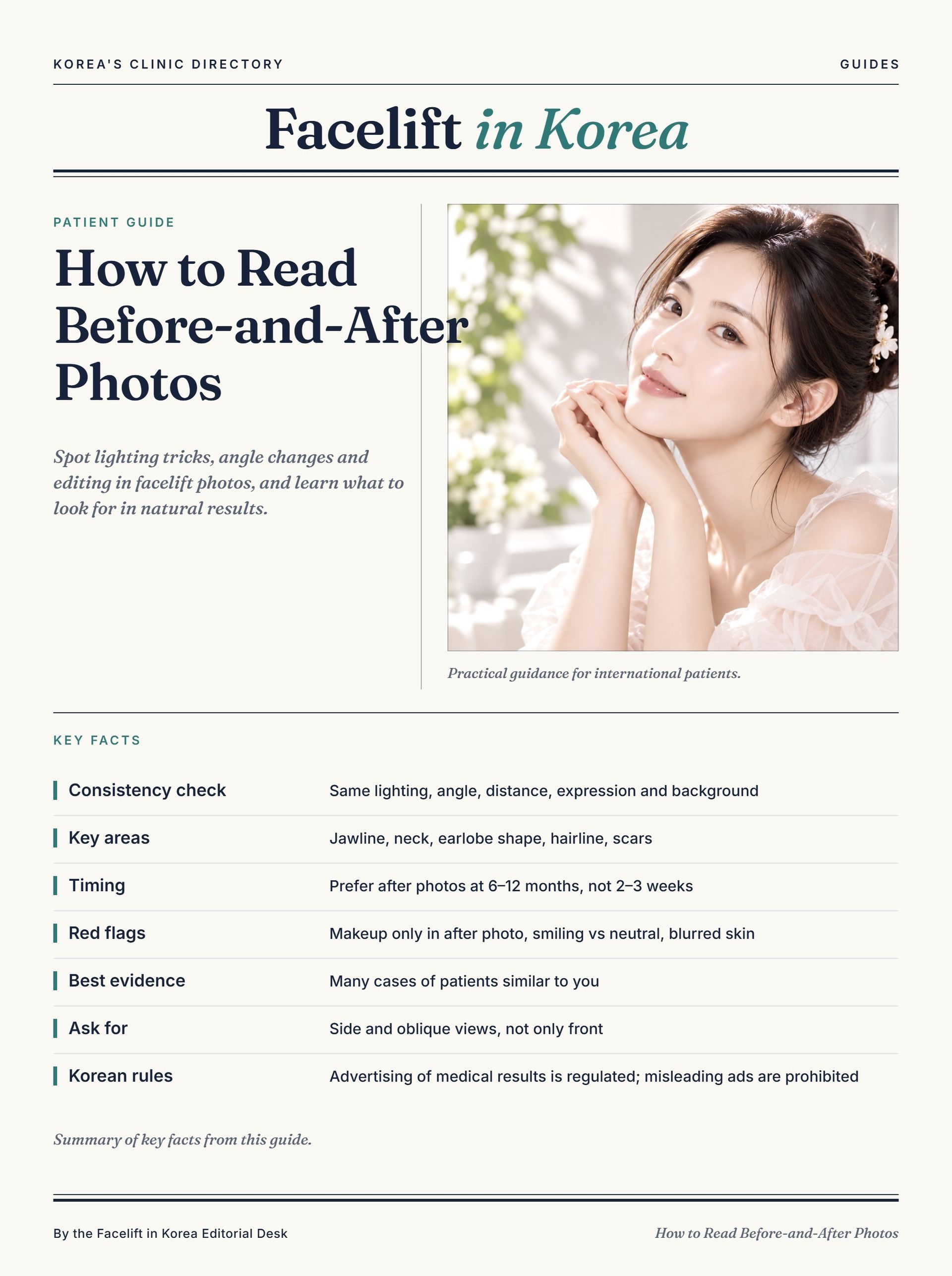
Key facts
| Consistency check | Same lighting, angle, distance, expression and background |
|---|---|
| Key areas | Jawline, neck, earlobe shape, hairline, scars |
| Timing | Prefer after photos at 6–12 months, not 2–3 weeks |
| Red flags | Makeup only in after photo, smiling vs neutral, blurred skin |
| Best evidence | Many cases of patients similar to you |
| Ask for | Side and oblique views, not only front |
| Korean rules | Advertising of medical results is regulated; misleading ads are prohibited |
Read next
Reader questions
Frequently asked questions
How can I tell if facelift photos are edited?
Look for airbrushed skin, warped backgrounds near the jaw, mismatched image quality, and very similar results across different faces. Ask to view original photos in the clinic.
When should facelift after photos be taken?
Photos at 6–12 months show settled results. Photos at 2–3 weeks may still show swelling and tightness.
Why do many Korean clinic photos show Asian patients?
Most local patients are East Asian. If your features differ, ask to see results on patients more similar to you.
Are before-and-after photos regulated in Korea?
Medical advertising in Korea is regulated and misleading claims are prohibited, but reliability still varies, especially on social media.
What is a pixie ear?
A stretched, pulled-down earlobe that can result from tension during facelift closure. Natural results keep the lobe's normal shape.
Next steps
Planning a facelift in Korea?
Compare clinics, check surgeon credentials and estimate your full trip budget before you book a consultation.
Facelift in Korea is an independent information directory. We do not perform procedures, and listings are not endorsements. This page is general information, not medical advice.