


Home › Patient Guides › The Natural Korean Facelift Aesthetic
Patient Guides
The Natural Korean Facelift Aesthetic: What It Means and How to Discuss It
By the Facelift in Korea Editorial Desk · Independent · How we report

The short answer
Quick answer: The natural Korean facelift aesthetic generally aims for a refreshed, youthful face that does not look operated on. Common goals include a smooth jawline, soft V-shaped lower face, preserved cheek volume, no wind-swept pulling and hidden scars. It often pairs lifting with volume restoration. It is a style, not a technique, so describe your own goals clearly to the surgeon.
What do clinics mean by a "natural" Korean facelift?
"Natural" is one of the most used words in Seoul plastic surgery marketing. For facelifts, it usually means the result should make you look rested and younger, without signs that you had surgery. Friends should notice you look well, not that your face has changed.
The style is shaped by beauty preferences common in Korea and East Asia, and by the anatomy of East Asian faces. It is not a single operation. Different surgeons use different techniques to aim for it.
What features are typically emphasized?
- A clean, smooth jawline. Jowls are lifted so the line from ear to chin is continuous.
- A soft V-shaped lower face. Korean aesthetics often favor a tapered lower face. Lifting can enhance this, sometimes alongside contouring or V-line lifting.
- Preserved midface volume. A youthful face has smooth, full cheeks. Surgeons often restore volume with fat grafting rather than only pulling tissue.
- Natural expression. Smiles and eye shape should look like yours.
- Discreet scars. Careful incision placement, often with short-scar or hidden-incision approaches.
What does it try to avoid?
- A "wind-swept" look, where the face seems pulled sideways toward the ears.
- A flat, hollow midface caused by lifting without addressing volume loss.
- Distorted earlobes or a shifted hairline or sideburn.
- Over-tight skin that looks shiny or mask-like.
Most of these are linked to pulling skin under tension. Many surgeons prefer techniques that lift the deeper layers, so the skin can be closed without tension. See deep plane vs SMAS facelift.
How does East Asian anatomy affect the approach?
Surgeons often note several features that are common in East Asian faces, though every face is different:
- Wider cheekbones and a broader lower face.
- Thicker skin and soft tissue in some patients.
- A flatter midface with less forward projection.
- A greater tendency to visible scar redness or darkening.
These features influence the direction of lift, how much volume to add and where to place incisions. Read more on our procedure page, facelift for Asian faces, and in facelift scarring and Asian skin.
Is the Korean aesthetic right for everyone?
Not necessarily. Beauty goals differ by culture and person. A patient from Europe, the Middle East or North America may want a stronger or more angular jawline, a different cheek shape, or simply to look like a younger version of themselves. A good surgeon adapts to your face and goals rather than applying one house style.
If you are not East Asian, ask whether the surgeon regularly treats patients with your facial structure, and ask to see those results. See how to read before-and-after photos.
How do you communicate your goals?
- Bring photos of yourself from 10 to 15 years ago. These are often more useful than celebrity photos.
- Describe what bothers you in plain words, such as "I want my jawline back" or "I look tired."
- Say what you do not want, for example "I don't want a slimmer face" or "I don't want my cheeks fuller."
- Ask the surgeon to explain what they would change and why, and what they would leave alone.
- Use an interpreter if needed, so subtle wording is not lost. See medical interpreters in Korea.
What should international patients know about marketing in Seoul?
Clinic websites and social media often use branded names for their lifting methods. Two clinics may use similar names for quite different operations, or different names for the same one. Focus on the details: which layers are lifted, how volume is handled, where the scars will be and what recovery looks like. Ignore promises of a guaranteed look or result.
Before-and-after photos online are selected by clinics and may be taken in flattering conditions. Treat them as examples, not predictions. A consultation with a clear discussion of your own anatomy is much more valuable.
The natural aesthetic is a goal many patients share. Achieving it depends on careful planning, skilled surgery and patience while swelling settles over several months.
This page is general information, not medical advice. Decisions about surgery should be made with a qualified, board-certified plastic surgeon after an in-person examination.
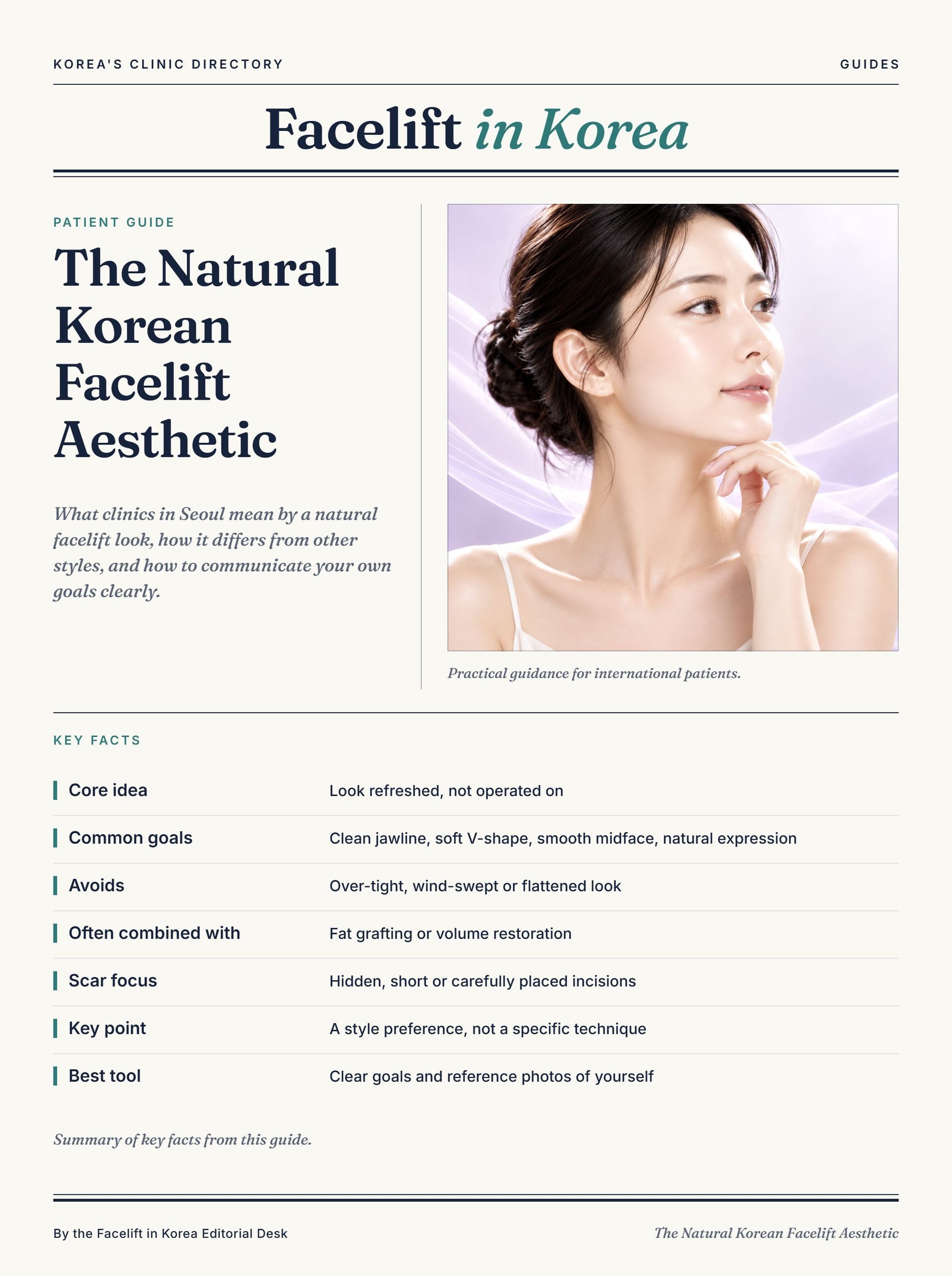
Key facts
| Core idea | Look refreshed, not operated on |
|---|---|
| Common goals | Clean jawline, soft V-shape, smooth midface, natural expression |
| Avoids | Over-tight, wind-swept or flattened look |
| Often combined with | Fat grafting or volume restoration |
| Scar focus | Hidden, short or carefully placed incisions |
| Key point | A style preference, not a specific technique |
| Best tool | Clear goals and reference photos of yourself |
| Related | Facelift for Asian faces |
Read next
Reader questions
Frequently asked questions
What is a natural Korean facelift?
It is a style of facelift result that aims to look refreshed and youthful without obvious signs of surgery. It usually focuses on a smooth jawline, preserved cheek volume and hidden scars.
Is the Korean facelift a specific technique?
No. It is an aesthetic goal. Surgeons may use SMAS, deep plane, short-scar or other techniques, often combined with fat grafting, to reach it.
Will a Korean facelift make my face V-shaped?
Many Korean patients like a soft V-shaped lower face, and lifting can enhance it. If you do not want a slimmer or more tapered look, tell your surgeon clearly.
Can non-Asian patients get a natural result in Korea?
Yes, but ask whether the surgeon regularly treats faces like yours and request relevant before-and-after photos. A good surgeon adapts to your anatomy and goals.
How do I avoid a pulled or wind-swept look?
Choose a surgeon who lifts deeper tissue and avoids skin tension, and discuss volume as well as lift. Ask to see results in side and three-quarter views.
Next steps
Planning a facelift in Korea?
Compare clinics, check surgeon credentials and estimate your full trip budget before you book a consultation.
Facelift in Korea is an independent information directory. We do not perform procedures, and listings are not endorsements. This page is general information, not medical advice.