


Home › Patient Guides › How Long Facelift Results Last
Patient Guides
How Long Do Facelift Results Last? What Patients in Korea Should Expect
By the Facelift in Korea Editorial Desk · Independent · How we report

The short answer
Quick answer: A well-performed facelift is commonly described as setting the clock back rather than stopping it. Many surgeons say results from a full SMAS or deep plane facelift often look good for roughly 7 to 10 years or more, while mini or thread-assisted lifts tend to last less. Skin quality, genetics, weight changes, sun and smoking all affect longevity.

How long does a facelift last?
There is no single number. Surgeons often describe a facelift as "turning back the clock." Your face keeps aging after surgery, but from a more youthful starting point. Ten years after a facelift, many people still look younger than they would have without surgery, even though some sagging has returned.
Common surgeon estimates, which vary by patient and study, are:
- Full facelifts that reposition deeper layers, such as SMAS and deep plane techniques: often roughly 7 to 10 years or longer before patients consider further treatment.
- Mini and short-scar lifts: usually less durable because less tissue is moved. Many patients see changes return within a few years.
- Skin-only lifts: tend to relax sooner, because skin alone stretches more than deeper tissue.
- Non-surgical lifting, such as threads and energy devices: generally months to a year or two, often with repeat sessions.
Be cautious about any clinic that promises a fixed number of years. No technique guarantees a result. Published studies use different methods and follow-up periods, so figures quoted online are rough guides, not promises for any one person.
Why do deeper techniques often last longer?
It helps to know what a facelift is trying to correct.
Facial aging involves more than loose skin. Fat pads descend, ligaments that hold tissue in place weaken and the face loses volume. Techniques that lift the deeper layer, called the SMAS, and release retaining ligaments aim to reposition tissue rather than just stretch skin. Many surgeons believe this gives a more natural and longer-lasting result. Debate continues about which deep technique lasts longest, and surgeon skill matters as much as the name of the method.
What makes results fade faster?
- Smoking and vaping. Nicotine damages skin quality and slows healing. See smoking and facelift safety.
- Sun exposure. UV light breaks down collagen and elastin.
- Large weight changes. Gaining and losing weight stretches tissue again.
- Thin or sun-damaged skin. Skin with less elasticity relaxes sooner.
- Genetics and bone structure. Strong cheekbones and jaw support soft tissue better.
- Age at surgery. Results may last differently depending on age and skin condition.
What helps results last longer?
- Daily sunscreen and hats.
- Keeping a stable weight.
- Not smoking.
- A sensible skin care routine, which your surgeon or dermatologist can suggest.
- Selective maintenance treatments, such as skin boosters, energy devices or small amounts of filler, if your surgeon agrees. These are optional.
Does the neck last as long as the face?
Not always. The neck has thin skin and the platysma muscle can form bands again over time. Some patients notice neck changes earlier than cheek and jowl changes. If the neck is a main concern, ask how your surgeon handles the platysma and what to expect long term.
What should international patients in Korea know?
Korean clinics often market lifts by technique name and promise "natural" or "long-lasting" results. Names vary between clinics, and two procedures with the same name may differ in depth. Ask the surgeon to explain in plain words which layers will be lifted and how they are fixed. Compare techniques using our deep plane vs SMAS and facelift vs thread lift pages.
Many Seoul clinics also offer maintenance packages of non-surgical treatments after surgery. These may be useful but are not required. Decide after you have healed, not at the moment of booking surgery.
Keep your operative summary. If you want a second procedure in ten years, perhaps in another country, your new surgeon will want to know exactly what was done. See revision facelift.
When will you see the final result?
Most swelling settles within a few months, but subtle refinement can continue for six to twelve months. Judge longevity from the one-year result, not the first weeks. Photos taken in the same light and pose at three months, one year and later years are the most honest way to track change. The facelift recovery timeline explains what to expect.
This page is general information, not medical advice. Decisions about surgery should be made with a qualified, board-certified plastic surgeon after an in-person examination.
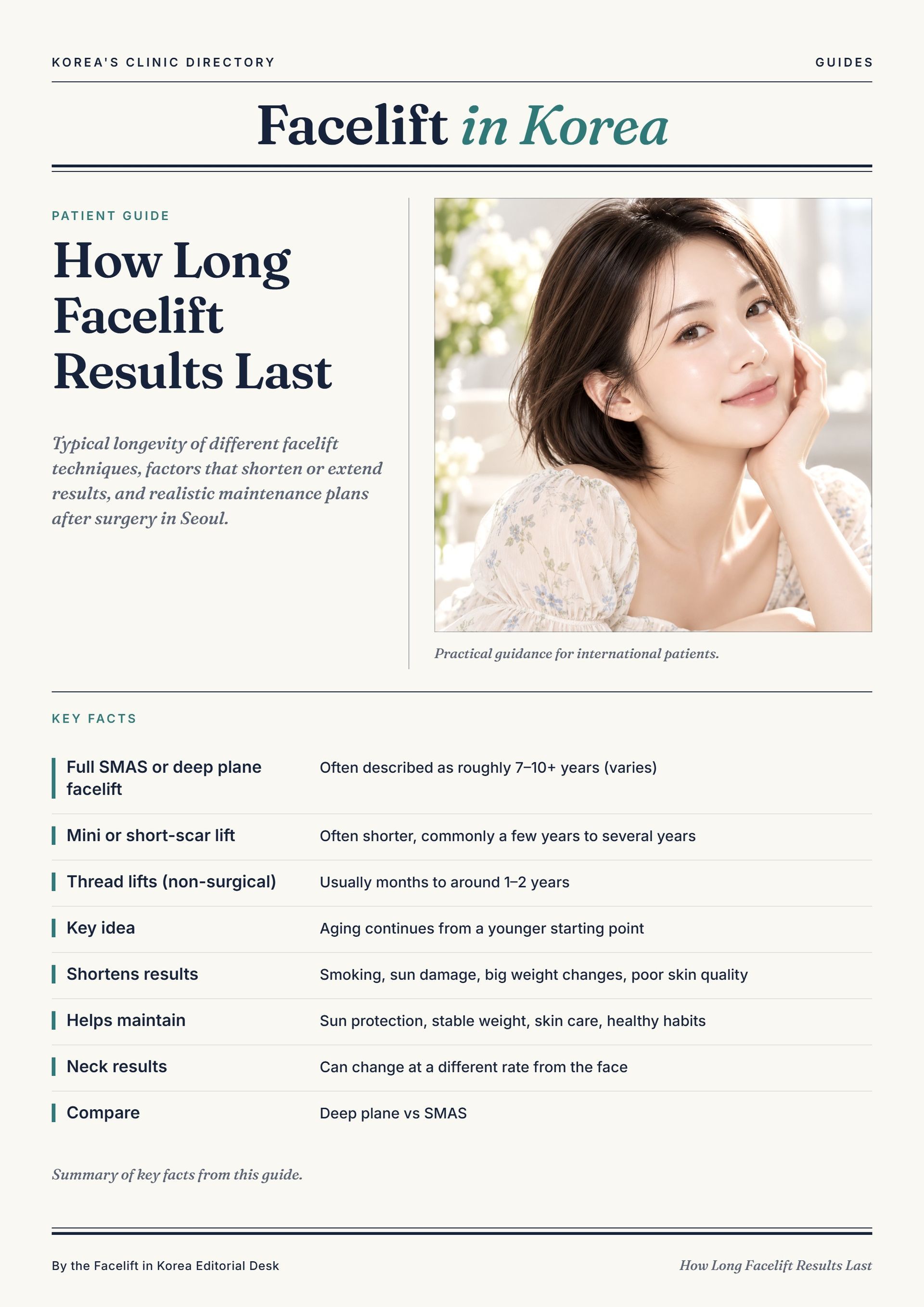
Key facts
| Full SMAS or deep plane facelift | Often described as roughly 7–10+ years (varies) |
|---|---|
| Mini or short-scar lift | Often shorter, commonly a few years to several years |
| Thread lifts (non-surgical) | Usually months to around 1–2 years |
| Key idea | Aging continues from a younger starting point |
| Shortens results | Smoking, sun damage, big weight changes, poor skin quality |
| Helps maintain | Sun protection, stable weight, skin care, healthy habits |
| Neck results | Can change at a different rate from the face |
| Compare | Deep plane vs SMAS |
Read next
Reader questions
Frequently asked questions
How many years does a facelift last?
Many surgeons say a full SMAS or deep plane facelift often looks good for roughly 7 to 10 years or more. Mini lifts usually last less. Results vary with skin, genetics and lifestyle.
Does a deep plane facelift last longer than a SMAS facelift?
Some surgeons believe deep plane techniques last longer, but evidence is mixed and surgeon skill matters a great deal. Both aim to lift deeper tissue rather than skin alone.
Will I look older than before when my facelift wears off?
No. Your face continues to age, but from a younger starting point. Most people still look younger than they would have without surgery.
Can I have a second facelift?
Yes. Secondary or revision facelifts are common many years later. Bring your original operative notes so the new surgeon knows what was done.
How can I make my facelift last longer?
Protect your skin from the sun, avoid smoking, keep a stable weight and follow a good skin care routine. Optional maintenance treatments can help some people.
Next steps
Planning a facelift in Korea?
Compare clinics, check surgeon credentials and estimate your full trip budget before you book a consultation.
Facelift in Korea is an independent information directory. We do not perform procedures, and listings are not endorsements. This page is general information, not medical advice.