


Home › Patient Guides › What Is the Best Age for a Facelift?
Patient Guides
What Is the Best Age for a Facelift? A Guide for Patients Considering Korea
By the Facelift in Korea Editorial Desk · Independent · How we report

The short answer
Quick answer: There is no single best age for a facelift. Surgeons judge readiness by aging signs such as jowls, neck laxity and loose skin, plus overall health, rather than by birthday. Many patients have their first facelift between their mid-40s and 60s, but healthy people in their 70s can also be candidates. Non-surgical care often suits earlier changes.
Is there a best age for a facelift?
No. Surgeons look at how your face has aged, not at your birth year. Two people aged 52 can have very different faces. One may have firm skin and only early jowls. Another may have deep folds and loose neck skin after sun exposure, smoking or large weight changes.
The question most surgeons ask is: does the amount of sagging justify surgery, and are you healthy enough for it?
What signs suggest you may be ready?
- Jowls that break the line of your jaw.
- Loose skin or bands in the neck.
- Deep folds from nose to mouth or lines from mouth to chin that are partly caused by sagging.
- Non-surgical treatments no longer giving the change you want.
- When you gently lift the skin in front of your ears, you like the change it makes.
Our concern page on jowls explains these changes in more detail.
What typically happens in each decade?
In your 40s
Early jowling and mild neck softness often appear. Many people still do well with non-surgical lifting. Those with clear early sagging may suit a limited or mini lift. Some surgeons believe earlier surgery on good-quality skin can give a natural result. See facelift in your 40s.
In your 50s
This is a common decade for a first full facelift. Jowls, neck changes and volume loss are often clearer, and skin still has reasonable elasticity. See facelift in your 50s.
In your 60s
Sagging, loose skin and neck bands are usually more pronounced. A facelift with neck work is common, sometimes combined with eyelids or fat grafting. Health checks become more important. See facelift in your 60s.
At 70 and beyond
Healthy patients in their 70s and older can have facelifts. Surgeons pay close attention to heart and lung health, blood pressure and medicines, and may adjust the plan. See facelift at 70+.
Is it better to have a facelift earlier or later?
Both views exist:
- Earlier: skin is more elastic, smaller changes are needed and the result may look subtle. But you may need a second procedure later in life.
- Later: the change is more noticeable and you may need only one facelift. But skin quality may be lower, and health risks rise with age.
Neither is right for everyone. Results also depend on how long they last. See how long facelift results last.
What health factors matter more than age?
- Smoking or nicotine use.
- Uncontrolled blood pressure, which is linked to bleeding after a facelift.
- Diabetes and other conditions that affect healing.
- Blood thinners and other medicines.
- Heart and lung conditions that affect anesthesia.
- Realistic expectations and good emotional readiness.
What should international patients in Korea know?
Korean clinics see many patients in their 40s seeking early lifting, often with a preference for subtle, natural change. Seoul is also known for a strong non-surgical lifting market, so you may be offered device treatments first. That can be sensible for early changes.
Older patients traveling to Korea should be especially careful with health checks. Bring recent test results and a full medicine list. Expect the clinic to run its own pre-operative tests. Allow extra recovery time before a long flight. See flying home after a facelift.
Ask the surgeon how they adapt technique to your age, for example deeper repositioning in older faces or more conservative lifting in younger ones. A good surgeon explains why the plan suits you, not just your age group.
Finally, think about timing in your own life. A facelift needs several weeks of lower activity and months of gradual settling. Many patients choose a period without major events, demanding work or caring duties. Being emotionally ready matters as much as the state of your skin.
This page is general information, not medical advice. Decisions about surgery should be made with a qualified, board-certified plastic surgeon after an in-person examination.
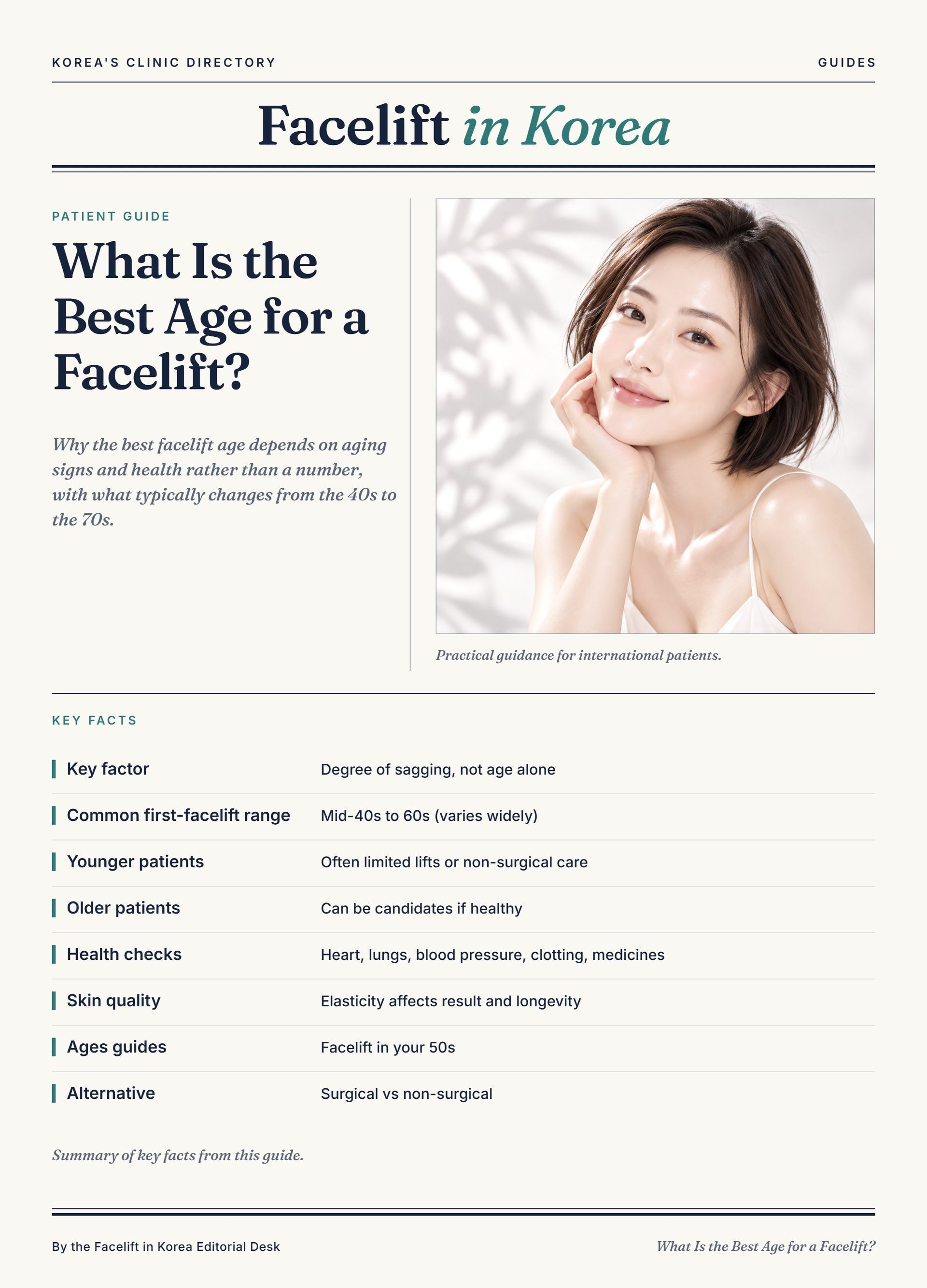
Key facts
| Key factor | Degree of sagging, not age alone |
|---|---|
| Common first-facelift range | Mid-40s to 60s (varies widely) |
| Younger patients | Often limited lifts or non-surgical care |
| Older patients | Can be candidates if healthy |
| Health checks | Heart, lungs, blood pressure, clotting, medicines |
| Skin quality | Elasticity affects result and longevity |
| Ages guides | Facelift in your 50s |
| Alternative | Surgical vs non-surgical |
Read next
Reader questions
Frequently asked questions
What is the most common age for a facelift?
Many people have their first facelift between their mid-40s and 60s. But surgeons decide by your degree of sagging and health, not age alone.
Is 40 too young for a facelift?
Not necessarily. Some people in their 40s have clear early jowls and may suit a limited lift. Many others do well with non-surgical treatment at that stage.
Can you get a facelift at 70 or older?
Yes, if you are healthy. Surgeons check heart and lung health, blood pressure and medicines carefully, and may adjust the plan.
Does a facelift last longer if done younger?
Some surgeons think good skin elasticity helps results age well, but you may want a second lift later in life. Longevity depends on many factors.
How do I know if I need a facelift or non-surgical treatment?
If small lifts of the skin in front of your ears give the change you want, non-surgical options may help. Clear jowls and loose neck skin usually respond better to surgery.
Next steps
Planning a facelift in Korea?
Compare clinics, check surgeon credentials and estimate your full trip budget before you book a consultation.
Facelift in Korea is an independent information directory. We do not perform procedures, and listings are not endorsements. This page is general information, not medical advice.