


Home › Patient Guides › Combining Other Procedures With a Facelift
Patient Guides
Combining Other Procedures With a Facelift in Korea
By the Facelift in Korea Editorial Desk · Independent · How we report

The short answer
Quick answer: Facelifts are commonly combined with eyelid surgery, brow lifts, fat grafting, neck lifts or liposuction, and sometimes chin implants. Combining can give a more balanced result with one recovery period. But longer surgery can raise anesthesia, bleeding and clot risks and extend recovery. Many surgeons set a limit on total operating time. Plan a longer stay in Korea for combined procedures.

Why do people combine procedures with a facelift?
A facelift mainly treats the lower face and neck: jowls, the jawline and loose neck skin. It does little for the eyelids, brows or forehead, and it does not add volume to hollow areas. If only one area is improved, the face can look unbalanced. A refreshed jawline can make tired eyes look more noticeable.
Combining procedures lets the surgeon treat several areas under one anesthetic and one recovery period. Many patients find this more practical than several trips. For international patients, it can also mean one set of flights, one recovery stay and one block of time off work. Those practical gains should never outweigh safety, though.
Which procedures are commonly combined?
- Upper or lower eyelid surgery (blepharoplasty). Treats hooded lids or under-eye bags. See eye and facelift combination.
- Brow lift. Raises low or heavy brows. A full upper face approach is described in brow + eyelid + facelift.
- Fat grafting. Moves your own fat to hollow cheeks, temples or under-eyes, adding volume a lift alone cannot.
- Neck lift or platysmaplasty. Treats neck bands and loose neck skin, often part of a facelift anyway.
- Neck liposuction. Removes fat under the chin.
- Chin implant. Improves a weak chin to define the jawline. See facelift + chin implant.
- Lip lift. Shortens a long upper lip.
- Skin resurfacing. Some surgeons treat fine lines around the mouth at the same time, while others stage it.
What are the safety trade-offs?
More procedures mean longer surgery. Surgeons generally agree that risk rises with operating time. Longer procedures can increase:
- Anesthesia time and its effects.
- Blood loss and the chance of a hematoma.
- Risk of blood clots, especially when combined with a long flight.
- Swelling and overall recovery time.
Many surgeons set a personal limit on total operating time and will stage procedures if the plan exceeds it. Your age and health also matter. A surgeon who suggests splitting surgery into two stages is often being careful, not cautious for no reason.
How does combining affect recovery?
- Swelling is usually greater and lasts longer.
- Eyelid surgery can blur vision for a few days and adds eye care.
- Fat grafting adds a donor site, often the abdomen or thighs, with its own bruising.
- Most patients need more time before flying and returning to work.
Many surgeons suggest a longer stay in Korea for combined surgery than for a facelift alone. See how long to stay in Korea after a facelift.
What should international patients in Korea know?
Korean clinics often promote combination packages, such as "eye plus face" or full upper-face rejuvenation. Packages can be good value, but check the details:
- Who performs each part? In some clinics, different surgeons handle eyes and face. That is acceptable if you know and agree. It is a problem if you are not told. See ghost surgery.
- How long will surgery take in total? Who monitors anesthesia throughout?
- Is every procedure medically sensible for you, or added to fill a package?
- What is the price of each part if you remove one?
Prices for combined procedures vary widely. See the facelift cost overview for indicative ranges and ask for an itemized quote.
When is staging better?
Staging means doing procedures on separate days or trips. Surgeons may suggest it when:
- The combined operating time would be very long.
- You have health conditions that raise anesthesia risk.
- One procedure needs healing before the next can be judged, such as fat grafting before final eyelid work.
Staging means more travel, but it may be safer. Ask your surgeon to explain the reasoning either way. If you do stage, ask how long to wait between procedures, whether the second stage needs a new consultation, and whether the package price changes. Get the full plan for both stages in writing before you pay a deposit.
This page is general information, not medical advice. Decisions about surgery should be made with a qualified, board-certified plastic surgeon after an in-person examination.
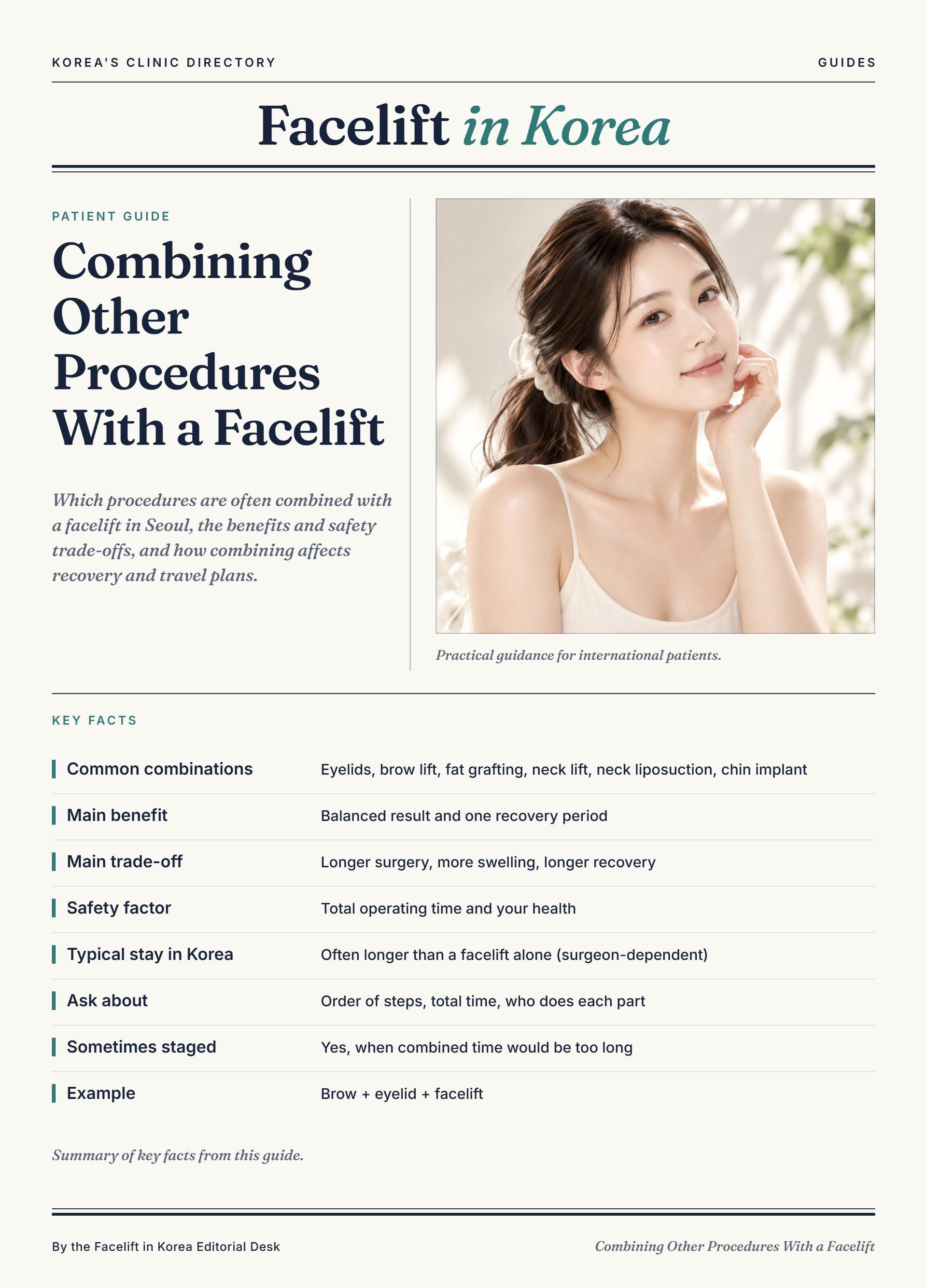
Key facts
| Common combinations | Eyelids, brow lift, fat grafting, neck lift, neck liposuction, chin implant |
|---|---|
| Main benefit | Balanced result and one recovery period |
| Main trade-off | Longer surgery, more swelling, longer recovery |
| Safety factor | Total operating time and your health |
| Typical stay in Korea | Often longer than a facelift alone (surgeon-dependent) |
| Ask about | Order of steps, total time, who does each part |
| Sometimes staged | Yes, when combined time would be too long |
| Example | Brow + eyelid + facelift |
Read next
Reader questions
Frequently asked questions
What procedures are often done with a facelift?
Common combinations include eyelid surgery, brow lift, fat grafting, neck lift, neck liposuction and chin implants. The right mix depends on your anatomy and goals.
Is it safe to combine eyelid surgery with a facelift?
Many surgeons combine them routinely in healthy patients. Combining extends operating time, so ask about the total length of surgery and anesthesia monitoring.
Does combining procedures make recovery longer?
Usually yes. Swelling tends to be greater, and you may need more time before flying home and returning to work.
Should I worry if different surgeons do different parts?
It can be normal in larger clinics, but you should be told in advance and agree to it in writing. Never accept an undisclosed change of surgeon.
Why would a surgeon refuse to combine everything I want?
Long operations raise risk. A surgeon who suggests staging is often prioritizing your safety.
Next steps
Planning a facelift in Korea?
Compare clinics, check surgeon credentials and estimate your full trip budget before you book a consultation.
Facelift in Korea is an independent information directory. We do not perform procedures, and listings are not endorsements. This page is general information, not medical advice.