


Home › Patient Guides › How to Verify a Board-Certified Plastic Surgeon in Korea
Patient Guides
How to Verify a Board-Certified Plastic Surgeon in Korea
By the Facelift in Korea Editorial Desk · Independent · How we report

The short answer
Quick answer: In Korea, a board-certified plastic surgeon is a doctor who completed plastic surgery residency and passed the national specialist exam, earning the title plastic surgery specialist. Other licensed doctors may legally perform cosmetic procedures but cannot use that title. Ask for the surgeon's specialist certificate, check the clinic's official name, and confirm membership of the Korean Society of Plastic and Reconstructive Surgeons.

What does board-certified mean in Korea?
Korea does not use the American phrase "board-certified," but it has an equivalent. After medical school and a license exam, a doctor can choose specialist training. Plastic surgery trainees complete an internship and then a multi-year plastic surgery residency at a teaching hospital, covering reconstructive and aesthetic surgery. They then pass the national specialist examination. Only these doctors may call themselves plastic surgery specialists.
The important detail for patients is that Korean law allows any licensed physician to perform cosmetic procedures. A doctor trained in general practice, dermatology or another field can open a clinic and offer lifting procedures, including surgery. This is legal, but it means "clinic offering facelifts" does not automatically mean "plastic surgery specialist."
How can I tell from the clinic's name?
Korean medical advertising rules restrict how a clinic can describe its specialty. In general, a clinic whose official Korean name includes "plastic surgery" (seonghyeong-oegwa) is run by a plastic surgery specialist. A clinic run by a non-specialist usually has a name ending in "clinic" (uiwon), with plastic surgery listed only as a treatment area, often in smaller text. English names and websites do not always follow this pattern, so check the Korean name on the signboard, receipt or business registration.
- Look for the Korean words for plastic surgery specialist on the doctor's profile.
- Be cautious with titles that cannot be checked, such as "international cosmetic surgery expert" or "aesthetic surgeon."
- Remember that a clinic can employ several doctors with different training.
How do I check society membership?
The main professional body is the Korean Society of Plastic and Reconstructive Surgeons (KSPRS). Full membership requires specialist certification. Many facelift surgeons also belong to the Korean Society for Aesthetic Plastic Surgery, an affiliated society. International memberships, such as ISAPS, add some reassurance but are not a substitute for Korean specialist status. Ask the clinic which societies the surgeon belongs to, and check the society's website where member information is available, or contact the society directly.
What documents can I ask to see?
- The surgeon's Korean specialist certificate in plastic surgery.
- Their medical license number.
- Their training history: medical school, residency hospital and any fellowships.
- Society membership certificates.
Reputable clinics often display these in the consultation room or on their website. A clinic that refuses to share basic credentials is a warning sign. For more context on comparing surgeons, see how to choose a facelift surgeon in Korea and our surgeon directory.
What should international patients know when checking credentials in Seoul?
Gangnam has a very high concentration of both specialist and non-specialist cosmetic clinics, and English marketing can blur the difference. Coordinators may describe every doctor as a "plastic surgeon." Ask the precise question: "Is Dr. ___ a certified plastic surgery specialist in Korea?" If you use an agency, ask the same and check the answer yourself; see medical tourism agencies in Korea.
- Clinics registered to attract foreign patients must have at least one specialist in each department through which they attract foreign patients. That is a minimum, not proof that your own surgeon is a specialist. See registered foreign-patient clinics.
- Confirm that the certified surgeon is the one named on your consent form; read ghost surgery in Korea.
Is a specialist always better than a non-specialist?
Training is the strongest single predictor of safe, consistent facelift results, because facelifts involve detailed anatomy, nerves and blood supply. Specialist status is not a guarantee, and experience in facelifts specifically matters too. A plastic surgery specialist who rarely does facelifts may be less suited to you than one who focuses on facial aging. Use specialist status as your first filter, then compare experience, results and aftercare. Our consultation question list helps with that second step, and how to read before-and-after photos helps you judge results.
This page is general information, not medical advice. Decisions about surgery should be made with a qualified, board-certified plastic surgeon after an in-person examination.
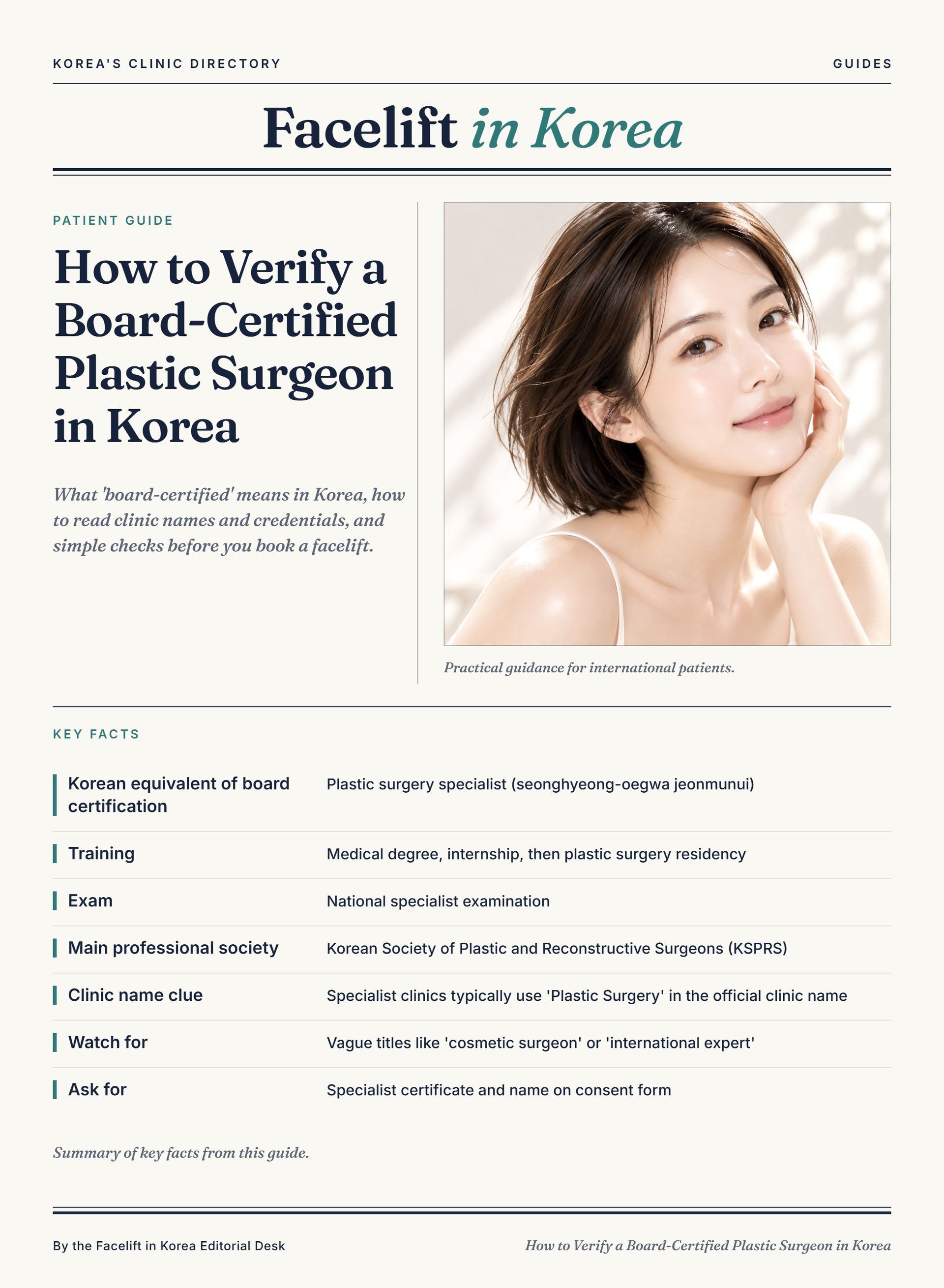
Key facts
| Korean equivalent of board certification | Plastic surgery specialist (seonghyeong-oegwa jeonmunui) |
|---|---|
| Training | Medical degree, internship, then plastic surgery residency |
| Exam | National specialist examination |
| Main professional society | Korean Society of Plastic and Reconstructive Surgeons (KSPRS) |
| Clinic name clue | Specialist clinics typically use 'Plastic Surgery' in the official clinic name |
| Watch for | Vague titles like 'cosmetic surgeon' or 'international expert' |
| Ask for | Specialist certificate and name on consent form |
Read next
Reader questions
Frequently asked questions
Can any doctor perform a facelift in Korea?
Any licensed physician can legally perform cosmetic procedures in Korea, but only those who completed plastic surgery residency and passed the specialist exam are plastic surgery specialists.
How long is plastic surgery training in Korea?
After medical school, doctors usually complete an internship followed by a multi-year plastic surgery residency, then pass a national specialist exam.
What is the KSPRS?
The Korean Society of Plastic and Reconstructive Surgeons, the main professional body for plastic surgery specialists in Korea.
Does a clinic name tell me if the doctor is a specialist?
Often. Korean naming rules generally reserve 'plastic surgery' in the official clinic name for specialist-run clinics, while others use 'clinic' with plastic surgery listed as a treatment area. Check the Korean name, not just the English one.
Is ISAPS membership the same as Korean board certification?
No. International memberships can be a good sign, but Korean specialist certification is the key credential to confirm.
Next steps
Planning a facelift in Korea?
Compare clinics, check surgeon credentials and estimate your full trip budget before you book a consultation.
Facelift in Korea is an independent information directory. We do not perform procedures, and listings are not endorsements. This page is general information, not medical advice.