


Home › Surgical Facelift Types
Surgical section
Surgical Facelift Types in Korea
This hub lists every surgical facelift and related procedure covered on Facelift in Korea, grouped by what each one treats. Each page explains the technique, who it suits, typical recovery and what international patients should ask in Seoul.
By the Facelift in Korea Editorial Desk · Last reviewed October 24, 2026 · How we report
The short answer
A surgical facelift repositions sagging skin and the deeper support layers of the face and neck through incisions usually hidden around the ears and hairline. In Korea the most common approaches are SMAS and deep plane facelifts, with shorter-scar options for early aging and separate neck, brow and midface lifts. The right type depends on where you sag, your skin quality and your recovery time.
Where to start
Which facelift type should you read about first?
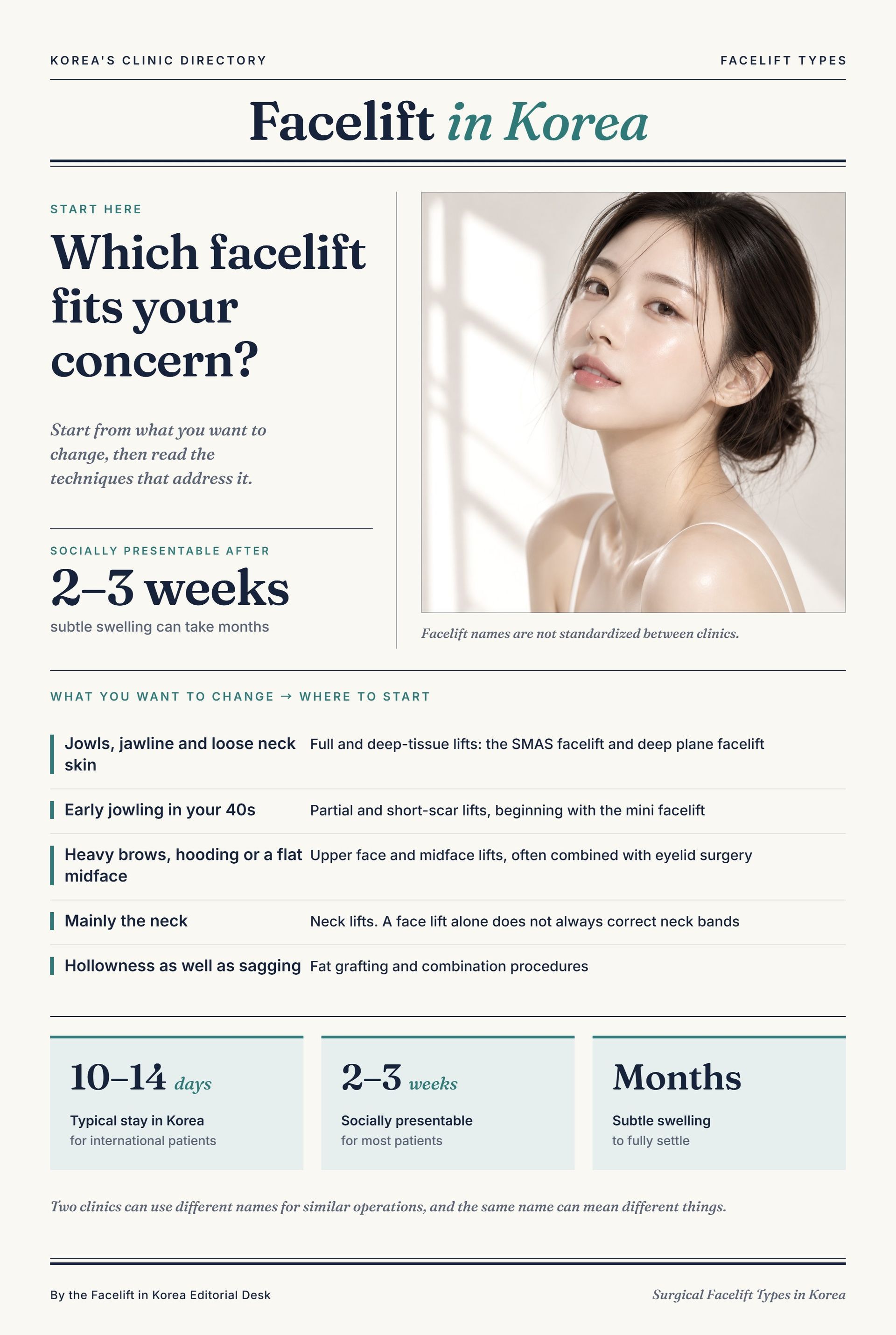
Facelift names are not standardized. Two clinics can use different names for similar operations, and the same name can mean different things. It helps to start from what you want to change, then read the techniques that address it.
- Jowls, a blurred jawline and loose neck skin together: start with the full and deep-tissue lifts, such as the SMAS facelift and deep plane facelift , and compare them in Deep Plane vs SMAS .
- Early jowling in your 40s with good skin: read the partial and short-scar lifts, beginning with the mini facelift .
- Heavy brows, hooding or a flat midface: see the upper face and midface group. These are often combined with eyelid surgery.
- Mainly the neck: see the neck group. A face lift alone does not always correct neck bands.
- Hollowness as well as sagging: lifting and volume are different problems. See the fat grafting and combination pages.
If you are not sure whether you need surgery at all, read Surgical vs Non-Surgical Facelift or start from your concern in Lifting Concerns . Before booking, check indicative prices in the cost guides and verify your surgeon using our surgeon checklist . A surgeon's in-person assessment, not a procedure name, should decide which technique is right for you.

The section index
Every surgical procedure we cover
Full and deep-tissue facelifts
Deep Plane Facelift
Lifts skin and deeper tissue together after releasing retaining ligaments.
Extended Deep Plane Facelift
A deep plane lift carried further into the midface and neck.
SMAS Facelift
Tightens the muscle-fascia layer beneath the skin; a widely used standard.
High SMAS Facelift
An SMAS lift extended higher to address the cheek area.
Composite Facelift
Moves skin, fat and muscle as one flap, including the lower eyelid area.
Full Facelift
The general term for lifting the midface, jawline and neck together.
Vertical Facelift
Emphasizes an upward rather than backward lifting direction.
Preservation Facelift
Aims to lift deeper tissue with less dissection of natural structures.
Lower Facelift
Focuses on jowls, jawline and the upper neck.
Neck lifts
Neck Lift (Platysmaplasty)
Tightens the platysma muscle to soften neck bands.
Deep Neck Lift
Also addresses deeper structures under the platysma for a sharper neck angle.
Mini Neck Lift
A more limited procedure for mild neck laxity.
Face + Neck Lift Combination
Treating the lower face and neck in one operation.
Facelift + Neck Liposuction
Adding fat removal under the chin to a facelift.
Partial and short-scar facelifts
Mini Facelift
Shorter incisions for early jowling and mild laxity.
Short-Scar Facelift
Avoids the long incision behind the ear where possible.
MACS Facelift
Uses suspension sutures through a short incision in front of the ear.
S-Lift
A short S-shaped incision lift for the lower face.
Skin-Only Facelift
Removes and tightens skin without lifting deeper layers.
Scarless (Hidden-Incision) Facelift
What "scarless" marketing usually means in practice.
Ponytail Facelift
Hairline-based lifting marketed for a swept-back look.
Endoscopic Facelift
Camera-assisted lifting through small incisions, mainly upper and midface.
Volume and add-on procedures
Facial Fat Transfer
Moves your own fat to restore lost facial volume.
Stem-Cell Enriched Fat Grafting Facelift
What "stem-cell" fat grafting claims mean and their limits.
Nano-Fat Facial Rejuvenation
Finely processed fat used for skin quality rather than volume.
Facelift + Buccal Fat Removal
When removing cheek fat is and is not sensible with a lift.
Facelift + Chin Implant
Improving jawline projection alongside lifting.
Upper face, brow and midface
Brow Lift
Raises a low or heavy brow and smooths the forehead.
Lateral Brow Lift
Lifts the outer tail of the brow only.
Temporal Lift
Lifts the outer brow and upper cheek through the temple hairline.
Upper Facelift
Addresses the forehead, brows and upper cheeks together.
Midface Facelift
Repositions descended cheek tissue.
Midface Lift + Fat Grafting
Combines lifting with volume restoration in the cheeks.
Lip Lift (Subnasal)
Shortens a lengthened upper lip through an incision under the nose.
Brow + Eyelid + Facelift (Upper Face Triad)
Planning a combined upper-face rejuvenation.
Eye and Facelift Combination
Eyelid surgery performed alongside a facelift.
Facelifts by age and situation
Facelift in Your 40s
Early, limited lifting and when it is worth waiting.
Facelift in Your 50s
The most common age for a first facelift.
Facelift in Your 60s
Planning for more laxity and combined procedures.
Facelift at 70+
Health screening, anesthesia and realistic goals.
Facelift for Men
Beard, hairline and incision planning for male patients.
Facelift for Asian Faces
Anatomy, skin and aesthetic goals specific to East Asian faces.
Facelift After Major Weight Loss
Handling excess skin and volume loss together.
Facelift After V-Line / Jaw Reduction Surgery
Lifting soft tissue that sagged after bone reduction.
Revision (Secondary) Facelift
Correcting or refreshing a previous facelift.
Reader questions
Surgical facelift FAQs
What is the most common facelift technique in Korea?
SMAS-based facelifts and deep plane facelifts are the two approaches most often discussed by Seoul surgeons for moderate to advanced sagging. Many surgeons adapt their technique to each patient rather than using one method for everyone. See Deep Plane vs SMAS Facelift.
Is a mini facelift enough?
A mini facelift can suit people with early jowling, good skin elasticity and little neck laxity. It usually does not correct significant neck bands or heavy sagging. Read Mini vs Full Facelift for a side-by-side view.
Does a facelift also lift the neck?
Most full facelifts improve the jawline and upper neck, but prominent platysma bands or fullness under the chin may need a dedicated neck lift. Ask your surgeon whether your plan includes neck work. See the Face + Neck Lift Combination page.
How long is recovery from a facelift?
Most patients look socially presentable after roughly two to three weeks, while subtle swelling can take several months to settle. International patients usually stay in Korea around 10 to 14 days. See the recovery timeline.
Can I combine a facelift with eyelid surgery or fat grafting?
Yes, combinations are common, but longer operations add anesthesia time and recovery. Your surgeon should explain the trade-offs and whether staging the procedures is safer. Read Combining Other Procedures With a Facelift.
Elsewhere in the journal
Explore other sections
Lifting Concerns
Start from the problem you want to fix.
Non-Surgical Lifting
Devices, threads and injectables.
Facelift Costs
Indicative price ranges and budgets.
Planning and Recovery Guides
Surgeon checks, visas and aftercare.
Comparisons
Techniques and destinations side by side.
Clinic Directory and Surgeon Directory
Seoul Areas, Patients by Country and the Glossary
Facelift in Korea is an independent information directory. We do not perform procedures and listings are not endorsements. Content is reviewed for accuracy but is not medical advice — see our editorial policy and medical disclaimer.