


Home › Patient Guides › Registered Foreign-Patient Clinics in Korea
Patient Guides
Registered Foreign-Patient Clinics in Korea: What Registration Means
By the Facelift in Korea Editorial Desk · Independent · How we report

The short answer
Quick answer: In Korea, a medical institution must register with its city or provincial government before it may attract foreign patients. Registration requires at least one specialist in each relevant department and medical malpractice insurance or membership of a mutual aid scheme, and it must be renewed every three years. It is a basic safeguard, not a quality rating, so still check your individual surgeon.

What is a registered foreign-patient clinic?
Korea actively promotes medical tourism, but it also regulates who may recruit foreign patients. Under the Act on Support for Overseas Expansion of Medical Services and Attraction of International Patients, any medical institution that wants to attract foreign patients must register with the head of its metropolitan city or province. In Seoul, that is the Seoul Metropolitan Government. The same law covers facilitators and agencies, which must register separately.
A foreign person can still walk into any Korean clinic and be treated. The registration rule applies to actively attracting or soliciting foreign patients, for example through overseas marketing, international departments or agency partnerships.
What does a clinic need to register?
- Specialists: at least one specialist for each medical department through which the clinic attracts foreign patients. For a plastic surgery department, that means at least one plastic surgery specialist.
- Insurance: medical malpractice liability insurance, or membership of a medical damages mutual aid association, as set by ministerial ordinance.
- No disqualifying convictions: people convicted under the law within set periods cannot register.
Registration is valid for three years and must be renewed. Clinics that attract foreign patients without registration face penalties of up to three years in prison or a fine of up to KRW 30 million.
What does registration not guarantee?
Registration is a legal minimum. It does not mean the government has assessed the clinic's surgical results, and it does not prove that the doctor operating on you is a specialist. A clinic may have one specialist and several non-specialist doctors. It also does not set prices or check marketing claims. Use registration as one filter, then verify your individual surgeon using our guide on how to verify a board-certified plastic surgeon in Korea.
Is there a higher level of accreditation?
The Ministry of Health and Welfare runs a separate, voluntary program called the Korean Accreditation Program for Hospitals serving Foreign patients (KAHF). It evaluates services for international patients, such as interpretation, patient safety and complaint handling, against detailed standards. Some larger clinics and hospitals hold it. It is a positive sign, but many good small clinics do not apply. Hospitals may also hold general Korean healthcare accreditation or international accreditation such as JCI.
What should international patients in Seoul know about registered clinics?
- Registered clinics usually have international coordinators and can issue invitation letters for the Korea medical visa (C-3-3).
- Malpractice insurance gives some financial protection if negligence is proven, though claims follow Korean law.
- Registered clinics and facilitators must follow rules on fees and advertising to foreign patients.
- The 10% VAT refund on cosmetic procedures for foreign patients, which registered clinics used to offer, ended at the end of 2025, as reported by Korean media. Check any current refund claims carefully; see VAT refund for cosmetic surgery in Korea.
How can I check whether a clinic is registered?
Ask the clinic for its foreign-patient attraction registration certificate and its registration number. Reputable international departments can show this readily. You can also contact Medical Korea, the government-backed information service for international patients run with the Korea Health Industry Development Institute (KHIDI), or the local health authority. Be wary if a clinic or agency avoids the question. Our guide to medical tourism agencies in Korea explains how unregistered brokers operate.
What if something goes wrong at a registered clinic?
Start by raising the issue with the clinic and your surgeon, and request your records. If you cannot resolve it, Medical Korea's support center can advise, and the Korea Medical Dispute Mediation and Arbitration Agency offers mediation. Korean media have reported that complaints and dispute inquiries from foreign patients have grown as patient numbers have risen, so keep records from the start. Read medical disputes in Korea for the routes, and browse the clinic directory to compare options.
This page is general information, not medical advice. Decisions about surgery should be made with a qualified, board-certified plastic surgeon after an in-person examination.
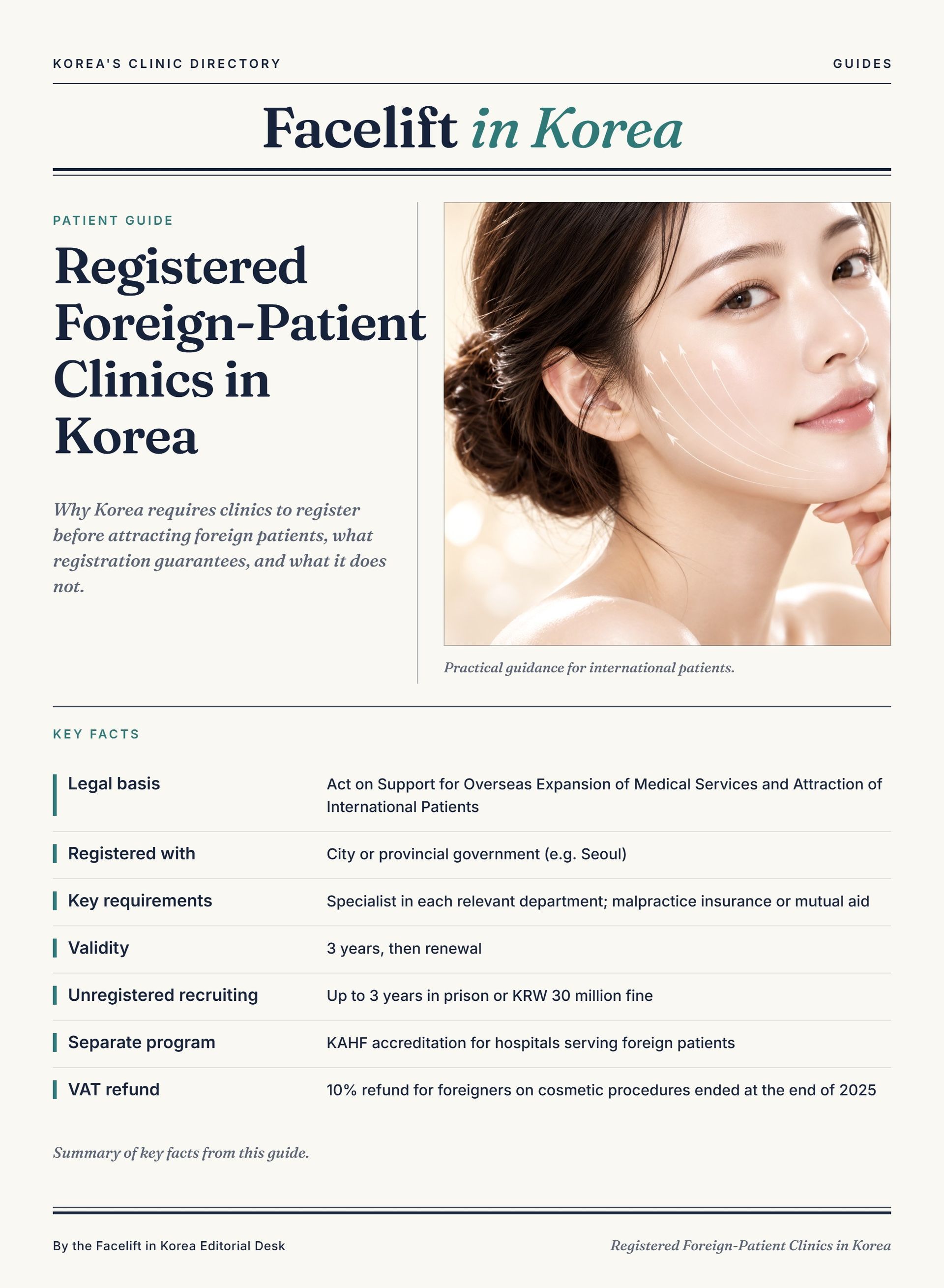
Key facts
| Legal basis | Act on Support for Overseas Expansion of Medical Services and Attraction of International Patients |
|---|---|
| Registered with | City or provincial government (e.g. Seoul) |
| Key requirements | Specialist in each relevant department; malpractice insurance or mutual aid |
| Validity | 3 years, then renewal |
| Unregistered recruiting | Up to 3 years in prison or KRW 30 million fine |
| Separate program | KAHF accreditation for hospitals serving foreign patients |
| VAT refund | 10% refund for foreigners on cosmetic procedures ended at the end of 2025 |
Read next
Reader questions
Frequently asked questions
Do Korean clinics need a license to treat foreigners?
Any licensed clinic may treat a foreign walk-in patient. To actively attract or recruit foreign patients, a clinic must be registered with its city or provincial government.
Does registration mean a clinic is safe?
It means the clinic meets basic requirements, including a specialist and malpractice insurance. It is not a quality rating, so still check your surgeon.
How long does registration last?
Three years, after which the clinic must renew it.
Can I still get a VAT refund on a facelift in Korea?
Korean media reported that the 10% VAT refund for foreign patients' cosmetic procedures ended at the end of 2025. Ask your clinic for current rules before relying on any refund.
What is KAHF accreditation?
A voluntary Ministry of Health and Welfare program that evaluates services for foreign patients. It is a positive sign but not required.
Next steps
Planning a facelift in Korea?
Compare clinics, check surgeon credentials and estimate your full trip budget before you book a consultation.
Facelift in Korea is an independent information directory. We do not perform procedures, and listings are not endorsements. This page is general information, not medical advice.