


Home › Patient Guides › Anesthesia Options for Facelift Surgery
Patient Guides
Anesthesia Options for Facelift Surgery in Korea
By the Facelift in Korea Editorial Desk · Independent · How we report
The short answer
Quick answer: Facelifts are done under general anesthesia, IV sedation with local anesthetic, or local anesthesia alone for small procedures. The choice depends on the technique, length of surgery, your health and the surgeon's practice. In Korea, ask who gives and monitors anesthesia, ideally a dedicated anesthesiologist, and what monitoring and emergency equipment the clinic has.
What types of anesthesia are used for a facelift?
There are three main approaches. Most surgeons combine them with local anesthetic injected into the face, which reduces pain and bleeding.
- General anesthesia. You are fully unconscious. A tube or airway device protects your breathing. An anesthesiologist controls your breathing, blood pressure and depth of anesthesia throughout.
- IV sedation (sometimes called twilight or sleep sedation). Medicines given through a drip make you deeply relaxed and sleepy. You breathe on your own. Depth can range from light to deep.
- Local anesthesia only. Numbing medicine is injected and you stay awake. This is mainly used for small procedures such as a limited mini facelift or a temporal lift.
Our glossary explains the difference in more detail: general anesthesia vs IV sedation.
How do surgeons choose?
The choice depends on several factors:
- Procedure length and extent. A full deep plane facelift with neck work can take several hours. Many surgeons prefer general anesthesia for longer, more extensive surgery.
- Your health. Heart and lung conditions, sleep apnea, weight and past reactions all matter.
- Combined procedures. Adding eyelids, fat grafting or a brow lift extends operating time. See combining procedures with a facelift.
- Surgeon and clinic practice. Some surgeons routinely use deep sedation, others general anesthesia.
Neither option is automatically safer. Safety depends a great deal on who is giving the anesthesia, how you are monitored and whether the clinic is equipped for emergencies.
What are the trade-offs?
- General anesthesia: controlled airway and stable conditions for long surgery. Some patients feel nausea or a sore throat afterward. It needs a full anesthesia team and recovery area.
- IV sedation: often a lighter recovery with less nausea. But deep sedation can affect breathing, and the airway is not protected by a tube, so careful monitoring is essential.
- Local only: quickest recovery and no sedation risks, but only suits short, limited procedures and some patients find it stressful.
What should you ask a clinic in Seoul?
- Who will give and monitor my anesthesia? Is it a specialist anesthesiologist who stays in the room for the whole operation?
- What monitoring will be used? Ask about oxygen levels, heart tracing, blood pressure and breathing (carbon dioxide) monitoring.
- What emergency equipment and drugs are on site? Is there a transfer agreement with a nearby hospital?
- Where will I recover, and who watches me until I am fully awake?
- Will I stay overnight? Some clinics keep facelift patients overnight. Others discharge the same day.
Add these to the consultation questions you send ahead of time.
What should international patients know about Korea?
Korean clinics range from small single-surgeon practices to large hospitals with several anesthesiologists. Many larger plastic surgery clinics in Gangnam say they employ full-time anesthesiologists. Ask for this in writing rather than assuming.
Since September 2023, Korean law has required operating rooms where surgery is done on unconscious patients, such as under general anesthesia, to have CCTV installed, and to record on the patient's request. Ask how to request recording and how the footage is kept. This rule was partly a response to concerns about ghost surgery.
Pre-operative tests such as blood work and an ECG are usually done in Seoul a day or so before surgery. Bring past test results and an English list of your medicines. Read medications to stop before a facelift.
How do you prepare for anesthesia?
- Follow fasting instructions exactly. Eating or drinking too close to sedation or general anesthesia can be dangerous.
- Tell the team about loose teeth, dentures, acid reflux, snoring or sleep apnea.
- Arrange for someone to escort you after discharge, or confirm the clinic will.
- Do not drink alcohol, drive or sign important documents for at least 24 hours after sedation or general anesthesia.
What does recovery from anesthesia feel like?
Most patients feel sleepy and a little confused for a few hours. Nausea is possible, and clinics usually give medicine to prevent it. A sore throat can follow general anesthesia. Report breathing difficulty, chest pain or confusion that gets worse. The first days of healing are covered in facelift recovery day by day.
This page is general information, not medical advice. Decisions about surgery should be made with a qualified, board-certified plastic surgeon after an in-person examination.
Key facts
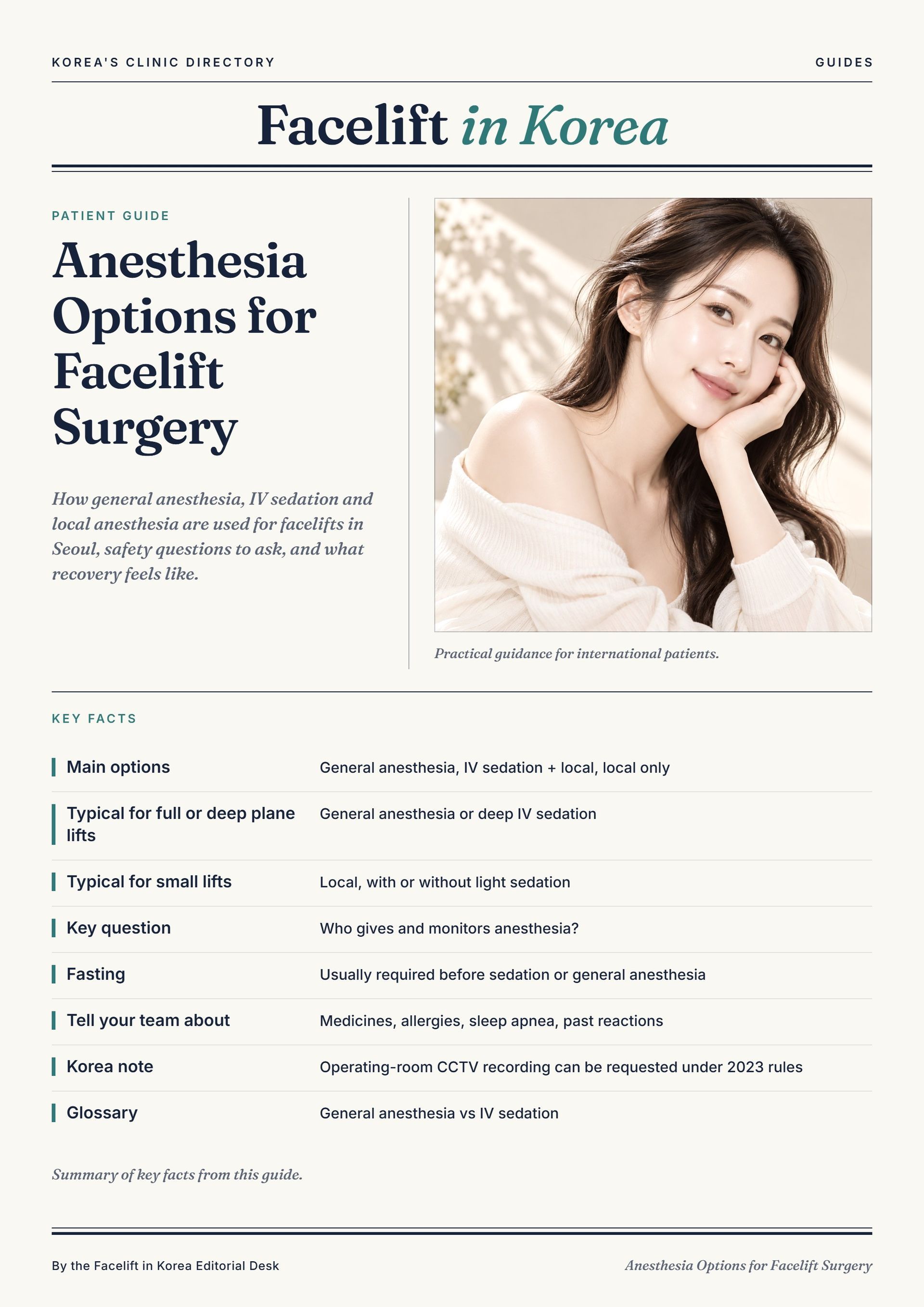
| Main options | General anesthesia, IV sedation + local, local only |
|---|---|
| Typical for full or deep plane lifts | General anesthesia or deep IV sedation |
| Typical for small lifts | Local, with or without light sedation |
| Key question | Who gives and monitors anesthesia? |
| Fasting | Usually required before sedation or general anesthesia |
| Tell your team about | Medicines, allergies, sleep apnea, past reactions |
| Korea note | Operating-room CCTV recording can be requested under 2023 rules |
| Glossary | General anesthesia vs IV sedation |
Read next
Reader questions
Frequently asked questions
Is a facelift done under general anesthesia?
Many full facelifts are done under general anesthesia, but some surgeons use deep IV sedation with local anesthetic. Smaller lifts may use local anesthesia alone. Your surgeon will recommend an approach after examining you.
Is IV sedation safer than general anesthesia for a facelift?
Not automatically. Each has different risks. Safety depends heavily on who gives the anesthesia, how you are monitored and how well the clinic is equipped.
Do Korean clinics have anesthesiologists?
Many larger clinics in Seoul employ anesthesiologists, but not all do. Ask who will give and monitor your anesthesia and get the answer in writing.
Can I request CCTV recording during surgery in Korea?
Korean rules introduced in 2023 require CCTV in operating rooms where patients are unconscious, with recording on the patient's request. Ask the clinic how to request it.
How long does it take to recover from anesthesia after a facelift?
Most people feel drowsy for several hours. You should not drink alcohol, drive or make important decisions for at least 24 hours.
Next steps
Planning a facelift in Korea?
Compare clinics, check surgeon credentials and estimate your full trip budget before you book a consultation.
Facelift in Korea is an independent information directory. We do not perform procedures, and listings are not endorsements. This page is general information, not medical advice.