


Home › Patient Guides › Surgical vs Non-Surgical Facelift: Which Do You Need?
Patient Guides
Surgical vs Non-Surgical Facelift in Korea: Which Do You Need?
By the Facelift in Korea Editorial Desk · Independent · How we report
The short answer
Quick answer: A surgical facelift repositions sagging deeper tissue and removes excess skin, giving the largest and longest-lasting change, with one to two weeks of social downtime. Non-surgical options such as HIFU, RF, threads and injectables give milder, temporary improvement with little downtime. Early laxity often suits non-surgical care; clear jowls, neck sagging and loose skin usually need surgery.
What is the basic difference?
A surgical facelift is an operation. The surgeon makes incisions, usually around the ears, lifts and repositions the deeper tissue of the face and neck, and removes extra skin. Examples include SMAS, deep plane and mini facelifts.
Non-surgical lifting uses devices, threads or injections without cutting and lifting tissue. Common types in Korea include:
- Focused ultrasound (HIFU), such as Ultherapy or Shurink.
- Radiofrequency (RF), such as Thermage or Oligio.
- Thread lifts using dissolvable threads.
- Injectables, such as fillers, collagen stimulators and botulinum toxin.
See our hub of non-surgical lifting treatments for details on each.
How do results compare?
- Amount of lift. Surgery can move tissue by a much greater amount. Non-surgical options tighten or support tissue more subtly.
- Loose skin. Only surgery removes excess skin. Devices may tighten skin a little, but cannot remove a fold.
- Longevity. Surgical results often last many years. Non-surgical effects usually fade over months to around two years and need repeat sessions. See how long facelift results last.
- Predictability. Device results vary more between people. Some see clear tightening, others very little.
How do downtime and risk compare?
- Surgery: anesthesia, incisions, swelling and bruising. Most people need one to two weeks before they feel comfortable in public, and longer for full recovery. Risks include hematoma, nerve injury and scarring. See facelift risks.
- Non-surgical: usually little or no downtime. Possible effects include redness, swelling, tenderness, bruising and, rarely, burns, nerve irritation, lumps or thread problems.
Non-surgical does not mean risk-free. Choose qualified practitioners for these treatments too. Ask who performs the treatment, which device and settings are used, and what happens if a side effect appears after you fly home.
Who usually suits each approach?
Many surgeons think in stages:
- Early changes (often 30s to mid-40s): mild loss of firmness, early lines, slight volume loss. Non-surgical care is often enough.
- Moderate changes: early jowls and some neck softening. Some people do well with combined non-surgical treatment. Others benefit from a limited lift.
- Advanced changes: clear jowls, deep folds, loose neck skin or neck bands. Surgery is usually the more effective option.
Age is only a rough guide. Skin quality, bone structure and weight history matter more. See best age for a facelift.
Can you combine both?
Yes. Many patients use non-surgical treatments before a facelift to delay surgery, and afterward to maintain skin quality. Some surgeons add fat grafting during a facelift to restore volume. Ask your surgeon how treatments fit together and how long to wait between them. Some surgeons prefer patients to avoid certain threads or fillers before surgery, because they can make dissection harder. See combining procedures with a facelift.
What should international patients in Korea know?
Korea is known for a wide range of lifting devices, including Korean-made HIFU and RF machines, and for competitive pricing. Gangnam clinics often promote "lifting" packages that mix several devices. This can make non-surgical options very tempting.
A few cautions:
- A clinic that offers only devices may steer you toward devices. A surgeon who offers only surgery may steer you toward surgery. Getting opinions from both types of practice helps.
- Repeated device sessions add up. Compare the total cost over several years, not one session. See non-surgical lifting cost in Korea.
- Check genuine devices and tips. Ask to see the device and confirm it is authentic.
Our comparison page facelift vs thread lift covers one common decision in detail.
How do you decide?
Look in a mirror and gently lift the skin in front of your ears. If that small lift makes the change you want, a non-surgical option may be enough. If you need to pull a lot to fix the jowls and neck, surgery is more likely to help. Then get an in-person examination from a qualified surgeon. Bring a list of past treatments, with dates, so the surgeon can see what has and has not worked for you. An honest surgeon will tell you if surgery is not yet worth it.
This page is general information, not medical advice. Decisions about surgery should be made with a qualified, board-certified plastic surgeon after an in-person examination.
Key facts
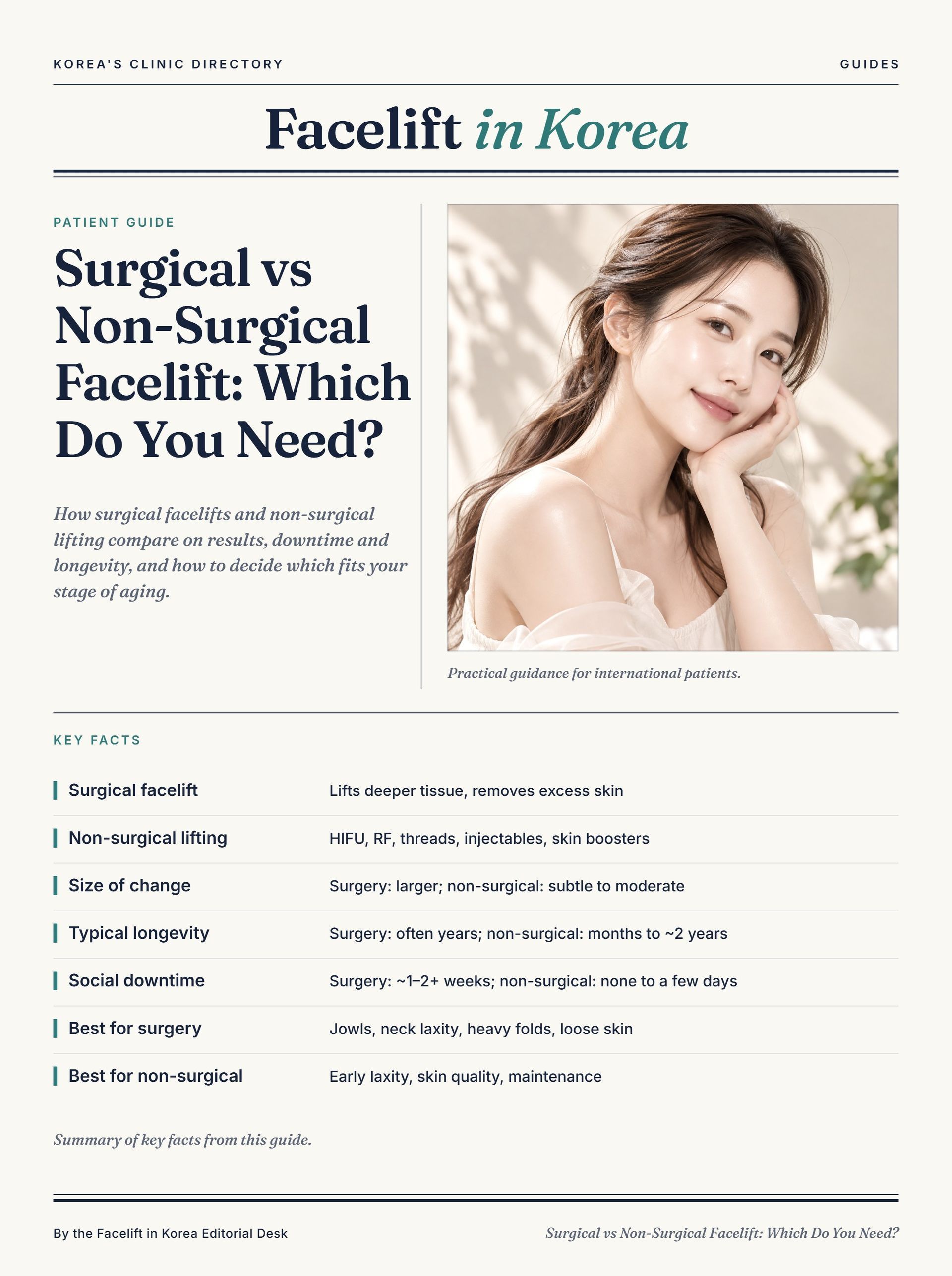
| Surgical facelift | Lifts deeper tissue, removes excess skin |
|---|---|
| Non-surgical lifting | HIFU, RF, threads, injectables, skin boosters |
| Size of change | Surgery: larger; non-surgical: subtle to moderate |
| Typical longevity | Surgery: often years; non-surgical: months to ~2 years |
| Social downtime | Surgery: ~1–2+ weeks; non-surgical: none to a few days |
| Best for surgery | Jowls, neck laxity, heavy folds, loose skin |
| Best for non-surgical | Early laxity, skin quality, maintenance |
| Cost guide | Non-surgical cost |
Read next
Reader questions
Frequently asked questions
Is a non-surgical facelift as good as a surgical facelift?
No. Non-surgical treatments give milder, temporary improvement. They can be very useful for early aging, but they cannot match the lift or skin removal of surgery.
How long does a non-surgical facelift last?
Most non-surgical results last from several months to about two years, depending on the treatment. Repeat sessions are usually needed.
At what point do I need a surgical facelift?
When jowls, neck laxity or loose skin are clearly visible and devices no longer give the change you want, surgery is usually more effective. A surgeon can assess this in person.
Are non-surgical lifting treatments in Korea cheaper?
Single sessions are often competitively priced in Korea, but repeated treatments add up over years. Compare the total long-term cost with a one-time surgery.
Can I have HIFU or threads before a facelift?
Often yes, but some surgeons prefer a gap before surgery because some treatments can affect tissue planes. Tell your surgeon about every past treatment.
Next steps
Planning a facelift in Korea?
Compare clinics, check surgeon credentials and estimate your full trip budget before you book a consultation.
Facelift in Korea is an independent information directory. We do not perform procedures, and listings are not endorsements. This page is general information, not medical advice.