


Home › Surgical Facelifts › Midface Lift + Fat Grafting
Surgical Facelifts
Midface Lift with Fat Grafting in Seoul, Korea
By the Facelift in Korea Editorial Desk · Independent · How we report

The short answer
Quick answer: A midface lift with fat grafting repositions sagging cheek tissue and then adds your own purified fat to areas that have lost volume, such as the cheeks, tear troughs and temples. It treats both descent and hollowing in one operation. In Seoul it usually takes 3 to 4 hours, and most international patients stay about 10 to 14 days.
Why combine a midface lift with fat grafting?
The aging midface changes in two ways. First, the cheek fat pad descends. Second, the face loses volume as fat and bone thin out. A lift alone repositions tissue but cannot fully replace lost volume. Fat grafting alone adds volume but cannot lift heavy tissue. Combining the two addresses both problems.
Many surgeons see this pairing as a way to achieve a softer, more youthful contour, rather than a tight or flat look.
How does fat grafting work?
Fat grafting, also called fat transfer, takes fat from another part of your body, usually the abdomen or thighs, using gentle liposuction. The fat is then cleaned and concentrated, often by centrifuge or filtration. Tiny amounts are injected through fine cannulas into the face, layer by layer, so that each droplet can establish a blood supply.
Not all transferred fat survives. Surgeons often say that a portion of the injected fat is reabsorbed over the first few months, and the amount varies between people. Some patients need a second session to fine-tune volume.
Who is a good candidate?
- People with flat or hollow cheeks plus visible cheek descent
- Those with deep tear troughs or a sharp lid-cheek junction (see tear trough hollows)
- Patients with facial volume loss after weight loss or with aging
- People with enough body fat to harvest and a stable weight
Very thin patients may not have enough fat to harvest. People who expect a large weight change soon may see the grafted fat change in size too.
Where is fat usually placed?
Common areas include the cheeks, the tear trough and lid-cheek junction, the temples, the nasolabial folds and sometimes the lips or chin. The surgeon plans the amount and placement based on your face shape and goals. Under-eye fat grafting needs particular care, since lumps can be visible in thin eyelid skin.
How should I prepare for combined lifting and fat grafting?
- Keep your weight stable for a few months before surgery, since grafted fat behaves like fat from where it came.
- Avoid smoking and nicotine, which reduce blood flow and fat survival.
- Stop blood-thinning medicines and supplements only as your doctor advises.
- Bring loose clothing that does not press on the fat donor area.
Let your surgeon know about any past fillers, threads or facial surgery, as these can change the plan.
What is recovery like?
This combination usually causes more swelling than a midface lift alone. The face can look puffy and full for one to three weeks, partly because surgeons sometimes slightly overfill to allow for fat loss. The donor site may feel sore and bruised, similar to liposuction. Most people return to social life at about 2 to 3 weeks. Final results become clear at around 3 to 6 months, when fat survival has settled. Avoid pressing or massaging grafted areas unless your surgeon advises it.
What are the risks?
Risks include the usual midface lift risks, plus fat-specific ones: uneven absorption, lumps or irregularities, overcorrection, cysts or calcification in small areas, and donor-site irregularity. Rare but serious risks include fat entering a blood vessel, which is why careful technique with blunt cannulas is essential. Learn more in facelift risks and complications.
Midface lift with fat grafting in Korea: what international patients should know
Fat grafting is widely used in Seoul, and many clinics offer enhanced versions such as micro-fat, nano-fat or cell-enriched grafts. These variations may improve skin texture or graft handling, but claims about higher survival rates vary, and evidence is still developing. See stem-cell enriched fat grafting for more context.
Ask how fat is processed, how much the surgeon plans to inject in each area and whether a touch-up session is included. Tell the surgeon about any old filler in your face. Plan a longer stay in Seoul because swelling is more noticeable with this combination. For a comparison of approaches, see facelift vs facial fat grafting.
This page is general information, not medical advice. Decisions about surgery should be made with a qualified, board-certified plastic surgeon after an in-person examination.
Key facts
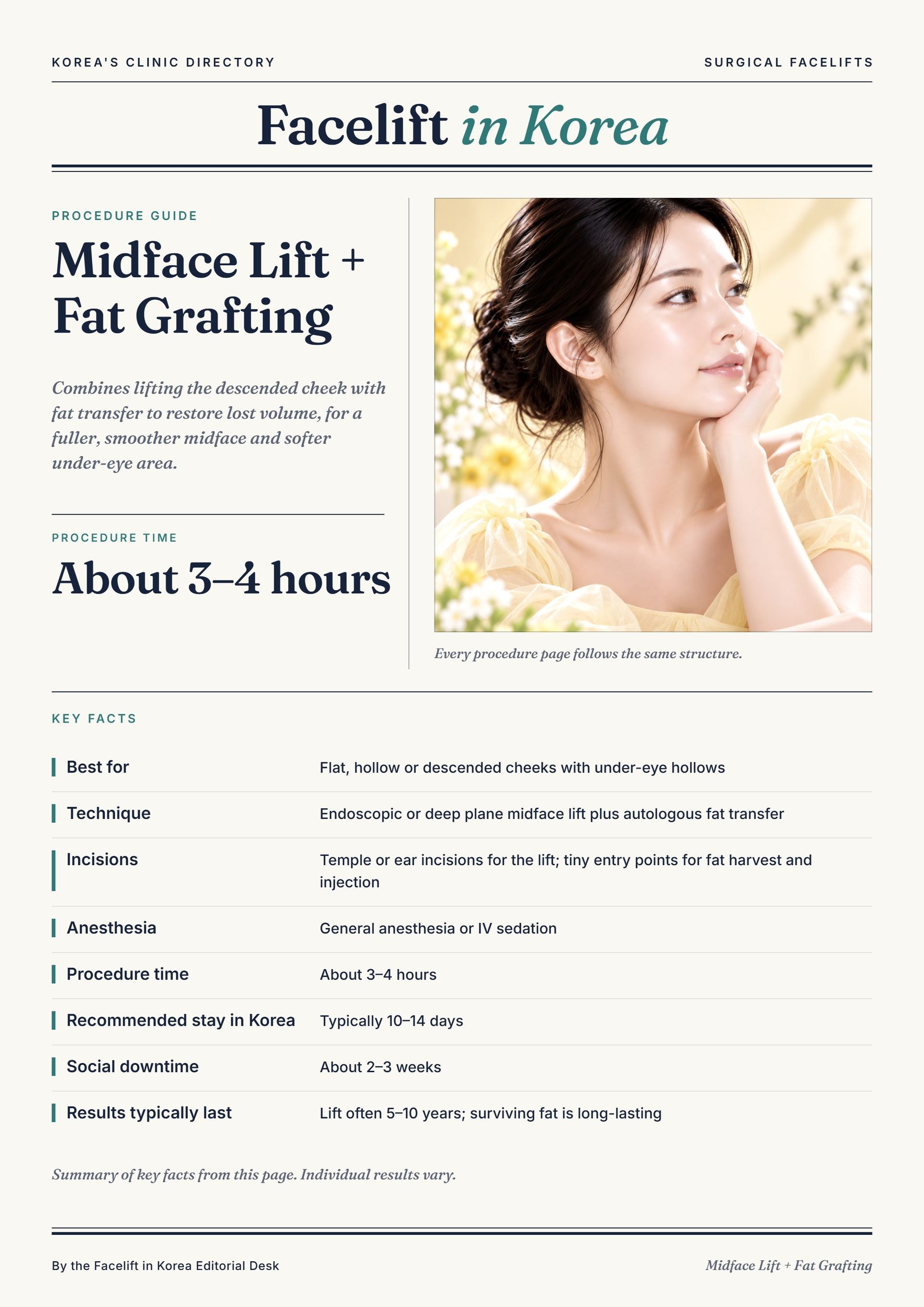
| Best for | Flat, hollow or descended cheeks with under-eye hollows |
|---|---|
| Technique | Endoscopic or deep plane midface lift plus autologous fat transfer |
| Incisions | Temple or ear incisions for the lift; tiny entry points for fat harvest and injection |
| Anesthesia | General anesthesia or IV sedation |
| Procedure time | About 3–4 hours |
| Recommended stay in Korea | Typically 10–14 days |
| Social downtime | About 2–3 weeks |
| Results typically last | Lift often 5–10 years; surviving fat is long-lasting |
| Price guide | Midface lift cost in Korea |
Read next
Reader questions
Frequently asked questions
How much grafted fat survives?
It varies between people and techniques. A portion is usually reabsorbed in the first few months, and some patients need a second session.
Where does the fat come from?
Usually the abdomen, flanks or thighs. The surgeon chooses an area where you have enough fat to spare.
How long does swelling last after midface fat grafting?
Most visible swelling settles within 2 to 3 weeks, but the final shape becomes clear at around 3 to 6 months.
Is fat grafting better than filler?
Fat can last longer and feel natural, but results are less predictable than filler. Fillers are adjustable and need no surgery.
Can fat grafting fix under-eye hollows?
It can soften hollows, but the under-eye area is delicate. Small amounts placed carefully reduce the risk of visible lumps.
Next steps
Planning a facelift in Korea?
Compare clinics, check surgeon credentials and estimate your full trip budget before you book a consultation.
Facelift in Korea is an independent information directory. We do not perform procedures, and listings are not endorsements. This page is general information, not medical advice.