


Home › Surgical Facelifts › Endoscopic Facelift
Surgical Facelifts
Endoscopic Facelift in Seoul, Korea
By the Facelift in Korea Editorial Desk · Independent · How we report
The short answer
Quick answer: An endoscopic facelift uses a thin camera inserted through short incisions in the scalp, temples or mouth to lift the forehead, brows and midface from beneath. It leaves small hidden scars and suits people with early upper and midface sagging but little loose skin. In Seoul it usually takes 2 to 3 hours, and most patients stay about 7 to 10 days.
What is an endoscopic facelift?
An endoscopic facelift is a minimally invasive approach to lifting the upper face and midface. An endoscope is a thin tube with a light and camera at its tip. The surgeon inserts it through short incisions, usually hidden in the scalp and temple hair, and watches a monitor while working beneath the tissues.
Instead of removing a large amount of skin, the surgeon releases the attachments that hold the brow and cheek tissues down, then lifts and fixes them higher. Depending on the plan, dissection can be beneath the periosteum (the thin lining of the bone) or in other deep layers. Because the scars are small and hidden, the approach appeals to younger patients.
Which areas can an endoscopic facelift treat?
- Forehead and brows: lifting low brows and softening frown lines
- Temples and outer eye area: lifting the tail of the brow and eye corners
- Midface: raising the cheek fat pad to soften the lid-cheek junction and the upper part of the nasolabial fold
An endoscopic approach is generally less effective for the jowls and neck, because these areas usually need skin removal. Patients with lower-face sagging often need a separate lower facelift or neck procedure.
Who is a good candidate?
Good candidates are typically in their late 30s to early 50s. They have early descent of the brows or cheeks, good skin elasticity and little excess skin. People with a flat or descended midface or tired-looking eyes often benefit. Older patients with significant skin laxity usually need techniques that remove skin.
What are the advantages and limits?
Advantages commonly described by surgeons include:
- Small scars hidden in the hair
- Less risk of hair loss than a long scalp incision
- A natural, vertical lift that avoids a stretched look
- Can be combined with fat grafting for volume
Limits include a smaller effect on jowls and neck, a learning curve for the surgeon, and swelling of the midface that can take weeks to settle. The brow and cheek may feel tight or look slightly over-lifted at first; this usually relaxes over a few weeks.
What is recovery like?
Swelling is often more noticeable in the cheeks and around the eyes than with skin-based lifts, especially if the midface is lifted. Bruising can track down to the lower eyelids. If an incision inside the mouth is used, you may need a soft diet for several days. Scalp stitches or staples usually come out in 7 to 10 days. Most patients return to social activities at about two weeks, while subtle swelling can last 2 to 3 months. Our facelift recovery timeline gives more detail.
What are the risks?
Risks include temporary nerve weakness in the forehead or cheek, numbness of the scalp or cheek, asymmetry, prolonged swelling, infection and, rarely, hair loss near incisions. In midface lifts, there may be temporary distortion of the lower eyelid or smile. Most of these improve with time, but an experienced surgeon reduces the likelihood.
Endoscopic facelifts in Korea: what international patients should know
Endoscopic forehead and midface lifts are offered by many plastic surgeons in Seoul. Korean patients often have a flatter midface and wider cheekbones. Surgeons may combine an endoscopic midface lift with fat grafting to build projection and soften the cheek transition. The natural Korean facelift aesthetic guide explains this style.
Ask whether the surgeon routinely uses an endoscope, or whether "endoscopic" refers to only part of the procedure. Ask how the lifted tissue is fixed, and what the plan is if your jowls need treating in the future. Plan to stay in Seoul until stitches are removed, and expect your midface to look fuller than usual for a few weeks.
When comparing techniques, the endoscopic vs open brow lift page may also help.
This page is general information, not medical advice. Decisions about surgery should be made with a qualified, board-certified plastic surgeon after an in-person examination.
Key facts
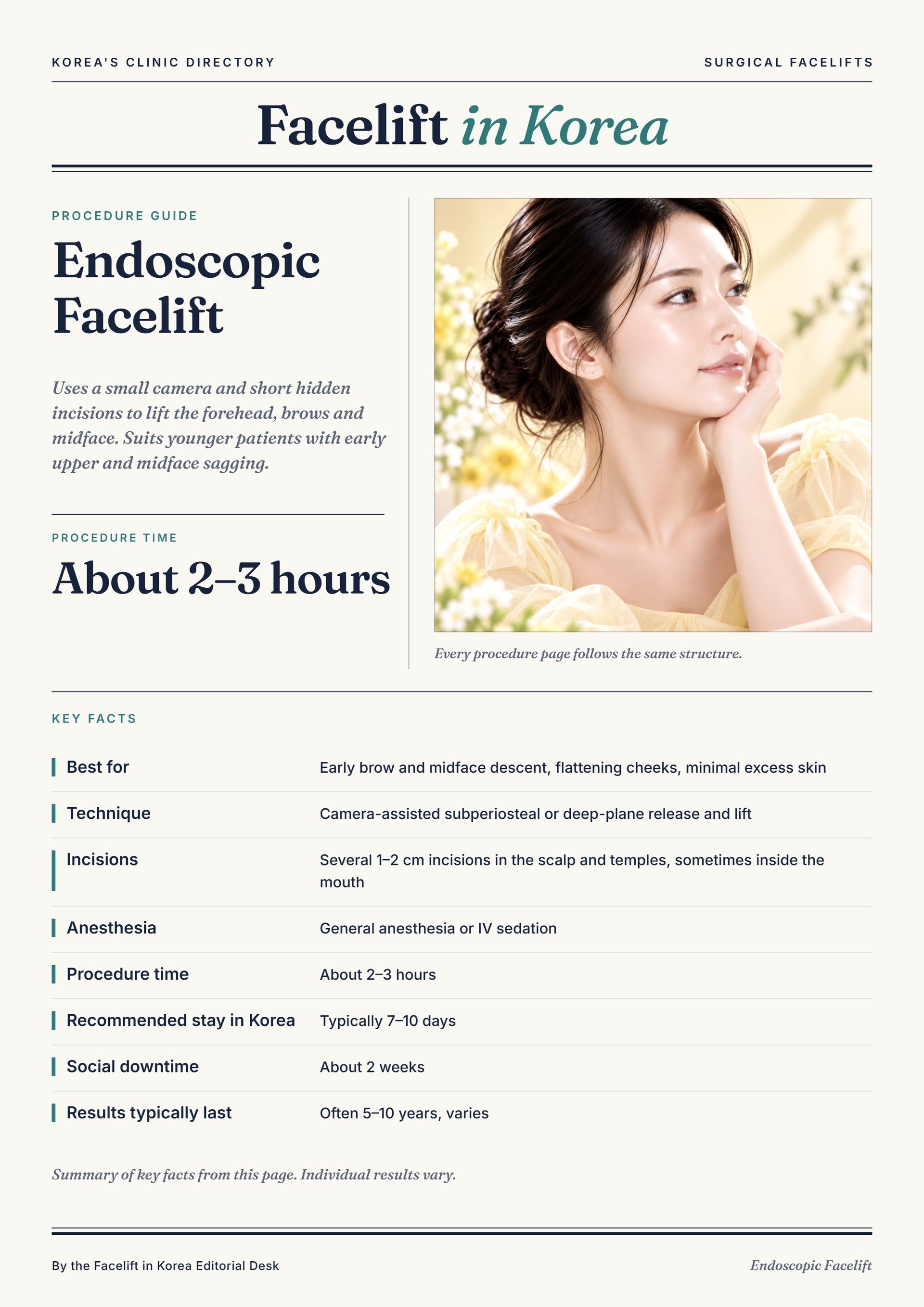
| Best for | Early brow and midface descent, flattening cheeks, minimal excess skin |
|---|---|
| Technique | Camera-assisted subperiosteal or deep-plane release and lift |
| Incisions | Several 1–2 cm incisions in the scalp and temples, sometimes inside the mouth |
| Anesthesia | General anesthesia or IV sedation |
| Procedure time | About 2–3 hours |
| Recommended stay in Korea | Typically 7–10 days |
| Social downtime | About 2 weeks |
| Results typically last | Often 5–10 years, varies |
| Price guide | Midface lift cost in Korea |
Read next
Reader questions
Frequently asked questions
Does an endoscopic facelift leave scars?
It leaves several short scars, usually hidden in the scalp or temple hair. If an incision inside the mouth is used, it leaves no visible scar.
Can an endoscopic facelift fix jowls?
Usually only slightly. Jowls and neck laxity typically need a lower facelift or neck lift that removes skin.
What age is best for an endoscopic facelift?
Many candidates are in their late 30s to early 50s with early sagging and good skin elasticity.
How long does swelling last after an endoscopic midface lift?
Visible swelling often settles in 2 to 3 weeks, while subtle fullness can last 2 to 3 months.
Is an endoscopic facelift the same as a mini facelift?
No. A mini facelift works through incisions near the ear and focuses on the lower face, while an endoscopic lift targets the brow and midface from above.
Next steps
Planning a facelift in Korea?
Compare clinics, check surgeon credentials and estimate your full trip budget before you book a consultation.
Facelift in Korea is an independent information directory. We do not perform procedures, and listings are not endorsements. This page is general information, not medical advice.