


Home › Surgical Facelifts › Lip Lift (Subnasal)
Surgical Facelifts
Lip Lift (Subnasal Lip Lift) in Seoul, Korea
By the Facelift in Korea Editorial Desk · Independent · How we report

The short answer
Quick answer: A subnasal lip lift (often called a bullhorn lip lift) removes a thin strip of skin just under the nose to shorten the distance between the nose and the upper lip. This can restore upper lip shape and a little tooth show that is often lost with age. It is usually done under local anesthesia in about an hour. Plan about 7 days in Korea.
What is a subnasal lip lift?
With age, the upper lip tends to lengthen and thin. The pink part of the lip (the vermilion) rolls inward, the upper teeth show less when the mouth is relaxed, and the area between nose and lip looks longer and flatter. A subnasal lip lift addresses this by removing a narrow strip of skin directly below the nose. When the gap is closed, the upper lip is shortened and gently turned outward.
The incision follows the base of the nose and is often shaped like a gull wing or a bullhorn, which is why it is also called a bullhorn lip lift. Surgeons try to hide the scar in the natural shadow where the nose meets the lip.
Why is a lip lift sometimes combined with a facelift?
A facelift lifts the cheeks, jowls and neck, but it does not change the length of the upper lip. Some people find that after a facelift the mouth area looks older than the rest of the face. A lip lift can restore balance. It can be done at the same time as a facelift or separately. It also pairs well with treatments for lip corner lifting or accordion lines.
Who is a good candidate?
A lip lift may suit people who:
- Have a long distance between the base of the nose and the upper lip
- Show little or no upper teeth when the lips are relaxed
- Have a thin or inward-rolled upper lip
- Prefer a structural change rather than repeated filler injections
It is not usually suitable for people who already have a short upper lip or significant tooth show, as it can create an unnatural "gummy" look. People prone to thick or raised scars need careful discussion.
How does it compare with lip filler?
Filler adds volume and can make the lip look fuller. However, in a long upper lip, filler can make the lip look heavy or push it forward without restoring its shape. A lip lift shortens the lip and changes its position. Many surgeons describe the two as complementary rather than competing: a lift corrects length, and small amounts of filler or fat can then refine volume. The fat grafting vs filler page covers volume options.
What is recovery like?
- Days 1–3: swelling of the upper lip, which may feel stiff; smiling is limited
- Days 5–7: stitches removed
- Weeks 2–4: swelling settles; lip movement feels more natural
- Months 3–12: scar matures, fading from pink to pale
Eating soft food and avoiding wide mouth opening for the first week helps. Scar care is central to a good result. Silicone gel, sun protection and, in some cases, laser or other treatments may be used. The scar care guide applies equally to lip lift scars.
What are the risks?
The most common concern is the scar. Most fade well, but some people develop redness, widening or thickening, which may need treatment. Other risks include asymmetry, over-shortening, changes in the shape of the nostril base, numbness and, rarely, a need for revision. A careful surgeon will measure precisely and remove conservatively.
Lip lifts in Seoul: what international patients should know
Lip lifts have become more visible in Seoul over the past several years, both among younger patients seeking a shorter philtrum and among older patients as part of facial rejuvenation. Some practical points:
- Purpose matters. A lip lift for aging aims to restore what was lost. Ask the surgeon to explain how much will be removed and why.
- Scar tendency. If you have a history of raised scars, tell the surgeon. Many Korean clinics have in-house laser and scar programs; ask whether follow-up treatment is included.
- Short trip. About 7 days in Korea is usually enough, as stitches come out around day 5–7.
- Combining procedures. If you plan a facelift too, ask whether doing both together makes sense for your recovery and goals.
This page is general information, not medical advice. Decisions about surgery should be made with a qualified, board-certified plastic surgeon after an in-person examination.
Key facts
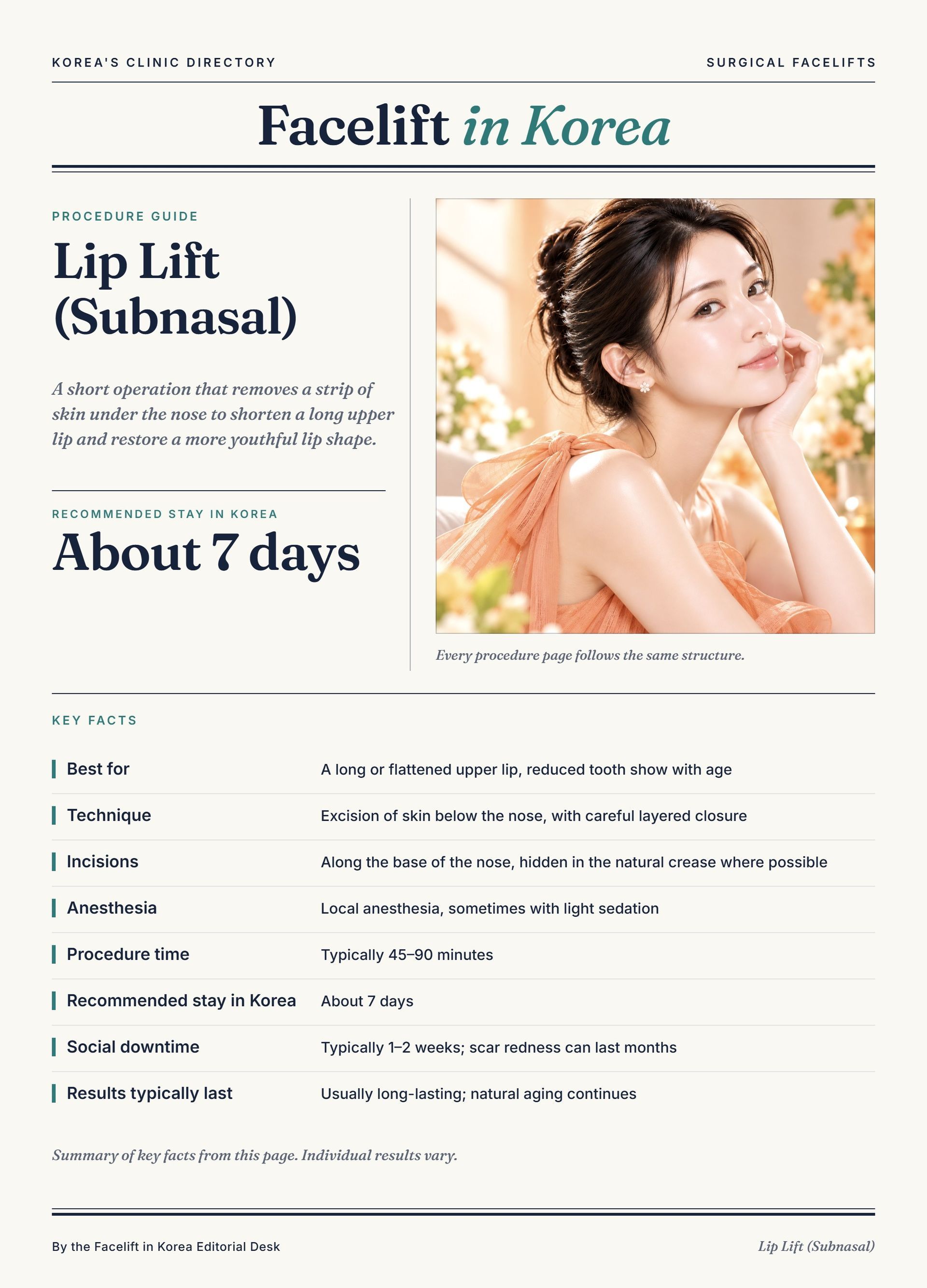
| Best for | A long or flattened upper lip, reduced tooth show with age |
|---|---|
| Technique | Excision of skin below the nose, with careful layered closure |
| Incisions | Along the base of the nose, hidden in the natural crease where possible |
| Anesthesia | Local anesthesia, sometimes with light sedation |
| Procedure time | Typically 45–90 minutes |
| Recommended stay in Korea | About 7 days |
| Social downtime | Typically 1–2 weeks; scar redness can last months |
| Results typically last | Usually long-lasting; natural aging continues |
| Price guide | Facelift cost in Korea overview |
Read next
Reader questions
Frequently asked questions
Will a lip lift leave a visible scar?
There is always a scar, but it is placed along the base of the nose where it is usually hard to see once healed. It may look pink for several months before fading.
How long does a lip lift last?
The shortening is usually long-lasting. The face continues to age, so subtle changes may appear over many years.
Can a lip lift be done with a facelift?
Yes. Many surgeons combine them because a facelift does not shorten the upper lip. Combining can save time but adds a little to swelling and recovery.
Is a lip lift better than lip filler?
They do different things. A lip lift shortens the lip and turns it outward, while filler adds volume. Some people benefit from both.
How long should I stay in Korea after a lip lift?
About 7 days is usually enough for stitch removal and a check. Scar care continues at home.
Next steps
Planning a facelift in Korea?
Compare clinics, check surgeon credentials and estimate your full trip budget before you book a consultation.
Facelift in Korea is an independent information directory. We do not perform procedures, and listings are not endorsements. This page is general information, not medical advice.