


Home › Surgical Facelifts › S-Lift
Surgical Facelifts
S-Lift (Short Scar Lift) in Seoul, Korea
By the Facelift in Korea Editorial Desk · Independent · How we report
The short answer
Quick answer: An S-lift is a short-scar facelift that uses an S-shaped incision in front of the ear to lift the lower face and jowls, usually with some SMAS tightening. It suits people with early to moderate sagging and little neck laxity. In Seoul it is often done under local anesthesia with sedation, and about 7–10 days in Korea is usually enough.
What is an S-lift?
The S-lift is a type of short-scar facelift. Its name comes from the S-shaped incision placed in front of the ear. Compared with a traditional facelift, the incision is shorter and usually does not continue far behind the ear. Through this opening, the surgeon tightens the SMAS layer, often by folding it with stitches (plication) or suspending it with strong sutures, then trims a small amount of skin.
The S-lift belongs to the same family as the mini facelift, the short-scar facelift and the MACS facelift. The names overlap a great deal, and different clinics use them in different ways.
Who is a good candidate?
An S-lift is usually considered for people who:
- Have early jowls and a softening jawline
- Have mild to moderate laxity in the lower cheeks
- Have little loose skin or banding in the neck
- Want a shorter recovery and smaller scars
It is less suitable for people with heavy neck laxity, significant midface descent or a lot of excess skin. In those cases, a short incision often cannot remove enough skin, and the result may be limited or relax sooner. The mini facelift vs full facelift comparison is a helpful way to check where you fit.
How is an S-lift performed?
Techniques vary by surgeon, but the steps are typically:
- Local anesthetic is injected, usually with sedation
- An S-shaped incision is made in front of the ear
- The skin is lifted over a limited area of the cheek
- The SMAS is tightened by plication or purse-string sutures
- Excess skin is trimmed and the incision closed
Because the dissection is limited, the operation is shorter and swelling is usually less than with a full facelift. Some surgeons add small-volume fat grafting or neck liposuction during the same session to round out the result. These additions are worth discussing, but each one extends recovery slightly. If you are comparing an S-lift with a thread lift, remember that threads give a temporary lift lasting months, while a surgical short-scar lift usually lasts years. The facelift vs thread lift page sets out the differences.
S-lift vs MACS lift: what is the difference?
Both are short-scar lifts. The MACS lift is a specific technique that uses purse-string sutures anchored near the temple to lift tissue in a vertical direction. An S-lift is a broader term for a short S-shaped incision approach, which may use plication, suspension or a small SMAS flap. The MACS vs short-scar facelift page compares them in more detail.
What is recovery like?
- Days 1–3: mild to moderate swelling, light dressing or compression band
- Days 5–7: stitches typically removed
- Days 7–14: bruising fades and most people return to light activities
- Weeks 4–8: residual swelling resolves
Many people feel comfortable in public with light makeup after 10–14 days. Avoid heavy exercise for about 3–4 weeks. See swelling and bruising after a facelift for tips.
What are the limitations and risks?
The main limitation is that a short incision can only address so much. Results are usually more modest and may not last as long as a full SMAS or deep plane facelift. Risks are similar to other facelifts but generally lower in scale: bruising, hematoma, infection, visible scarring, small irregularities and temporary numbness. Small puckers in front of the ear may occur early and usually settle.
S-lifts in Seoul: what international patients should know
Short-scar lifts are popular in Seoul with patients in their 40s and early 50s who want a refresh without a long recovery. They are often marketed alongside non-surgical treatments as a "step up" from threads or HIFU. Things to keep in mind:
- Ask what the name means. "S-lift," "mini lift" and "short-scar lift" may describe slightly different procedures at different clinics.
- Confirm SMAS work. Ask whether the SMAS will be tightened. A skin-only short lift tends to relax quickly.
- Short trips are possible. About 7–10 days is often enough, but keep one or two buffer days.
- Scar placement. Ask how the incision will follow the natural curve of your ear, especially if your hair is short.
This page is general information, not medical advice. Decisions about surgery should be made with a qualified, board-certified plastic surgeon after an in-person examination.
Key facts
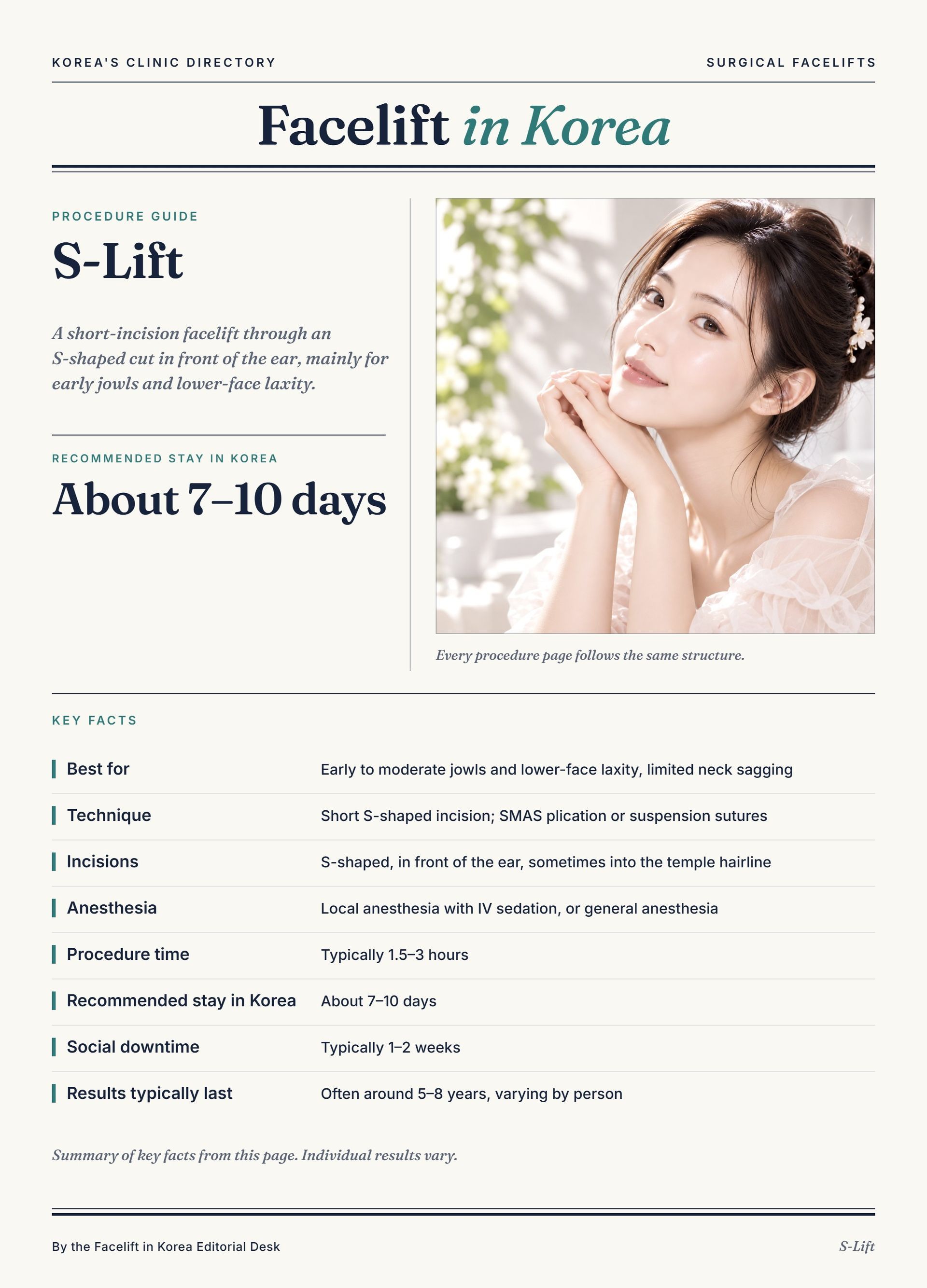
| Best for | Early to moderate jowls and lower-face laxity, limited neck sagging |
|---|---|
| Technique | Short S-shaped incision; SMAS plication or suspension sutures |
| Incisions | S-shaped, in front of the ear, sometimes into the temple hairline |
| Anesthesia | Local anesthesia with IV sedation, or general anesthesia |
| Procedure time | Typically 1.5–3 hours |
| Recommended stay in Korea | About 7–10 days |
| Social downtime | Typically 1–2 weeks |
| Results typically last | Often around 5–8 years, varying by person |
| Price guide | Mini facelift cost in Korea |
Read next
Reader questions
Frequently asked questions
What does S-lift stand for?
The name refers to the S-shaped incision in front of the ear. It is a short-scar facelift rather than a brand or patented technique.
How long does an S-lift last?
Results often last around 5–8 years, depending on skin quality, age and lifestyle. They are usually less durable than a full deep-layer facelift.
Is an S-lift the same as a mini facelift?
They are closely related and the terms are often used interchangeably. Ask each clinic exactly which layers are lifted and how long the incision is.
Does an S-lift tighten the neck?
Only to a limited degree. People with significant neck laxity usually need a neck lift or a fuller facelift.
How long should I stay in Korea for an S-lift?
About 7–10 days is usually enough for stitch removal and an early check.
Next steps
Planning a facelift in Korea?
Compare clinics, check surgeon credentials and estimate your full trip budget before you book a consultation.
Facelift in Korea is an independent information directory. We do not perform procedures, and listings are not endorsements. This page is general information, not medical advice.