


Home › Surgical Facelifts › Facial Fat Transfer
Surgical Facelifts
Facial Fat Transfer in Seoul, Korea
By the Facelift in Korea Editorial Desk · Independent · How we report

The short answer
Quick answer: Facial fat transfer takes a small amount of your own fat by gentle liposuction, purifies it and injects it into areas of the face that have lost volume, such as the cheeks, temples, under-eyes and nasolabial folds. Part of the fat is reabsorbed, but surviving fat is long-lasting. In Seoul it takes about 1 to 2 hours, with a stay of around 5 to 7 days.
What is facial fat transfer?
Facial fat transfer, also called fat grafting or autologous fat injection, uses your own body fat as a natural filler. The surgeon removes fat from an area such as the abdomen, flanks or inner thighs through a thin cannula. The fat is then cleaned and concentrated to separate healthy fat cells from oil, blood and fluid. Finally, it is injected in tiny amounts into the face.
Because fat is your own tissue, there is no risk of allergy to the material. Once grafted fat establishes a blood supply, it becomes living tissue and can last for many years. See the fat grafting glossary entry for a short definition.
Which areas can fat transfer treat?
- Cheeks: to restore a rounded, youthful contour (see hollow cheeks)
- Temples: to soften hollowing that makes the face look gaunt
- Under-eyes: to blend the lid-cheek junction and reduce dark shadows
- Nasolabial folds and marionette lines: to soften deep creases
- Forehead, chin and jawline: to improve contour
- Lips: for subtle fullness, though results are less predictable here
Who is a good candidate?
Good candidates have visible facial volume loss from aging, weight loss or genetics. They should be in good health, have enough spare fat to harvest and keep a stable weight. Fat transfer suits people who want a natural, longer-lasting alternative to repeated fillers. It does not lift sagging skin. If you have significant jowls or loose skin, a lift is usually needed alongside it.
Fat transfer or filler: which is better?
Both restore volume, but they behave differently:
- Fat: natural tissue, potentially long-lasting, useful for large areas, but requires surgery and has less predictable survival.
- Hyaluronic acid filler: precise, adjustable and reversible, with little downtime, but temporary and may need regular top-ups.
Many people use filler for small areas and fat for broader volume. The fat grafting vs filler comparison explains the trade-offs in more depth.
How much fat survives?
This is the most common question. A portion of transferred fat is reabsorbed by the body in the first few months. The amount varies with technique, the area treated, blood supply, smoking and individual healing. Areas with more movement, such as the lips, tend to keep less fat. For this reason, some patients need a second, smaller session after about three to six months.
What is recovery like?
The face is usually swollen for one to two weeks. Surgeons may slightly overfill to account for fat loss, so early fullness is normal. Bruising may appear on the face and at the donor site. Avoid pressing on grafted areas, sleeping face-down or using strong facial massage until your surgeon approves. Most people return to normal activities within one to two weeks, and the final result is usually visible at around three to six months.
What are the risks?
Risks include uneven results, lumps, overcorrection, undercorrection, cysts, small areas of calcification and donor-site irregularity. Fat in the under-eye area can sometimes form visible bumps in thin skin. A rare but serious risk is fat entering a blood vessel, which can affect blood flow to the skin or, very rarely, the eye. Experienced surgeons use blunt cannulas and inject small amounts slowly to reduce this risk. Read facelift risks and complications for wider context.
Facial fat transfer in Korea: what international patients should know
Fat grafting is very popular in Seoul, both alone and combined with facelifts. Many clinics market special processing methods, such as micro-fat, nano-fat, or fat enriched with stromal vascular fraction (SVF). Some of these may help in specific situations, but marketing claims about fat survival are not always backed by strong evidence. Treat high survival percentages quoted in advertisements with caution.
Ask the surgeon where fat will be taken from, how it will be processed, how many milliliters will be placed in each area and whether a touch-up is included in the price. Mention any previous filler, as old filler may need to be dissolved first. Bring photos of yourself when younger, which can help guide natural placement.
This page is general information, not medical advice. Decisions about surgery should be made with a qualified, board-certified plastic surgeon after an in-person examination.
Key facts
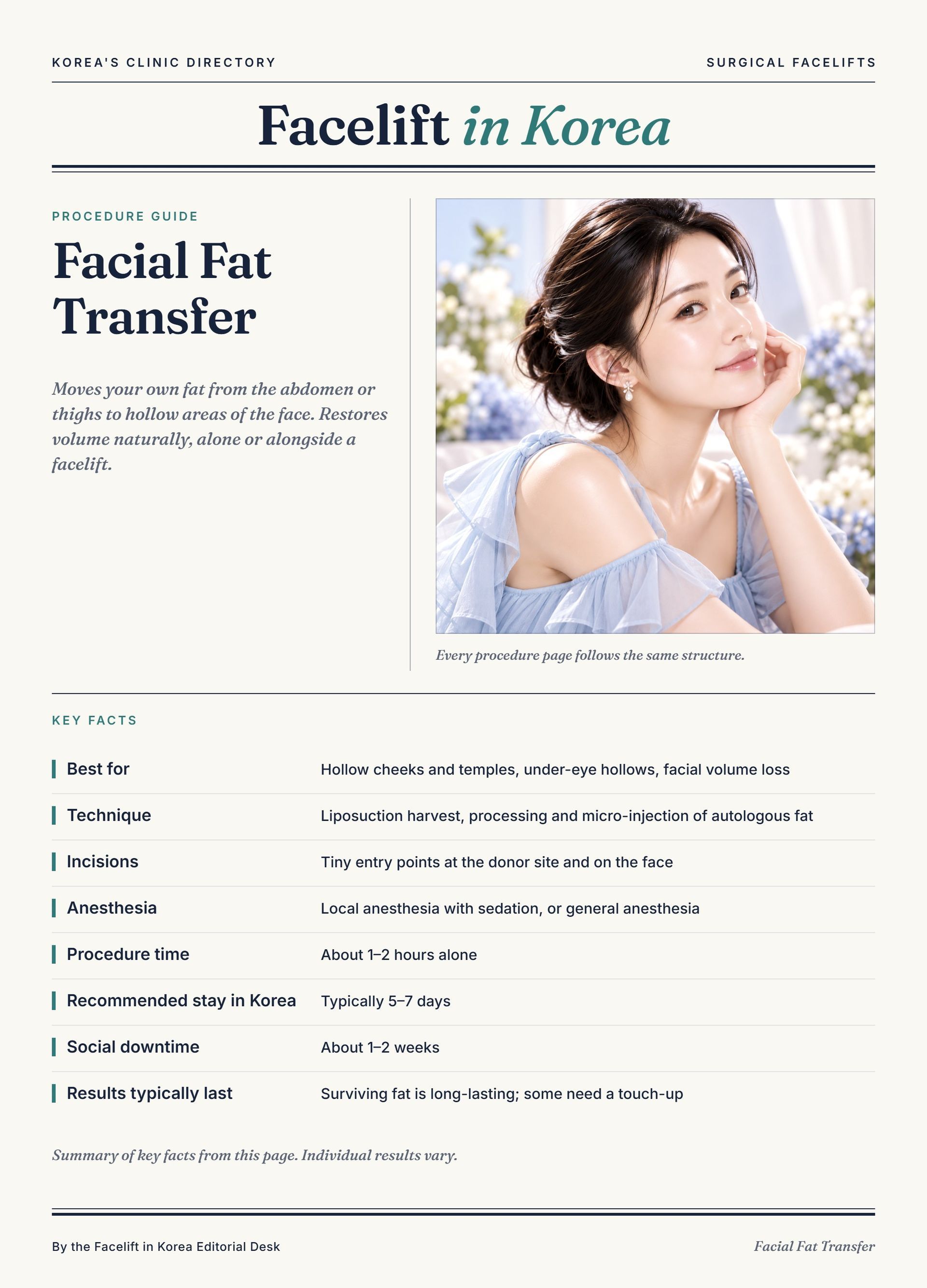
| Best for | Hollow cheeks and temples, under-eye hollows, facial volume loss |
|---|---|
| Technique | Liposuction harvest, processing and micro-injection of autologous fat |
| Incisions | Tiny entry points at the donor site and on the face |
| Anesthesia | Local anesthesia with sedation, or general anesthesia |
| Procedure time | About 1–2 hours alone |
| Recommended stay in Korea | Typically 5–7 days |
| Social downtime | About 1–2 weeks |
| Results typically last | Surviving fat is long-lasting; some need a touch-up |
| Price guide | Facial fat grafting cost in Korea |
Read next
Reader questions
Frequently asked questions
How long does facial fat transfer last?
Fat that survives the first few months usually remains long-term, aging naturally with your face. Some patients need a touch-up to reach their goal.
Where is fat taken from for facial grafting?
Usually the abdomen, flanks or inner thighs. The surgeon chooses an area with enough spare fat.
Is fat transfer safer than filler?
Both have risks. Fat avoids foreign material, but involves surgery and liposuction. Filler is less invasive but temporary.
Can fat transfer fix dark circles under the eyes?
It can soften shadows caused by hollowness. Pigmentation-related dark circles will not improve with fat.
Will gaining or losing weight affect my fat grafts?
Yes. Grafted fat can grow or shrink with significant weight changes, so a stable weight helps maintain results.
Next steps
Planning a facelift in Korea?
Compare clinics, check surgeon credentials and estimate your full trip budget before you book a consultation.
Facelift in Korea is an independent information directory. We do not perform procedures, and listings are not endorsements. This page is general information, not medical advice.