


Home › Surgical Facelifts › Facelift + Chin Implant
Surgical Facelifts
Facelift with Chin Implant in Seoul, Korea
By the Facelift in Korea Editorial Desk · Independent · How we report

The short answer
Quick answer: A facelift combined with a chin implant pairs lifting of the jowls and neck with added chin projection. A small or retruded chin can limit how defined the jawline and neck look after a facelift, so some surgeons add an implant, usually silicone or porous polyethylene, placed through a small incision under the chin. Plan about 10–14 days in Korea.
Why add a chin implant to a facelift?
The chin is the front anchor of the jawline. When the chin is small or set back, the jaw-to-neck line tends to look short and soft, even in younger people. With age, jowls and neck laxity make this worse. A facelift can lift the jowls and tighten the neck, but it cannot add bone projection. In people with a weak chin, the result may still look less defined than expected.
Adding a chin implant can lengthen the jawline visually, sharpen the angle between the chin and neck, and help the lifted skin drape more smoothly. Surgeons often describe it as completing the frame of the lower face.
Who is a good candidate?
The combination is generally considered for people who have:
- Jowls, neck laxity or both, suitable for a facelift
- A chin that sits behind an imaginary vertical line from the lower lip in profile
- Normal bite (occlusion), or a bite problem that is not being corrected
- Good general health
People with significant bite problems may need orthodontic or jaw surgery assessment instead. If your concern is mainly a prejowl sulcus(the dip beside the chin), an extended chin implant or volume treatment may address it directly. A witch's chin calls for a different approach.
What types of chin augmentation are used?
- Silicone implants: smooth, solid implants available in many shapes and sizes. Widely used and removable if needed.
- Porous polyethylene implants: allow tissue to grow into them, which helps stability but makes removal harder.
- Sliding genioplasty: the chin bone is cut and moved forward. Used for larger changes or vertical adjustments, but a bigger operation.
- Fat grafting or filler: softer, less predictable projection; filler is temporary.
The fat grafting vs filler page explains non-implant volume options.
How is the combined procedure done?
Most commonly, the surgeon performs the facelift and neck work first. The chin implant is placed through a small incision under the chin, which may already be used for neck tightening, or through an incision inside the lower lip. The implant sits on the bone in a precise pocket and is secured so it does not shift. Some surgeons also release the tissue around the prejowl area so the implant and lift blend smoothly.
What is recovery like?
Recovery follows the facelift timeline, with some added tightness around the chin:
- Swelling and numbness of the chin and lower lip are common for several weeks
- A chin dressing or tape may be worn for a few days
- Stitches are removed around days 5–10
- Most people feel comfortable socially at two to three weeks
If the implant was placed through the mouth, oral hygiene and soft food matter in the first week. The facelift recovery timeline gives a wider view.
What are the risks?
Implant-specific risks include infection, shifting, asymmetry, temporary or, rarely, lasting numbness of the lower lip and chin, and gradual bone erosion beneath the implant over many years. Most problems are uncommon and treatable, but some require removal or replacement. These risks add to the usual facelift risks.
Facelift with chin implant in Seoul: what international patients should know
Korean facial surgery has deep experience with chin and jaw procedures, partly because chin augmentation and contouring are popular among younger patients. That experience can be helpful for facelift patients. A few points to consider:
- Different goals by age. Some chin shapes popular with younger Korean patients are slimmer and more pointed. For a facelift patient, the aim is usually support and balance. Make your preferred shape clear.
- Implant details in writing. Ask for the implant material and size, and keep a record for future doctors.
- Bring dental information. If you have had orthodontic work or have bite issues, share it in advance.
- Allow enough time. Plan about 10–14 days in Korea.
This page is general information, not medical advice. Decisions about surgery should be made with a qualified, board-certified plastic surgeon after an in-person examination.
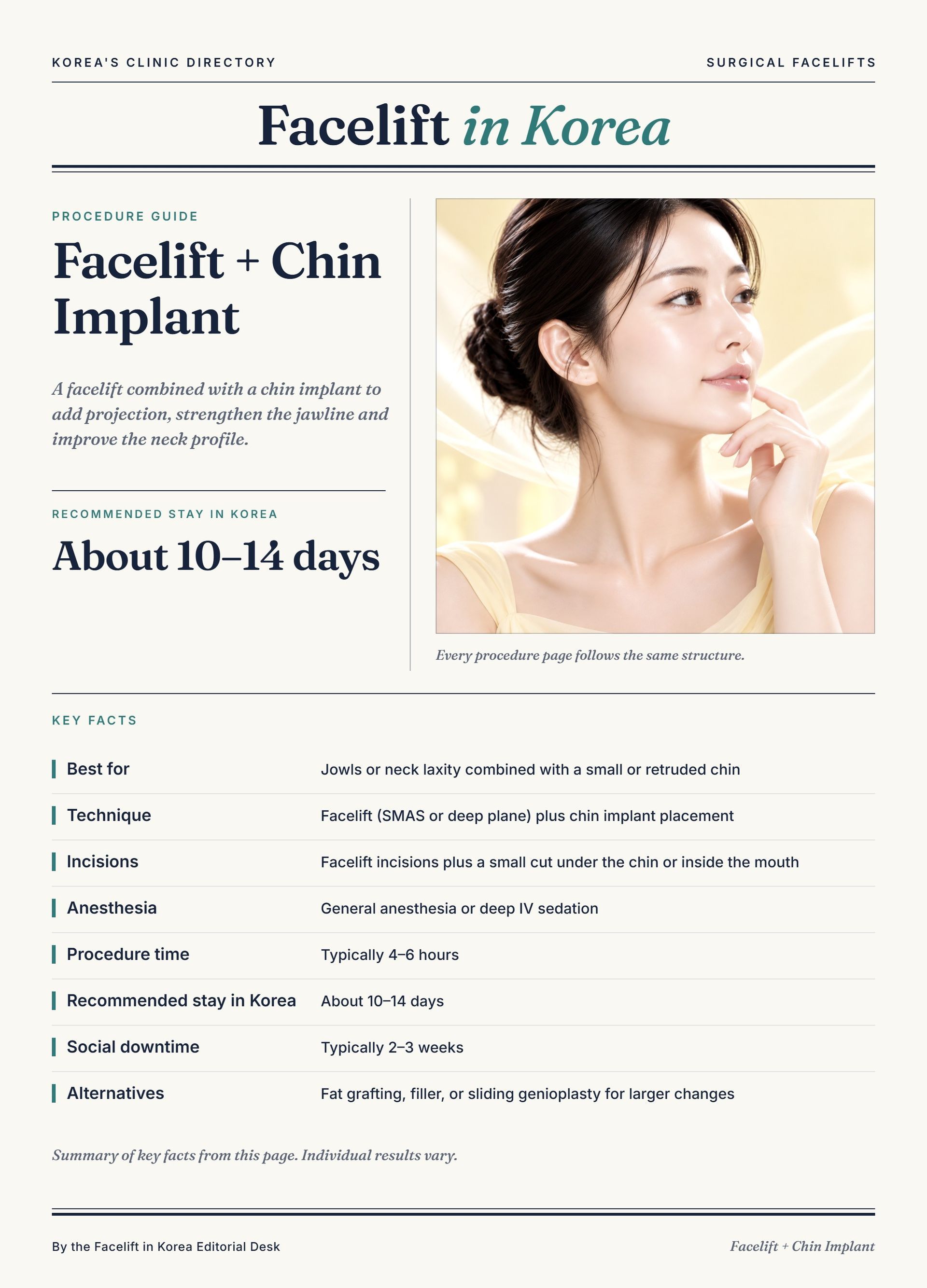
Key facts
| Best for | Jowls or neck laxity combined with a small or retruded chin |
|---|---|
| Technique | Facelift (SMAS or deep plane) plus chin implant placement |
| Incisions | Facelift incisions plus a small cut under the chin or inside the mouth |
| Anesthesia | General anesthesia or deep IV sedation |
| Procedure time | Typically 4–6 hours |
| Recommended stay in Korea | About 10–14 days |
| Social downtime | Typically 2–3 weeks |
| Alternatives | Fat grafting, filler, or sliding genioplasty for larger changes |
| Price guide | Facelift cost in Korea overview |
Read next
Reader questions
Frequently asked questions
Why would a surgeon suggest a chin implant with a facelift?
A small or set-back chin limits how defined the jawline and neck can look after a facelift. An implant adds projection so the lower face appears more balanced.
Is a chin implant permanent?
Implants are designed to stay long-term but can be removed or replaced if needed. Silicone implants are generally easier to remove than porous types.
Can fat be used instead of a chin implant?
Yes, for small changes. Fat grafting gives softer projection, but some of the fat may not survive, so results are less predictable.
Does a chin implant change my bite?
No. It sits on the outside of the chin bone and does not affect the teeth or bite. Bite problems need separate assessment.
How long should I stay in Korea for a facelift with chin implant?
Most clinics advise about 10–14 days for stitch removal and checks before flying.
Next steps
Planning a facelift in Korea?
Compare clinics, check surgeon credentials and estimate your full trip budget before you book a consultation.
Facelift in Korea is an independent information directory. We do not perform procedures, and listings are not endorsements. This page is general information, not medical advice.