


Home › Surgical Facelifts › Temporal Lift
Surgical Facelifts
Temporal Lift in Seoul, Korea
By the Facelift in Korea Editorial Desk · Independent · How we report

The short answer
Quick answer: A temporal lift raises the outer brow, the outer corner of the eye and the upper cheek through short incisions hidden in the temple hairline. It suits people with early sagging around the eyes and upper cheeks who do not need a full facelift. In Seoul it usually takes about 1 to 1.5 hours, and most international patients stay around 7 days.
What is a temporal lift?
A temporal lift, sometimes called a temple lift, is a surgical procedure performed through incisions in the temple hairline above and in front of the ears. The surgeon releases and lifts tissue at the side of the forehead, the outer brow and the area beside the eye. In some versions, the lift extends down toward the top of the cheek. The tissue is secured to the deep temporal fascia, a firm layer over the temple muscle.
The result is a gentle upward and outward lift of the outer eye area. Many patients describe it as making them look less tired.
Who is a good candidate for a temporal lift?
- People with drooping outer brows or downturned outer eye corners
- Those with crow's feet area laxity and early upper-cheek descent
- Patients in their late 30s to 50s with mild to moderate sagging
- People who want to avoid a full brow lift or facelift
A temporal lift does not treat jowls, the neck or deep nasolabial folds. If these are concerns, a facelift may be needed as well. Our temple lift concern page explains when this area alone is the right focus.
How does it compare with a lateral brow lift?
Both use temple incisions. A lateral brow lift concentrates on the brow tail and eyelid hooding. A temporal lift usually treats a wider zone, including the eye corner and sometimes the upper cheek. In practice, clinics define the procedures differently, so ask which areas will move and in which direction.
What does the procedure involve?
After local anesthesia and sedation, the surgeon makes an incision of a few centimeters on each side within the temple hair. The tissues above the temporal fascia are released down toward the outer brow and eye corner, sometimes with the help of an endoscope. The lifted tissue is anchored with stitches. A small strip of scalp may be removed, and the incision is closed. The procedure is often performed alongside eyelid surgery, a midface lift or fat grafting.
Temporal lift or thread lift?
Thread lifts are also used to lift the temple and outer eye area, without incisions. They offer less downtime but usually produce a smaller and shorter-lived change, often lasting months rather than years. A temporal lift gives a more durable result because tissue is released and fixed. For a broader view, see facelift vs thread lift.
What is recovery like?
Swelling and bruising often travel down to the eyelids and cheeks in the first few days. Tightness at the temples and slight discomfort when chewing are common early on, as the temple muscle is involved in jaw movement. Stitches or staples are typically removed around days 7 to 10. Most people return to normal social life within about 7 to 10 days. Avoid heavy exercise for a few weeks.
What are the risks?
Risks include asymmetry, hair loss or a widened scar at the incision, numbness at the temples, temporary weakness when raising the brows, infection and hematoma. The frontal branch of the facial nerve runs through the temple region, so experience with temple anatomy is important. Most nerve-related weakness is temporary.
Temporal lifts in Korea: what international patients should know
Temporal lifts are a common procedure in Seoul, often offered as a lighter alternative to a brow lift or facelift. Some clinics combine them with fat grafting to hollow temples, which can give a softer, fuller upper face. This combination is popular in Korea, where a smooth temple-to-cheek contour is often seen as youthful. Learn more on our facial fat transfer page.
Ask the surgeon how much lift is planned and how they will avoid a pulled or "cat-eye" appearance. If you often wear your hair pulled back, discuss incision placement. Plan to stay in Seoul until stitches are removed, and allow a few extra days if other procedures are combined.
This page is general information, not medical advice. Decisions about surgery should be made with a qualified, board-certified plastic surgeon after an in-person examination.
Key facts
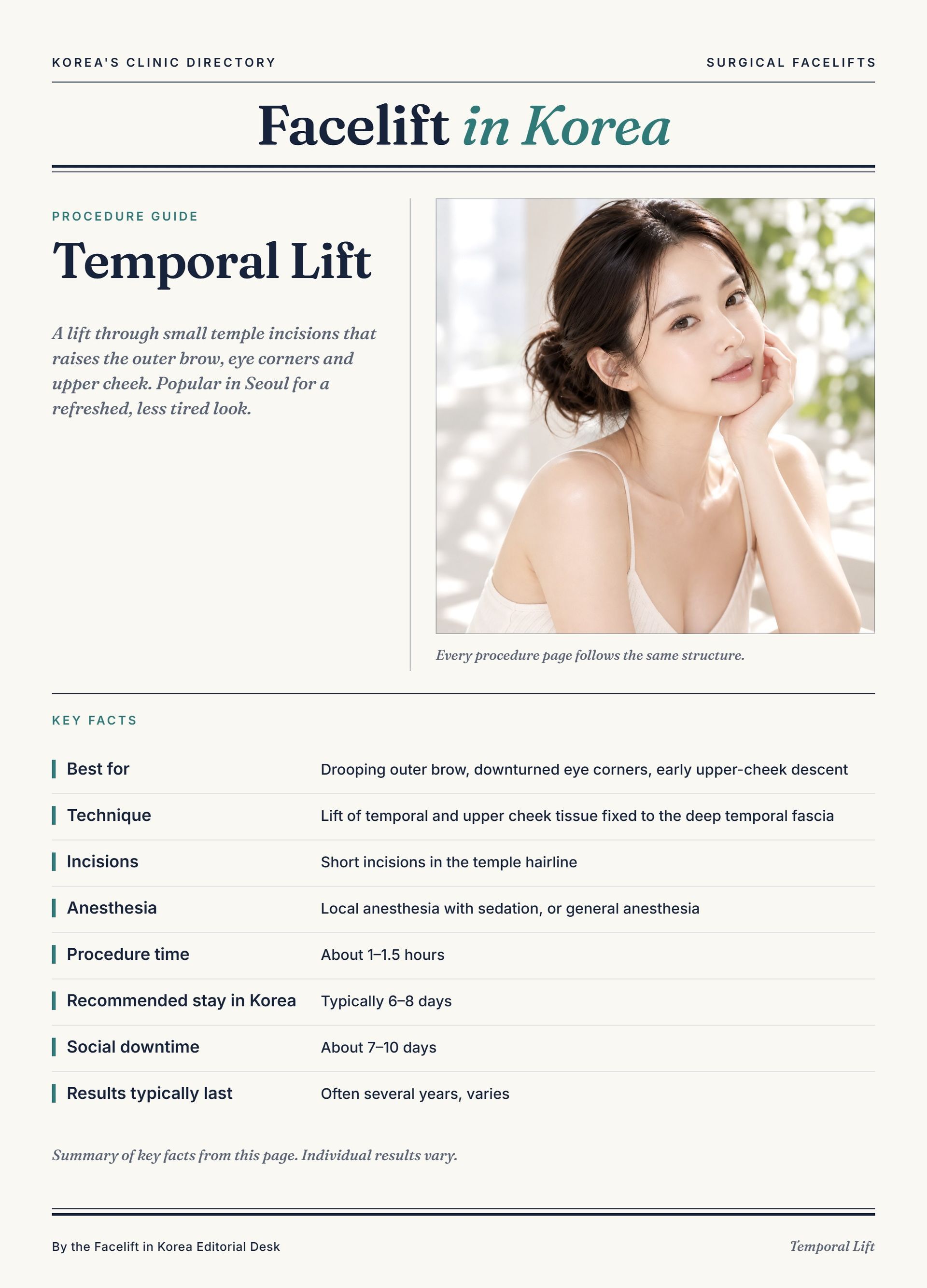
| Best for | Drooping outer brow, downturned eye corners, early upper-cheek descent |
|---|---|
| Technique | Lift of temporal and upper cheek tissue fixed to the deep temporal fascia |
| Incisions | Short incisions in the temple hairline |
| Anesthesia | Local anesthesia with sedation, or general anesthesia |
| Procedure time | About 1–1.5 hours |
| Recommended stay in Korea | Typically 6–8 days |
| Social downtime | About 7–10 days |
| Results typically last | Often several years, varies |
| Price guide | Brow lift cost in Korea |
Read next
Reader questions
Frequently asked questions
What does a temporal lift fix?
It lifts the outer brow, the outer corner of the eye and sometimes the upper cheek. It can reduce a tired look caused by sagging around the eyes.
Is a temporal lift the same as a temple lift?
Yes, the terms are often used for the same procedure. Some clinics use slightly different definitions, so ask exactly which areas are lifted.
Can a temporal lift cause a cat-eye look?
Over-lifting in the wrong direction can create a pulled outer eye. A conservative plan and careful direction of lift help avoid this.
Will I have scars after a temporal lift?
The incisions are short and hidden within the temple hair. Most people find them difficult to see once healed.
How long does a temporal lift last?
Results commonly last several years. Like all lifts, it does not stop aging, so changes continue gradually.
Next steps
Planning a facelift in Korea?
Compare clinics, check surgeon credentials and estimate your full trip budget before you book a consultation.
Facelift in Korea is an independent information directory. We do not perform procedures, and listings are not endorsements. This page is general information, not medical advice.