


Home › Surgical Facelifts › Revision (Secondary) Facelift
Surgical Facelifts
Revision Facelift (Secondary Facelift) in Seoul, Korea
By the Facelift in Korea Editorial Desk · Independent · How we report
The short answer
Quick answer: A revision (secondary) facelift is surgery on a face that has already had a facelift. It is done either to correct problems, such as a pulled look, visible scars or distorted earlobes, or to refresh results that have faded. It is usually more complex than a first facelift because of scar tissue and changed anatomy, so surgeon experience is essential. Plan about 2 weeks in Korea.
What is a revision facelift?
A revision facelift, also called a secondary facelift, is any facelift performed on someone who has had one before. There are two broad reasons people seek it:
- Correction. The first surgery left an unwanted result, such as a tight or "windswept" look, visible or widened scars, a shifted hairline or a pulled-down earlobe (sometimes called a "pixie ear").
- Refresh. The first facelift looked good but, after many years, natural aging has returned. This is sometimes called a "tuck-up" or secondary lift.
The two situations are quite different. A refresh after ten years is often similar to a first facelift. A correction a year or two after surgery can be one of the more technically demanding operations in facial plastic surgery.
Why is revision surgery more complex?
After a facelift, the tissue planes heal with scar tissue. The normal layers become harder to separate, blood supply to the skin may be altered, and the position of nerves can be less predictable. The surgeon also has less spare skin to work with. Common challenges include:
- Working through scar tissue without damaging the skin's blood supply
- Correcting skin tension that was placed too heavily on the skin rather than the deeper layers
- Restoring a natural hairline or sideburn position
- Repairing earlobe distortion and moving scars to less visible places
- Replacing volume lost through aging or over-tightening
Many revision surgeons use a deep plane approach so the lift is carried by deeper tissue and the skin can be closed with minimal tension. Volume is often restored with facial fat transfer.
When is the right time for a revision?
Most surgeons advise waiting until the tissues have fully healed. For corrective work this is commonly at least 12 months after the first operation, because swelling and scar tissue continue to change during the first year. Very early revision is usually reserved for urgent problems such as a hematoma or wound breakdown, which the original surgeon should manage.
For a refresh, there is no fixed timeline. Many people consider it 8–15 years after their first facelift. A refresh is often smaller than the original operation, because the deep layers may still be holding well and only the skin and neck have relaxed. In other cases, the surgeon may recommend a full deep lift again. A careful examination of how the earlier work has aged guides this decision.
How do I prepare for a revision consultation?
Good preparation gives the new surgeon the information they need:
- Get your operative report from the first surgery, if possible
- Bring photos from before your first facelift and at stages since
- Note what you liked and disliked about the first result
- List any complications, treatments or injections since
The guide to preparing photos for an online consultation explains which angles help surgeons assess revision cases remotely. Review questions to ask at a consultation, adding specific questions about the surgeon's revision experience.
What are the risks?
Revision carries the same risks as any facelift, including bleeding, infection and nerve injury. Because of scar tissue and reduced blood supply, the risk of skin healing problems can be higher, especially in smokers. Scar outcomes are also less predictable when working through old scars. A careful surgeon will explain what can and cannot realistically be corrected.
Revision facelifts in Seoul: what international patients should know
Seoul has a large number of experienced facial surgeons, and some clinics actively see revision patients, including those who had a first facelift in another country. Some practical considerations:
- Look for revision experience specifically. Ask how many secondary facelifts the surgeon performs and to see examples of revision cases, not just first-time facelifts.
- Be wary of guarantees. A responsible surgeon will not promise to fully erase a previous result.
- Allow extra time. Plan around 14 days in Seoul, and consider a longer stay if scar revision or earlobe repair is included.
- Plan follow-up. Arrange how you will send photos and get advice after returning home.
This page is general information, not medical advice. Decisions about surgery should be made with a qualified, board-certified plastic surgeon after an in-person examination.
Key facts
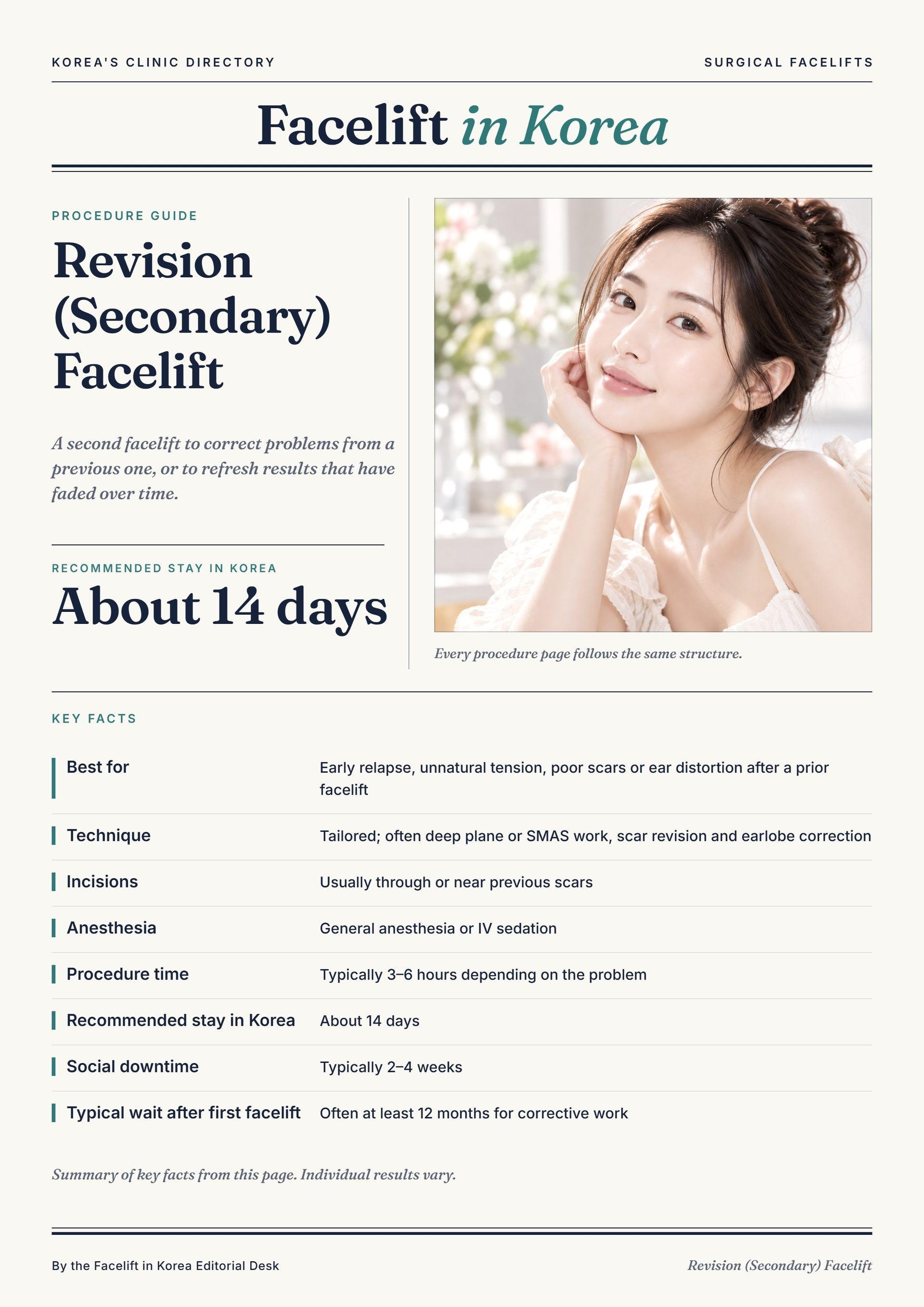
| Best for | Early relapse, unnatural tension, poor scars or ear distortion after a prior facelift |
|---|---|
| Technique | Tailored; often deep plane or SMAS work, scar revision and earlobe correction |
| Incisions | Usually through or near previous scars |
| Anesthesia | General anesthesia or IV sedation |
| Procedure time | Typically 3–6 hours depending on the problem |
| Recommended stay in Korea | About 14 days |
| Social downtime | Typically 2–4 weeks |
| Typical wait after first facelift | Often at least 12 months for corrective work |
| Price guide | Revision facelift cost in Korea |
Read next
Reader questions
Frequently asked questions
How soon after a facelift can I have a revision?
For corrective work, most surgeons recommend waiting at least 12 months so swelling and scar tissue settle. Urgent problems in the early weeks should be handled by your original surgeon.
Can a revision facelift fix a pulled or windswept look?
Often it can be improved, particularly by moving the tension to deeper layers and restoring volume. How much can be corrected depends on your skin, scar tissue and the extent of the original surgery.
Can a Korean surgeon revise a facelift done in another country?
Yes, many Seoul surgeons see international revision patients. Bring your operative report and photos so they can understand what was done.
Is a revision facelift more expensive?
It is usually priced higher than a first facelift because it is more complex and takes longer. See the revision facelift cost page for indicative ranges.
Can a pixie ear be corrected?
An earlobe that has been pulled downward can often be improved with a small reconstruction during revision. The surgeon will also aim to reduce tension so it does not recur.
Next steps
Planning a facelift in Korea?
Compare clinics, check surgeon credentials and estimate your full trip budget before you book a consultation.
Facelift in Korea is an independent information directory. We do not perform procedures, and listings are not endorsements. This page is general information, not medical advice.