


Home › Surgical Facelifts › Preservation Facelift
Surgical Facelifts
Preservation Facelift in Seoul, Korea
By the Facelift in Korea Editorial Desk · Independent · How we report
The short answer
Quick answer: A preservation facelift is a newer facelift philosophy that aims to lift the face with less separation of tissue layers, keeping more of the natural connections between skin, fat and the SMAS. Techniques vary, but the goal is a natural result with potentially less swelling. Evidence is still developing. In Seoul, plan about 10–14 days in Korea.
What is a preservation facelift?
The term "preservation" comes from rhinoplasty, where surgeons began keeping more of the nose's natural structure instead of removing and rebuilding it. The same idea has been applied to facelifts. A preservation facelift aims to lift the face while disturbing fewer tissue connections.
In a traditional facelift, the skin is separated widely from the SMAS beneath it, and the two layers are lifted separately. In a preservation approach, the surgeon keeps more of the skin attached to the deeper layers. The deep tissue is then lifted, often using a deep plane or similar method, and the skin moves with it as one composite unit.
There is no single definition. Some surgeons use the term for very limited skin undermining. Others use it for techniques that preserve specific ligaments or blood vessels. It is best viewed as a philosophy rather than a fixed operation.
What are the proposed benefits?
Surgeons who favor preservation techniques suggest several possible advantages:
- Better blood supply to the skin, which may support healing
- Less swelling and bruising in some patients
- A natural result, because the skin is not pulled separately
- Less risk of a tight or flat appearance
These benefits are plausible and supported by surgeon experience, but long-term comparative research is still limited. Be cautious of any claim that a preservation lift is proven to last longer or recover faster than other modern techniques.
Are there any trade-offs?
Keeping the skin attached means the surgeon has less freedom to redrape it in different directions. In people with a lot of loose skin, this can make it harder to remove all the excess, especially in the neck. Some surgeons also note a learning curve, since the technique depends on precise work in the deep plane close to facial nerve branches. Ask how long the surgeon has used the approach and how they handle the neck. A preservation lift is not a shortcut. It is usually a full operation with a similar length of surgery to other deep facelifts.
Who might be a candidate?
Preservation approaches are often considered for people with moderate sagging who want a soft, natural change. They may suit:
- People with good skin quality and moderate jowling
- Those concerned about looking "done"
- Patients with a history of slow healing, where protecting blood supply is important
People with very heavy, loose skin, significant neck laxity, or a lot of sun damage may need more skin redraping. A standard full facelift may be more appropriate in those cases.
How is it different from a deep plane facelift?
There is considerable overlap. Most preservation facelifts use deep plane principles. The main difference is the degree of skin undermining: deep plane lifts may still separate the skin over a wider area near the ear, while preservation-focused surgeons try to minimize this further. The deep plane vs SMAS comparison explains the layers involved.
What is recovery like?
Recovery is broadly similar to other deep facelifts. Expect swelling for one to three weeks, stitches removed between days 5 and 10, and most people returning to social life at around two to three weeks. Some patients report less bruising, but individual healing varies. The day-by-day recovery guide sets out what to expect.
Preservation facelifts in Seoul: what international patients should know
Korean aesthetic culture places strong value on natural-looking results. Phrases like "natural lift" and "no-pull facelift" are common in Seoul clinic marketing, and "preservation" has entered this vocabulary. The natural Korean facelift aesthetic guide explains this preference. Practical advice:
- Ask for specifics. Which tissue connections are preserved? How much skin is undermined? Is the neck addressed?
- Look at results over time. Ask for examples at one year or later, not just a few weeks after surgery.
- Do not choose by label. A skilled surgeon using any modern technique can achieve a natural result.
- Allow enough time. Plan about 10–14 days in Seoul.
This page is general information, not medical advice. Decisions about surgery should be made with a qualified, board-certified plastic surgeon after an in-person examination.
Key facts
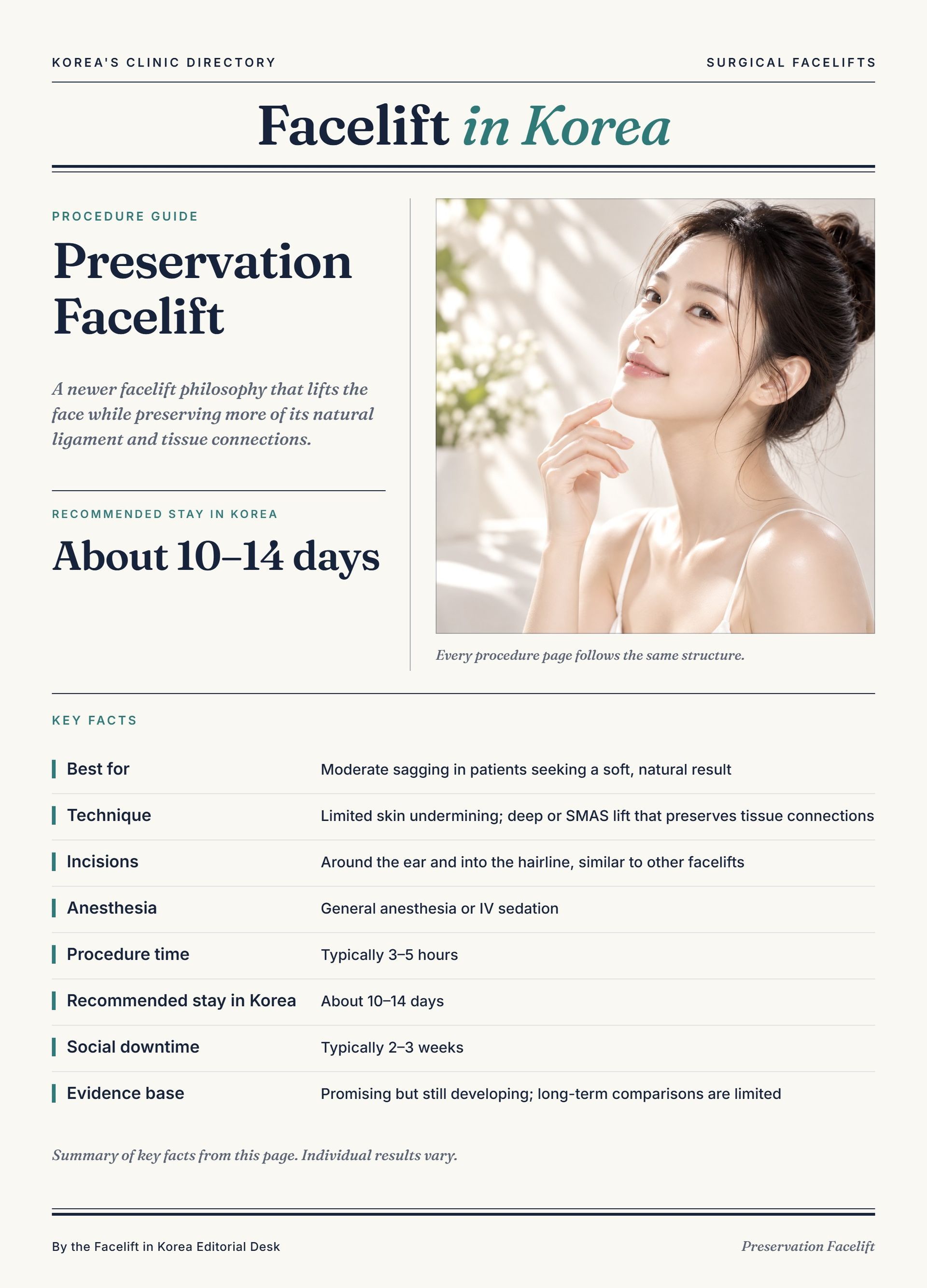
| Best for | Moderate sagging in patients seeking a soft, natural result |
|---|---|
| Technique | Limited skin undermining; deep or SMAS lift that preserves tissue connections |
| Incisions | Around the ear and into the hairline, similar to other facelifts |
| Anesthesia | General anesthesia or IV sedation |
| Procedure time | Typically 3–5 hours |
| Recommended stay in Korea | About 10–14 days |
| Social downtime | Typically 2–3 weeks |
| Evidence base | Promising but still developing; long-term comparisons are limited |
| Price guide | Deep plane facelift cost in Korea |
Read next
Reader questions
Frequently asked questions
What is a preservation facelift?
It is a facelift approach that lifts deep tissue while keeping more of the natural connections between skin and deeper layers. The aim is a natural result with less tissue disruption.
Is a preservation facelift better than a deep plane facelift?
Not necessarily. Many preservation lifts are a refinement of deep plane principles. Long-term evidence comparing them is still limited, so surgeon skill matters more than the label.
Does a preservation facelift have less swelling?
Some surgeons report less swelling and bruising because less tissue is separated. Healing varies from person to person.
How long does a preservation facelift last?
Long-term data are still being gathered. Surgeons generally expect durability similar to other deep facelifts, often around 10 years, but this is not yet well established.
Can I get a preservation facelift in Seoul?
Some Seoul surgeons describe their technique as preservation or no-pull. Ask each clinic to explain exactly what is preserved and to show long-term results.
Next steps
Planning a facelift in Korea?
Compare clinics, check surgeon credentials and estimate your full trip budget before you book a consultation.
Facelift in Korea is an independent information directory. We do not perform procedures, and listings are not endorsements. This page is general information, not medical advice.