


Home › Surgical Facelifts › Facelift for Asian Faces
Surgical Facelifts
Facelift for Asian Faces in Seoul, Korea
By the Facelift in Korea Editorial Desk · Independent · How we report
The short answer
Quick answer: Many surgeons adapt facelift planning for East Asian patients, who more often have wider faces, flatter midfaces, thicker or heavier soft tissue and a higher tendency toward visible or thickened scars. These are tendencies, not rules. In practice this can mean more focus on lifting heavy tissue, careful vector choice, and meticulous incision placement and scar care. An individual examination always matters most.
Do Asian faces need a different facelift?
There is no single "Asian facelift." Faces vary widely within and across East, Southeast and South Asian populations, and every patient needs an individual plan. Still, surgeons who operate on many East Asian patients describe some patterns that come up more often and can influence technique. Knowing about them can help you ask better questions.
What anatomical features are commonly considered?
Features surgeons often mention include:
- Heavier soft tissue. Thicker skin and more subcutaneous fat can make the face heavier to lift. A lift that relies only on skin may relax quickly, so many surgeons favor lifting the deeper layers.
- Flatter midface. A less projected cheek and nose area means cheek descent can show as flatness and deep nasolabial folds rather than hollowness. Fat grafting or a midface-focused lift may be considered.
- Wider lower face. A broader jaw angle or strong masseter muscles affect how jowls appear and where the lift should be directed.
- Skin aging pattern. Many people with more melanin in their skin show fine wrinkles later but notice sagging and heaviness as the main sign of aging.
- Prior facial contouring. Some patients have had V-line, cheekbone reduction or chin surgery in the past, which changes how tissue is supported.
Again, these are trends, not certainties. A surgeon should examine your face rather than assume. Patients of Asian heritage who grew up abroad, and patients of mixed heritage, may have any combination of these features or none of them.
Is non-surgical lifting a better first step?
For early laxity, many people in Korea start with energy devices or threads, which are widely available in Seoul. These can help for a time, but they do not reposition heavy tissue the way surgery does. Repeated thread lifts can also leave scar bands that make later surgery a little harder, so tell your surgeon about every treatment you have had. The surgical vs non-surgical facelift guide can help you judge which stage you are at.
How do these factors affect technique?
In practice, surgeons may:
- Prefer deep plane or high SMAS methods to carry heavier tissue
- Choose a more vertical lift vector to avoid widening an already broad face
- Combine the lift with fat transfer to support a flat midface
- Reduce bulk in specific areas, such as neck or jowl fat, conservatively
- Take extra care when releasing tissue after previous contouring surgery
What about scarring?
Many patients of East Asian heritage have a higher tendency toward red, raised or widened scars and toward darkening of the skin after injury (post-inflammatory hyperpigmentation). Surgeons respond with:
- Incisions placed in natural creases and inside the hairline or ear contour
- Closing the skin with as little tension as possible, carrying the lift in the deeper layers
- Early scar care such as silicone gel, sun protection and, when needed, steroid injection or laser
The facelift scarring and Asian skin guide covers this in depth.
What results are people usually looking for?
Goals are individual. Some patients want a softer, more rested look. Others want a clearer jawline or less heaviness around the mouth. Many prefer a result that looks unchanged to friends but refreshed. Be wary of anyone who assumes your goals based on your ethnicity. Bring photos of yourself at a younger age; these are often more useful than photos of other people.
Facelifts for Asian faces in Seoul: what international patients should know
Seoul surgeons operate mostly on East Asian faces, so many have deep experience with heavier tissue, flatter midfaces and scar management. This can be an advantage for patients of Asian heritage living abroad. Some tips:
- Share your history. Mention any previous contouring, threads, fillers or energy treatments. Repeated threads or filler can change tissue planes.
- Discuss width. If you are concerned about the face looking wider after lifting, raise it directly.
- Look at relevant examples. Ask to see results in patients with similar age and features.
- Plan scar follow-up. Ask what scar care is included and how it continues once you are home. The natural Korean facelift aesthetic guide explains common goals in Seoul.
This page is general information, not medical advice. Decisions about surgery should be made with a qualified, board-certified plastic surgeon after an in-person examination.
Key facts
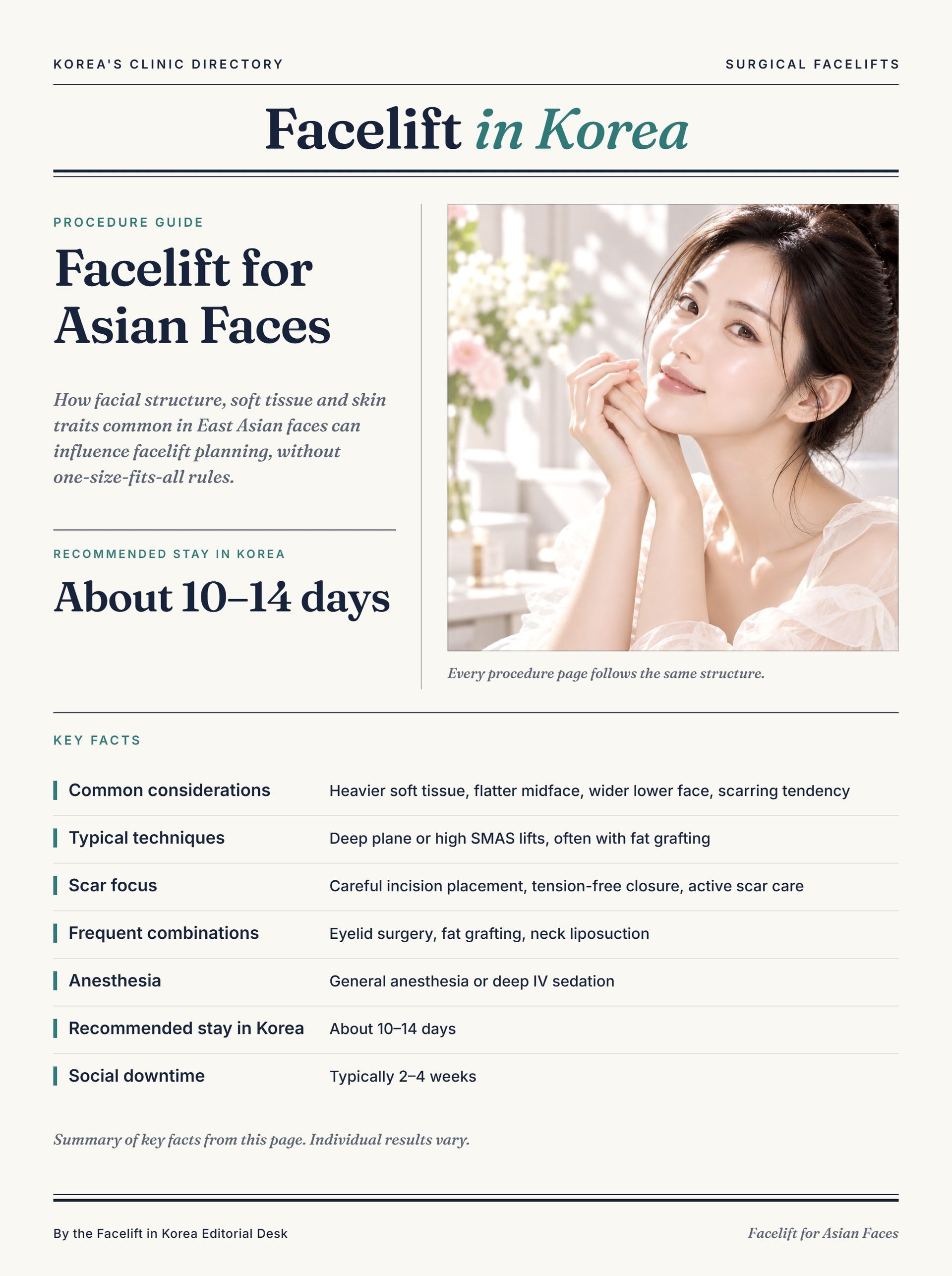
| Common considerations | Heavier soft tissue, flatter midface, wider lower face, scarring tendency |
|---|---|
| Typical techniques | Deep plane or high SMAS lifts, often with fat grafting |
| Scar focus | Careful incision placement, tension-free closure, active scar care |
| Frequent combinations | Eyelid surgery, fat grafting, neck liposuction |
| Anesthesia | General anesthesia or deep IV sedation |
| Recommended stay in Korea | About 10–14 days |
| Social downtime | Typically 2–4 weeks |
| Price guide | Facelift cost in Korea overview |
Read next
Reader questions
Frequently asked questions
Is a facelift different for Asian patients?
The principles are the same, but surgeons often adapt the plan for features that are more common in East Asian faces, such as heavier soft tissue and a flatter midface. Every face still needs individual assessment.
Do Asian patients scar worse after a facelift?
Many have a higher tendency toward raised or darker scars, but most heal well with careful technique and scar care. Tell your surgeon if you have had thick scars before.
Will a facelift make my face look wider?
It can if the lift is directed mainly sideways. Many surgeons use a more vertical vector for broader faces. Raise this concern at consultation.
Can I have a facelift after V-line or cheekbone surgery?
Yes, but prior contouring changes the anatomy and tissue support. Choose a surgeon with experience in both and share your surgical records.
Why do many Asian patients choose Seoul for facelifts?
Seoul surgeons have extensive experience with East Asian facial anatomy and scar management. Patients should still verify credentials and experience individually.
Next steps
Planning a facelift in Korea?
Compare clinics, check surgeon credentials and estimate your full trip budget before you book a consultation.
Facelift in Korea is an independent information directory. We do not perform procedures, and listings are not endorsements. This page is general information, not medical advice.