


Home › Surgical Facelifts › Composite Facelift
Surgical Facelifts
Composite Facelift in Seoul, Korea
By the Facelift in Korea Editorial Desk · Independent · How we report
The short answer
Quick answer: A composite facelift is a deep facelift technique in which the skin, fat, SMAS and the orbicularis oculi muscle around the lower eye are lifted together as a single flap. It targets the midface and lower eyelid junction as well as the jowls. It is a specialized, longer operation, so surgeon experience matters. Plan about 2 weeks in Korea.

What is a composite facelift?
The composite facelift is a deep facelift technique developed to treat the midface more completely. "Composite" means that several layers are lifted together as one flap: the skin, the fat beneath it, the SMAS, and the orbicularis oculi, which is the ring-shaped muscle around the eye.
Including the eye muscle matters because aging often lengthens the junction between the lower eyelid and the cheek. The cheek drops, and a visible line or hollow appears below the eye. A standard facelift may lift the jowls well but leave this area unchanged. A composite lift aims to raise the cheek back up toward the lower lid, shortening that junction and creating a smoother transition.
Who might be a candidate?
Surgeons may consider a composite lift when a patient has:
- Significant midface descent, with cheeks that look low and flat
- A long or hollow lower eyelid-cheek junction, sometimes with tear trough hollows
- Deep nasolabial folds and jowls
- Good general health and no smoking
It is less often chosen for younger patients with mild changes, or for people whose main concern is the neck. Some patients get a similar overall improvement from a midface lift with fat grafting or a lower eyelid procedure combined with a standard facelift.
How is it performed?
The details depend on the surgeon, but most composite facelifts involve:
- Standard facelift incisions around the ear and into the hairline
- A deep plane dissection that releases the retaining ligaments of the cheek
- Release of the orbicularis muscle, often through a lower eyelid or upper eyelid approach
- Lifting the whole composite flap upward and securing it
- Neck tightening through the platysma if needed
Because the lift continues up toward the eye, there is a learning curve, and the operation is longer than a typical SMAS facelift. Some surgeons add small fat grafts to the cheek or under the eye at the same time, because lifting alone does not replace volume that has been lost with age. Others prefer to keep the operation focused on repositioning and treat volume separately later.
What are the trade-offs?
The composite technique can give strong midface improvement, but it has some recognized downsides:
- Longer swelling. Swelling in the cheeks and around the eyes can persist for several weeks or longer.
- Eyelid position. Any work near the lower eyelid carries a risk of temporary lid pulling or rounding of the eye shape. Surgeons take steps to prevent this.
- Fewer specialists. Fewer surgeons perform this technique regularly than standard SMAS or deep plane lifts.
Discuss these risks in detail. The guide to facelift risks and complications is a useful starting point.
What does recovery involve?
Expect more visible swelling than with a lower-face-only lift, especially around the eyes in the first two weeks. Most patients:
- Wear a compression garment for the first few days
- Have stitches removed between days 5 and 10
- Return to light social contact after about 3–4 weeks
- See the final midface shape at 4–6 months
Because the eyelid area is involved, some patients notice dry or watery eyes for a short time, and lubricating eye drops are often advised. Cold compresses and keeping the head raised help in the first week. The day-by-day recovery guide shows what is typical.
Composite facelifts in Seoul: what international patients should know
Midface rejuvenation is a strong focus in Seoul, where many patients care about a smooth under-eye and cheek contour. However, the term "composite facelift" is less common in Korean clinic marketing than "deep plane" or "midface lift." Some practical tips:
- Ask what the term means to that surgeon. Some clinics use "composite" loosely to describe any multi-layer lift.
- Bring clear photos. Photos of your face from several angles help the surgeon judge your eyelid-cheek junction during an online consultation.
- Allow enough time. Because the eyes are involved, plan around 14 days in Seoul before flying home.
- Use an interpreter for complex discussions. Technical conversations about eyelid support are worth having in your own language.
This page is general information, not medical advice. Decisions about surgery should be made with a qualified, board-certified plastic surgeon after an in-person examination.
Key facts
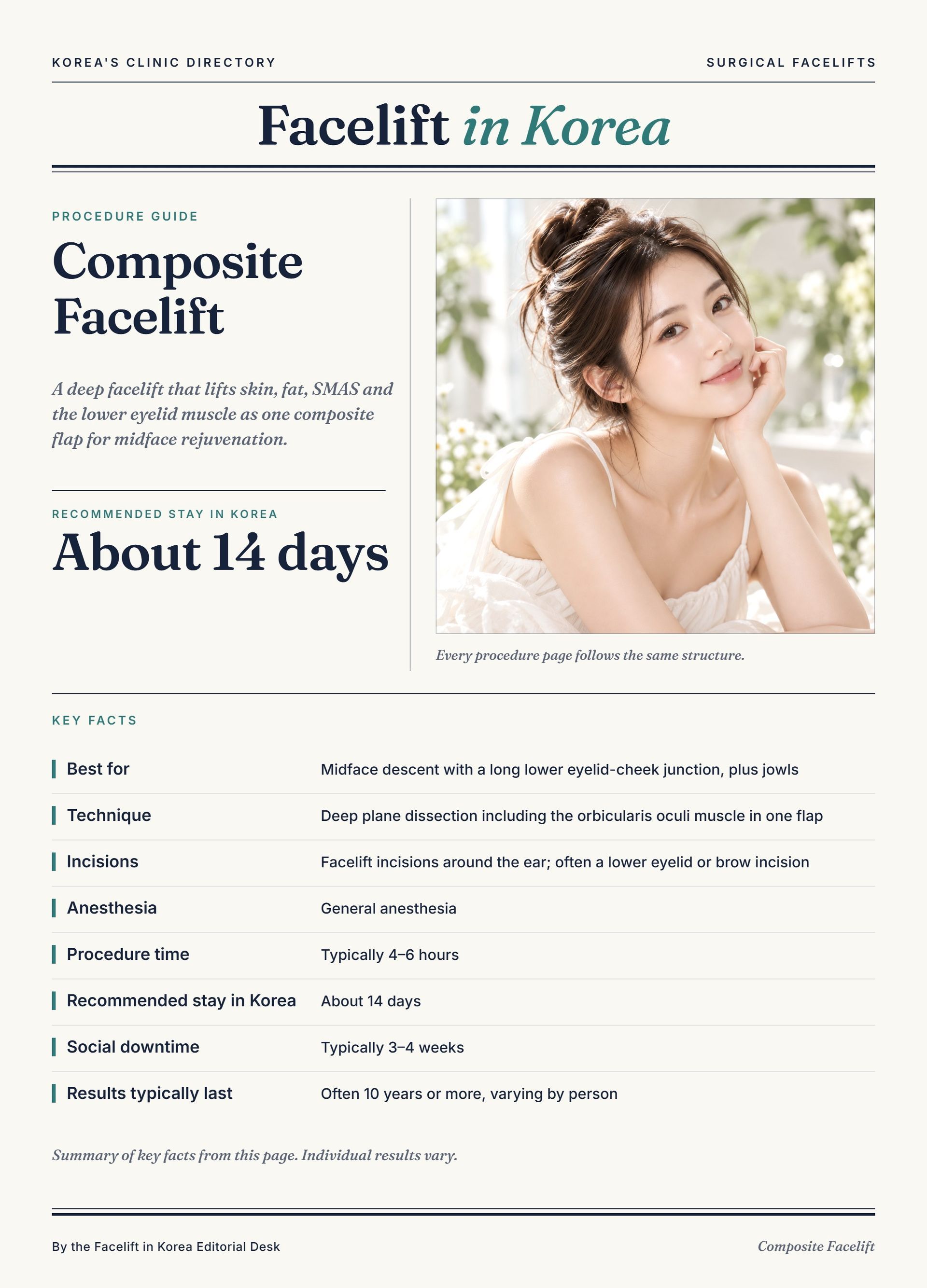
| Best for | Midface descent with a long lower eyelid-cheek junction, plus jowls |
|---|---|
| Technique | Deep plane dissection including the orbicularis oculi muscle in one flap |
| Incisions | Facelift incisions around the ear; often a lower eyelid or brow incision |
| Anesthesia | General anesthesia |
| Procedure time | Typically 4–6 hours |
| Recommended stay in Korea | About 14 days |
| Social downtime | Typically 3–4 weeks |
| Results typically last | Often 10 years or more, varying by person |
| Price guide | Facelift cost in Korea overview |
Read next
Reader questions
Frequently asked questions
What is the difference between a composite facelift and a deep plane facelift?
Both release deep tissue, but a composite facelift also includes the orbicularis muscle around the lower eye in the lifted flap. This targets the eyelid-cheek junction more directly.
Does a composite facelift treat under-eye hollows?
It can improve hollowness caused by cheek descent by lifting the cheek toward the lower eyelid. Hollows caused mainly by volume loss may still need fat grafting or filler.
Is a composite facelift available in Seoul?
Some Seoul surgeons perform composite or very similar multi-layer midface lifts. Ask each clinic to describe exactly what layers are lifted.
How long is recovery after a composite facelift?
Most patients need around 3–4 weeks before they feel comfortable socially. Residual swelling around the eyes and cheeks can take several months to fully settle.
Can a composite facelift change my eye shape?
Work near the lower eyelid carries a risk of lid pulling or a rounder eye shape, usually temporary. Ask your surgeon how they support the lower eyelid.
Next steps
Planning a facelift in Korea?
Compare clinics, check surgeon credentials and estimate your full trip budget before you book a consultation.
Facelift in Korea is an independent information directory. We do not perform procedures, and listings are not endorsements. This page is general information, not medical advice.