


Home › Surgical Facelifts › Scarless (Hidden-Incision) Facelift
Surgical Facelifts
Scarless (Hidden-Incision) Facelift in Seoul, Korea
By the Facelift in Korea Editorial Desk · Independent · How we report

The short answer
Quick answer: No surgical facelift is truly scarless. A "scarless" facelift is a marketing name for techniques that hide incisions inside the ear, along the hairline or in the scalp so scars are hard to see once healed. Some clinics also use the term for thread lifts, which are not surgery. Ask exactly where incisions will be and how scars are managed.

Is a scarless facelift possible?
Any surgical facelift that removes skin or lifts deep tissue requires incisions, and every incision heals with a scar. A "scarless" or "hidden-incision" facelift is a facelift designed so that those scars are as hard to see as possible. With careful planning and good healing, scars can become very discreet, but they do not disappear.
Some clinics also use "scarless" for thread lifts or energy treatments. These do not leave surgical scars but are not facelifts and give a smaller, shorter-lived effect. See facelift vs thread lift to understand the difference.
Where are incisions hidden?
- Inside the tragus: a retrotragal incision runs along the inner edge of the small flap in front of the ear canal, so the scar is hidden by the ear's own shape.
- Around the earlobe: the incision follows the natural crease where the earlobe meets the cheek.
- Behind the ear: the incision sits in the fold behind the ear and, if needed, follows the hairline rather than crossing it.
- Temple and scalp: incisions inside the hair, sometimes with a camera, as in an endoscopic facelift.
Who is a good candidate?
Hidden-incision techniques suit most facelift patients, but some anatomy makes them easier. People with good skin quality, mild to moderate laxity and no history of thickened scars tend to heal most discreetly. Those with a lot of loose neck skin may need a longer incision behind the ear. Men with beards may need a pre-tragal incision instead of a retrotragal one, so beard hair is not moved onto the ear.
What affects how visible scars become?
Scar visibility depends on several factors:
- Tension: scars widen when skin is closed under tension. Lifting the deep layer reduces skin tension.
- Skin type: darker and East Asian skin can be more prone to pigmentation and thickened scars.
- Smoking: reduces blood flow and can lead to poor healing.
- Aftercare: sun protection, silicone gel and avoiding strain on the incision help.
For more, see facelift scarring and Asian skin and facelift scar care.
What is recovery like?
Recovery depends on the underlying technique. Incisions are often red or pink for several weeks and gradually fade over 6 to 12 months. Stitches are typically removed between days 5 and 10. Some patients notice firmness along the scar for a few months. Scar treatments such as laser or steroid injections can help if a scar thickens.
What are the risks?
Risks include those of any facelift, as well as scar-specific issues: widened or raised scars, pigment changes, distortion of the tragus or earlobe (sometimes called a "pixie ear"), and visible hairline steps. Experienced surgeons plan incisions to reduce these risks.
What questions should I ask about incision placement?
- Will the incision run inside the tragus or in front of it, and why for my face?
- Will there be any scar behind the ear or in the back hairline?
- How will you avoid moving my sideburn or hairline?
- How do you prevent earlobe distortion?
- What scar treatments do you offer if a scar thickens or darkens?
Clear answers to these questions are often more useful than a technique name. Write them down at your consultation so you can compare clinics.
Scarless facelifts in Korea: what international patients should know
Hidden scars are a strong selling point in Seoul, and many clinics advertise "scarless" or "no-scar" lifting. Read these claims carefully. Ask whether the procedure is surgical or non-surgical, where exactly incisions will be, and what scar care the clinic provides after you return home.
Ask to see healed results at least six months after surgery, photographed close-up from the side. Discuss your scar history and skin type, and whether laser follow-up is available. A good surgeon will be honest that every surgical facelift leaves a scar.
This page is general information, not medical advice. Decisions about surgery should be made with a qualified, board-certified plastic surgeon after an in-person examination.
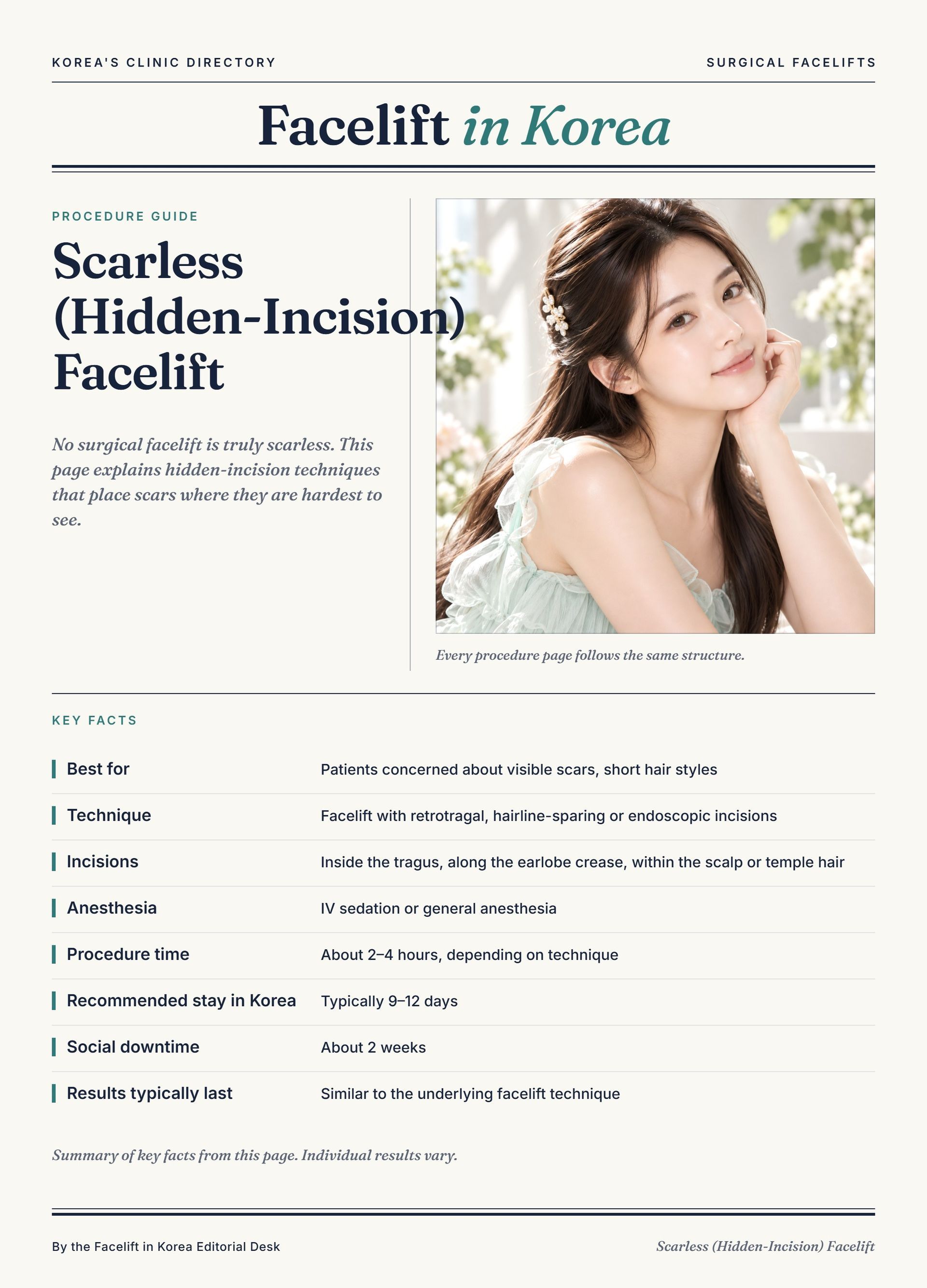
Key facts
| Best for | Patients concerned about visible scars, short hair styles |
|---|---|
| Technique | Facelift with retrotragal, hairline-sparing or endoscopic incisions |
| Incisions | Inside the tragus, along the earlobe crease, within the scalp or temple hair |
| Anesthesia | IV sedation or general anesthesia |
| Procedure time | About 2–4 hours, depending on technique |
| Recommended stay in Korea | Typically 9–12 days |
| Social downtime | About 2 weeks |
| Results typically last | Similar to the underlying facelift technique |
| Price guide | Facelift cost in Korea overview |
Read next
Reader questions
Frequently asked questions
Is there really a scarless facelift?
No surgical facelift is truly scarless. The term usually means incisions are hidden in natural creases and the hairline.
Where are scars hidden in a facelift?
Common places are inside the tragus, around the earlobe, in the fold behind the ear and within the scalp or temple hair.
Are thread lifts scarless facelifts?
Thread lifts leave no surgical scars, but they are not facelifts. Their effect is smaller and shorter-lived.
Do Asian patients scar more after facelifts?
East Asian skin can be more prone to pigmentation or thickened scars. Careful technique and aftercare help.
How long do facelift scars take to fade?
Most scars fade over 6 to 12 months. Sun protection and scar care support healing.
Next steps
Planning a facelift in Korea?
Compare clinics, check surgeon credentials and estimate your full trip budget before you book a consultation.
Facelift in Korea is an independent information directory. We do not perform procedures, and listings are not endorsements. This page is general information, not medical advice.