


Home › Surgical Facelifts › High SMAS Facelift
Surgical Facelifts
High SMAS Facelift in Seoul, Korea
By the Facelift in Korea Editorial Desk · Independent · How we report
The short answer
Quick answer: A high SMAS facelift is a SMAS facelift in which the surgeon starts the SMAS dissection higher, at or above the cheekbone (zygomatic arch), instead of below it. This lets the lift reach the midface and cheek, not just the jowls. In Seoul it is typically done under general anesthesia or sedation, with about 10–14 days in Korea recommended.
What is a high SMAS facelift?
The SMAS (superficial musculoaponeurotic system) is the supportive layer under the skin and fat of the face. A traditional SMAS facelift lifts and tightens this layer, usually starting the dissection just below the cheekbone. That works well for the jowls and jawline, but it has limited effect on the cheek and midface.
In a high SMAS facelift, the surgeon begins the SMAS dissection higher, along or above the zygomatic arch (the bony ridge in front of the ear that forms the cheekbone). Because the cheek fat sits above the old cut line, a higher starting point lets the surgeon lift the midface along with the lower face. Many surgeons describe this as a middle path between a standard SMAS lift and a deep plane facelift.
Who is a good candidate?
A high SMAS approach is often considered for people who notice:
- Cheeks that have slipped down, making the face look tired or flat in the upper half
- Heavier nasolabial folds
- Jowls and a softer jawline
- Mild to moderate neck laxity
It suits people who want a natural result across the mid and lower face without the widest dissection. Patients with very heavy skin or advanced neck sagging may need additional neck work. If hollowness rather than sagging is the main problem, see hollow cheeks, as volume restoration may be needed too.
How does the procedure work?
While each surgeon has their own method, the steps are usually similar:
- An incision runs from the temple hairline, around the front of the ear and behind it
- The skin is lifted over a limited area
- The SMAS is cut along a line at or above the cheekbone and lifted as a flap
- The SMAS is repositioned upward and backward and secured with stitches
- Excess skin is trimmed and the incision closed without tension
Some surgeons combine this with fat grafting to restore lost volume, or with a neck lift through a small incision under the chin.
High SMAS vs deep plane: what is the difference?
Both aim to move deeper tissue rather than simply pulling skin. In a deep plane lift, the skin and SMAS stay attached and move together after the ligaments are released. In a high SMAS lift, the SMAS is usually lifted as a separate layer from the skin. Surgeons disagree about which gives longer-lasting or more natural results, and both can be excellent in skilled hands. The deep plane vs SMAS comparison sets out the trade-offs.
What is recovery like?
Most people experience swelling and bruising for the first one to two weeks. A rough timeline:
- Days 1–2: compression dressing, possible drain, sleeping with the head raised
- Days 5–7: first stitches removed, swelling at its peak then easing
- Days 10–14: remaining stitches out, most people fit to fly
- Weeks 3–6: back to normal social life for most
Tightness and numbness near the ears and temples are normal and gradually ease. The swelling and bruising guide explains how to manage this phase.
High SMAS facelifts in Seoul: what international patients should know
In Korea, SMAS-based facelifts remain widely performed, and many Seoul surgeons now describe their technique as "high SMAS" or "extended SMAS." The terms are not used consistently, so ask the clinic exactly where the SMAS incision will be placed and whether the midface will be addressed.
- Temple incisions and hair. A high SMAS lift often uses a temple incision. Ask whether it will sit inside the hairline or along it, and how this affects your sideburn position.
- Scar care. Many patients of East Asian heritage have a higher tendency to visible or thickened scars. Ask about scar placement and aftercare.
- Combination offers. Clinics may suggest adding eyelid surgery or fat grafting. These can help, but each addition lengthens surgery and recovery.
For indicative pricing, see the SMAS cost page linked in the key facts.
This page is general information, not medical advice. Decisions about surgery should be made with a qualified, board-certified plastic surgeon after an in-person examination.
Key facts
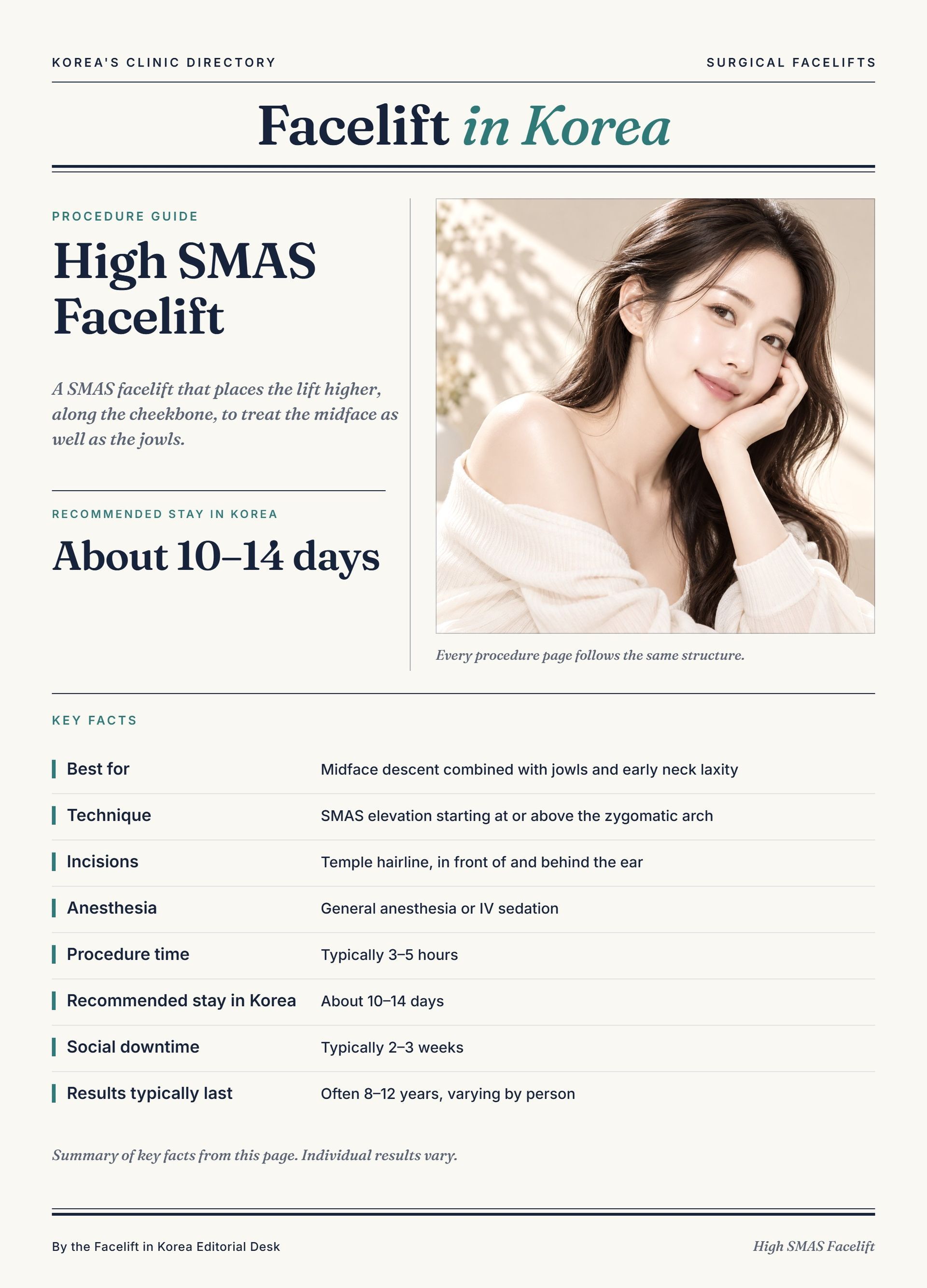
| Best for | Midface descent combined with jowls and early neck laxity |
|---|---|
| Technique | SMAS elevation starting at or above the zygomatic arch |
| Incisions | Temple hairline, in front of and behind the ear |
| Anesthesia | General anesthesia or IV sedation |
| Procedure time | Typically 3–5 hours |
| Recommended stay in Korea | About 10–14 days |
| Social downtime | Typically 2–3 weeks |
| Results typically last | Often 8–12 years, varying by person |
| Price guide | SMAS facelift cost in Korea |
Read next
Reader questions
Frequently asked questions
Is a high SMAS facelift the same as a deep plane facelift?
No. Both reach deeper than a skin lift and can treat the midface, but a high SMAS lift usually separates the SMAS from the skin, while a deep plane lift moves them together. Surgeons choose between them based on anatomy and their own experience.
Does a high SMAS facelift lift the cheeks?
That is its main advantage over a standard SMAS lift. Starting the dissection at or above the cheekbone lets the surgeon reposition cheek tissue as well as the jowls.
How long does a high SMAS facelift last?
Results commonly last around 8–12 years. Aging continues, so the face will still change over time.
Will I have scars in my hairline?
Usually the incision runs in or along the temple hairline and around the ear. With good technique and care, scars typically fade to fine lines, though healing varies.
How soon can I fly home from Seoul?
Most clinics suggest waiting around 10–14 days so stitches can be removed and a follow-up check done.
Next steps
Planning a facelift in Korea?
Compare clinics, check surgeon credentials and estimate your full trip budget before you book a consultation.
Facelift in Korea is an independent information directory. We do not perform procedures, and listings are not endorsements. This page is general information, not medical advice.