


Home › Surgical Facelifts › Facelift in Your 40s
Surgical Facelifts
Facelift in Your 40s: Options in Seoul, Korea
By the Facelift in Korea Editorial Desk · Independent · How we report

The short answer
Quick answer: In your 40s, aging usually shows as early jowls, deepening nasolabial folds, some volume loss and the first neck changes. Many people do well with non-surgical lifting or a limited lift such as a mini facelift or S-lift. A deeper facelift can make sense when sagging is already clear. In Seoul, options range from devices to deep plane surgery, so an honest assessment matters.
What does facial aging look like in your 40s?
For many people, the 40s are when the first structural signs of aging appear. Skin is usually still fairly elastic, but deeper changes start to show:
- A softer jawline as early jowls form
- Deeper lines from the nose to the mouth
- Slight flattening of the cheeks as the cheek fat starts to descend
- Hollowing under the eyes or at the temples
- The first visible neck bands
Genetics, sun exposure, smoking, weight changes and facial structure all influence how early these appear. Some people see few changes until their 50s; others notice them in their late 30s.
Facial structure shapes the pattern too. Korean surgeons often observe that faces with thicker skin and a flatter midface, which are common among East Asian patients, tend to show fewer fine lines in the 40s but more heaviness around the mouth and jaw. Faces with thinner skin and higher cheekbones may show hollowing first. Neither is better; they simply call for different plans.
Do I need a facelift in my 40s, or is non-surgical lifting enough?
This is the central question. For mild changes, non-surgical options can often help:
- Energy devices such as Ultherapy, Shurink or Thermage for mild tightening
- Thread lifts for a temporary lift of the cheeks and jowls
- Fillers or biostimulators to restore lost volume
- Botulinum toxin for expression lines and neck bands
These treatments have short downtime but give modest results that last months rather than years. Surgery starts to make sense when sagging is clearly visible at rest, when you need repeated non-surgical treatments with diminishing returns, or when the jowls and neck are the main concern. The surgical vs non-surgical facelift guide helps clarify where you stand.
Which surgical options suit people in their 40s?
Common choices include:
- Mini facelift or S-lift: short incisions and limited SMAS tightening for early jowls.
- Mini neck lift or neck liposuction: for early neck fullness or bands.
- Deep plane facelift: some surgeons recommend it even in the 40s when sagging is moderate, arguing that it gives longer-lasting results.
- Fat grafting: to restore cheek or temple volume alongside a lift.
There is real debate here. Some surgeons prefer a lighter lift now and a fuller one later. Others prefer one definitive deep lift. Ask each surgeon to explain why they recommend their approach for your face specifically.
Are there benefits to having a facelift earlier?
Possible benefits include better skin quality, which often heals well and drapes naturally, and a result that may look subtle because the change needed is smaller. Recovery can also be easier when you are younger and healthier. The best age for a facelift guide covers this question in depth.
Possible downsides include the cost and risk of surgery for a modest change, and the likelihood that you will want further treatment later in life. A facelift does not stop aging; it resets the clock.
How to avoid over-treatment in your 40s
At this age, small changes can look large. Some people undergo many filler or thread sessions and end up with a heavy or distorted look. Others have more surgery than they need. Good practice includes:
- Starting with the least invasive option that can reasonably achieve your goal
- Being wary of large package deals that bundle many procedures
- Bringing photos of yourself in your early 30s to set realistic goals
- Getting a second opinion if you are offered extensive surgery for mild changes
Facelifts in your 40s in Seoul: what international patients should know
Seoul is known for preventive and early-intervention aesthetics. Many Koreans in their 30s and 40s use devices, boosters and threads regularly, and clinics often market "early lifting" packages. This creates a wide choice but also some pressure to do more. Practical points:
- Combination trips. Some patients combine a mini lift with eyelid surgery or fat grafting. This can be efficient, but keep the total plan proportionate.
- Thread history. If you have had many thread lifts, tell your surgeon. Scar tissue from threads can affect later surgery.
- Short stays are possible. About 7–10 days for a mini lift; 10–14 days for a deeper lift.
- Cost comparison. Compare the long-term cost of repeated non-surgical treatments with a single surgical lift.
This page is general information, not medical advice. Decisions about surgery should be made with a qualified, board-certified plastic surgeon after an in-person examination.
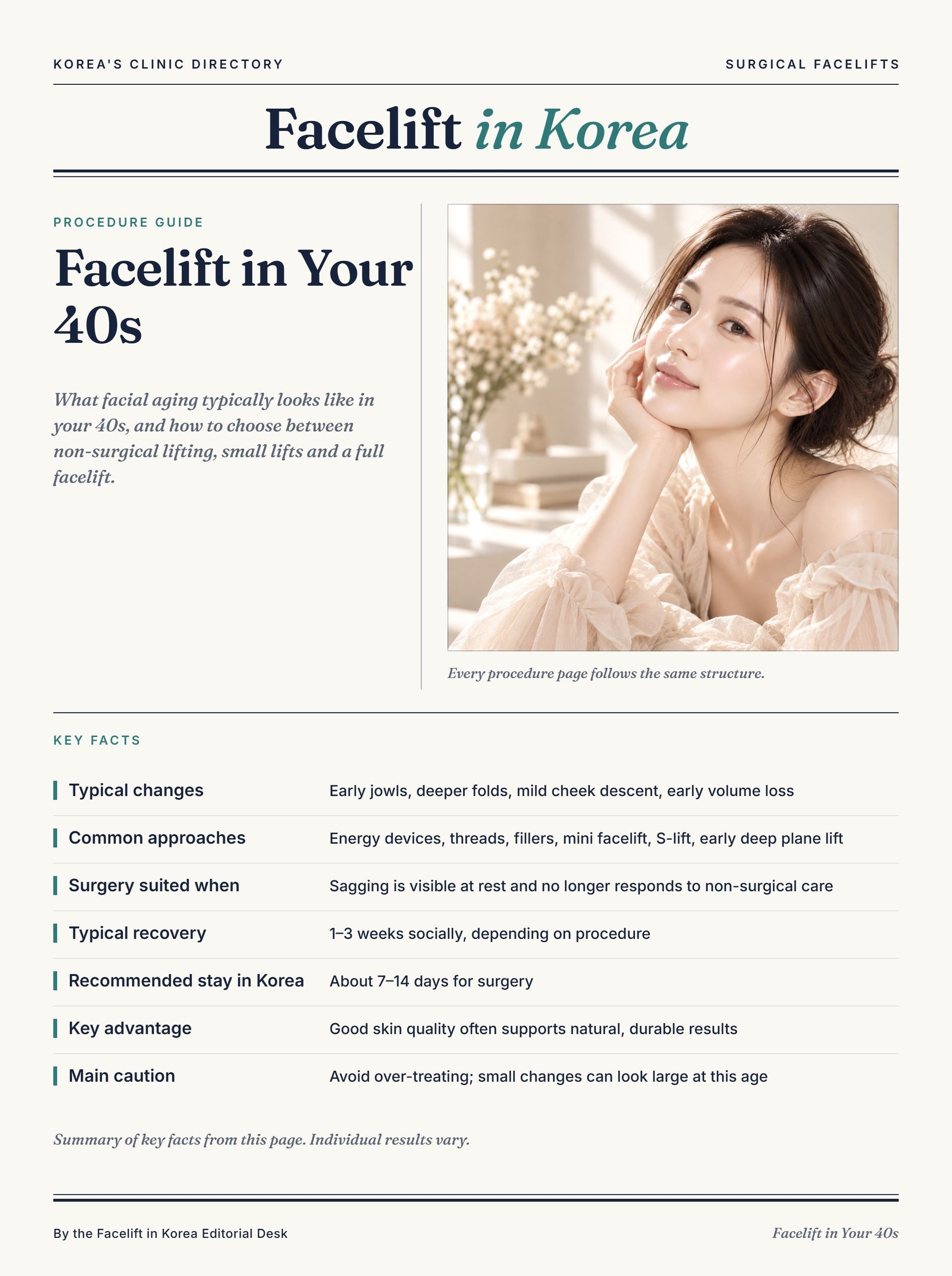
Key facts
| Typical changes | Early jowls, deeper folds, mild cheek descent, early volume loss |
|---|---|
| Common approaches | Energy devices, threads, fillers, mini facelift, S-lift, early deep plane lift |
| Surgery suited when | Sagging is visible at rest and no longer responds to non-surgical care |
| Typical recovery | 1–3 weeks socially, depending on procedure |
| Recommended stay in Korea | About 7–14 days for surgery |
| Key advantage | Good skin quality often supports natural, durable results |
| Main caution | Avoid over-treating; small changes can look large at this age |
| Price guide | Mini facelift cost in Korea |
Read next
Reader questions
Frequently asked questions
Is 40 too young for a facelift?
Not necessarily. Age matters less than the degree of sagging. Some people in their 40s have clear jowls and neck laxity that respond well to surgery, while others are better served by non-surgical treatment.
What is the best facelift for someone in their 40s?
Many people in their 40s consider a mini facelift, S-lift or neck liposuction. Some surgeons recommend a deep plane lift for moderate sagging. The right choice depends on your anatomy.
Will a facelift in my 40s last longer?
Good skin quality can help results look natural and last well. However, aging continues, and many people consider further treatment 10 or more years later.
Should I try threads or HIFU before a facelift?
For mild changes, these can help for several months with little downtime. If sagging is clearly visible at rest, surgery usually gives a more meaningful and durable result.
How long do I need in Seoul for a mini facelift in my 40s?
About 7–10 days is usually enough for a mini lift, and 10–14 days for a deeper facelift.
Next steps
Planning a facelift in Korea?
Compare clinics, check surgeon credentials and estimate your full trip budget before you book a consultation.
Facelift in Korea is an independent information directory. We do not perform procedures, and listings are not endorsements. This page is general information, not medical advice.