


Home › Surgical Facelifts › Deep Plane Facelift
Surgical Facelifts
Deep Plane Facelift in Seoul, Korea
By the Facelift in Korea Editorial Desk · Independent · How we report
The short answer
Quick answer: A deep plane facelift lifts the skin and the underlying SMAS muscle layer together as one unit, after releasing the ligaments that tether the cheek and jaw. In Seoul it is usually done under general anesthesia or deep sedation, takes about 3 to 5 hours, and most international patients plan a stay of around 10 to 14 days.

What is a deep plane facelift?
A deep plane facelift is a surgical technique that works beneath the SMAS, the thin fibrous layer that sits under the skin and fat of the face. Instead of separating skin from the SMAS and tightening each layer on its own, the surgeon enters the "deep plane" below the SMAS. The skin, fat and SMAS are then lifted together as one composite flap.
The key step is releasing the retaining ligaments. These are strong bands that anchor the soft tissue of the cheek and jaw to the bone. With age, tissue sags around them. Releasing them lets the surgeon reposition the midface and jowls with less pull on the skin surface. Many surgeons believe this is why results can look less "tight" or wind-swept.
Who is a good candidate for a deep plane facelift?
Surgeons generally consider this approach for people with clear, structural sagging rather than only skin laxity. Typical candidates have:
- Heavy or well-defined jowls that blur the jawline (see jowl lifting)
- Deep nasolabial folds caused by a descended cheek fat pad
- Midface flattening or hollowing under the eyes
- Good general health, no active smoking, and realistic expectations
It may be more surgery than needed for someone in their early 40s with mild laxity. In those cases a surgeon might suggest a lighter SMAS technique or a non-surgical option first.
How does it compare with an SMAS facelift?
Both techniques address the deeper layer, not just skin. A standard SMAS facelift folds or trims the SMAS and suspends it, while the deep plane method releases ligaments and moves the tissue as a single unit. Supporters of deep plane surgery point to stronger midface correction. Supporters of SMAS techniques note shorter operating time and a long track record. Skill and judgment matter more than the label. Our deep plane vs SMAS comparison explains the trade-offs in detail.
What happens on surgery day?
After final photographs and markings, the anesthesia team will put you to sleep or under deep sedation. Incisions usually follow the natural curve in front of the ear, or sit just inside the tragus, then wrap behind the ear into the hairline. Many surgeons combine the procedure with a neck lift, since the jawline and neck are closely linked. Drains may be placed for one or two days. Most clinics in Seoul keep patients overnight for observation.
What is recovery like?
Swelling and bruising usually peak around days 2 to 4. Stitches are often removed in stages between days 5 and 10. Tightness, numbness around the ears and cheeks, and some asymmetry from swelling are common in the first weeks and usually settle gradually. Many people feel comfortable in public with light makeup at around 2 to 3 weeks. Final refinement can take 6 to 12 months. Our facelift recovery timeline covers each stage.
What are the risks?
Because dissection is deeper and closer to branches of the facial nerve, surgeon experience is essential. Possible complications include hematoma, temporary nerve weakness, prolonged numbness, poor scarring, infection and asymmetry. Most temporary nerve weakness recovers over weeks to months, but you should discuss how often your surgeon sees it. Blood pressure control and avoiding blood thinners before surgery reduce hematoma risk.
Deep plane facelifts in Korea: what international patients should know
"Deep plane" has become a popular marketing term in Gangnam, and not every clinic uses it to mean the same thing. Some describe an extended SMAS technique under this name. Ask the surgeon to explain exactly which layer they dissect, which ligaments they release, and how many deep plane cases they perform each year.
Korean surgeons often design lifts around East Asian facial structure, with wider cheekbones and a softer midface, and many favor hidden incisions and a natural result. Confirm who will operate on you in person, the anesthesia plan, and the follow-up schedule before you fly. Plan enough time in Seoul for stitch removal and at least one post-operative check, and avoid booking a flight home before your surgeon clears you.
This page is general information, not medical advice. Decisions about surgery should be made with a qualified, board-certified plastic surgeon after an in-person examination.
Key facts
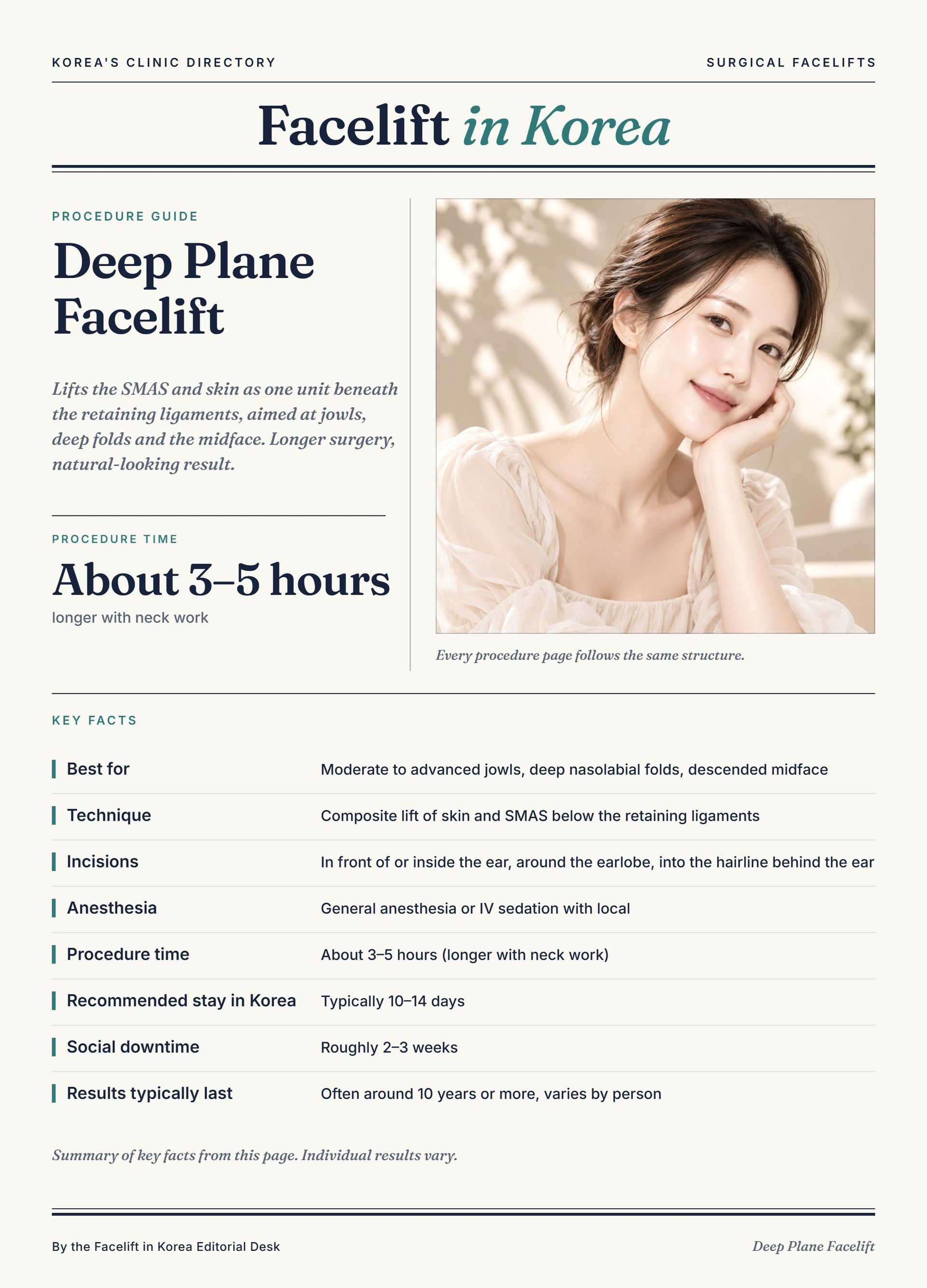
| Best for | Moderate to advanced jowls, deep nasolabial folds, descended midface |
|---|---|
| Technique | Composite lift of skin and SMAS below the retaining ligaments |
| Incisions | In front of or inside the ear, around the earlobe, into the hairline behind the ear |
| Anesthesia | General anesthesia or IV sedation with local |
| Procedure time | About 3–5 hours (longer with neck work) |
| Recommended stay in Korea | Typically 10–14 days |
| Social downtime | Roughly 2–3 weeks |
| Results typically last | Often around 10 years or more, varies by person |
| Price guide | Deep plane facelift cost in Korea |
Read next
Reader questions
Frequently asked questions
Is a deep plane facelift better than an SMAS facelift?
Not automatically. A deep plane lift can give stronger correction of the midface and jowls, but an experienced surgeon can achieve excellent results with SMAS techniques too. The right choice depends on your anatomy and the surgeon's expertise.
How long should I stay in Seoul after a deep plane facelift?
Most surgeons suggest around 10 to 14 days. This allows for drain removal, staged stitch removal and at least one follow-up check before flying home.
Will a deep plane facelift look pulled?
It is designed to avoid a tight, pulled look because tension is placed on the deeper layer rather than the skin. Results still depend on the surgeon's planning and your tissue quality.
Is a deep plane facelift done under general anesthesia in Korea?
Most Seoul clinics use general anesthesia or IV sedation for this procedure because of its length. Ask who the anesthesiologist is and how you will be monitored.
Can a deep plane facelift be combined with eyelid surgery?
Yes, it is often combined with upper or lower eyelid surgery, a neck lift or fat grafting. Combining procedures adds operating time and may lengthen recovery.
Next steps
Planning a facelift in Korea?
Compare clinics, check surgeon credentials and estimate your full trip budget before you book a consultation.
Facelift in Korea is an independent information directory. We do not perform procedures, and listings are not endorsements. This page is general information, not medical advice.