


Home › Surgical Facelifts › Full Facelift
Surgical Facelifts
Full Facelift in Seoul, Korea
By the Facelift in Korea Editorial Desk · Independent · How we report
The short answer
Quick answer: A full facelift is a comprehensive operation that treats the midface, jawline and neck together, rather than one zone. Surgeons usually combine a SMAS or deep plane facelift with neck tightening, sometimes adding fat grafting. In Seoul it is performed under general anesthesia or deep sedation, and most clinics advise about 10–14 days in Korea before flying home.
What is a full facelift?
"Full facelift" is a patient-friendly term rather than a single technique. It describes an operation that addresses the whole lower two-thirds of the face and the neck at once. That usually means lifting the cheeks, softening the nasolabial folds, restoring a clean jawline and tightening the neck.
By contrast, a mini facelift treats mainly the jowls through shorter incisions, and a lower facelift focuses on the jaw and upper neck. A full facelift is chosen when sagging is present in several areas and a partial lift would leave an uneven result, such as a tight jaw above a loose neck.
What does a full facelift usually include?
The exact plan depends on your anatomy, but most full facelifts combine several elements:
- Deep layer lift. The SMAS is tightened or the deep plane is released so that the cheek and jowl tissue moves up as a unit.
- Neck lift. Loose neck skin is redraped, and the platysma muscle may be tightened through a small incision under the chin.
- Skin redraping. Excess skin is trimmed and closed with minimal tension.
- Optional volume. Fat grafting may be added where hollows have formed, such as the cheeks or temples.
Surgeons in Seoul use a range of techniques for the deep layer. The mini vs full facelift comparison and the deep plane vs SMAS comparison explain the main differences.
Who is a good candidate?
A full facelift is generally considered for people who have:
- Noticeable jowls and loss of jawline definition
- Deep folds from the nose to the mouth and from the mouth to the chin
- Loose skin or bands in the neck
- Skin that no longer responds well to non-surgical tightening
Most patients are in their late 40s to 70s, but age matters less than the degree of sagging and general health. Smokers, people with uncontrolled blood pressure or diabetes, and those on blood thinners need careful assessment. If you are unsure whether you need surgery yet, read surgical vs non-surgical facelift.
What is the recovery like?
Recovery after a full facelift is longer than after a mini lift, mainly because the neck is involved. A typical course is:
- First 48 hours: compression bandage, possible drains, rest with the head raised
- Days 5–7: first stitches out, swelling and bruising at their most visible
- Days 10–14: remaining stitches removed, most patients cleared to fly
- Weeks 3–4: comfortable in social settings for many people
- Months 3–6: final contour settles
Tightness under the chin and numbness around the ears are common and fade over weeks to months. For a detailed breakdown, see the facelift recovery timeline.
What are the main risks?
A full facelift is major surgery. Risks include hematoma (a collection of blood under the skin), infection, poor scarring, hair loss near incisions, asymmetry, prolonged numbness and, rarely, injury to a facial nerve branch. Careful blood pressure control after surgery helps reduce bleeding risk. Ask your surgeon how they monitor patients overnight and what happens if a complication occurs after you return home.
Full facelifts in Seoul: what international patients should know
Seoul's facelift market has grown alongside its reputation for eyelid and facial contouring surgery. Many Gangnam clinics now see international facelift patients regularly. Some points to keep in mind:
- Packages vary. One clinic's "full facelift" may include neck work and fat grafting, while another lists them separately. Ask for an itemized plan.
- Overnight stay. Some clinics keep patients overnight; others discharge the same day to a nearby hotel. Ask what monitoring is provided.
- Combination procedures. Eyelid or brow surgery is often suggested at the same time. This can be efficient, but it adds operating time and swelling.
- Surgeon identity. Confirm that the surgeon you meet will perform the whole operation.
For pricing, see the overview linked in the key facts above.
This page is general information, not medical advice. Decisions about surgery should be made with a qualified, board-certified plastic surgeon after an in-person examination.
Key facts
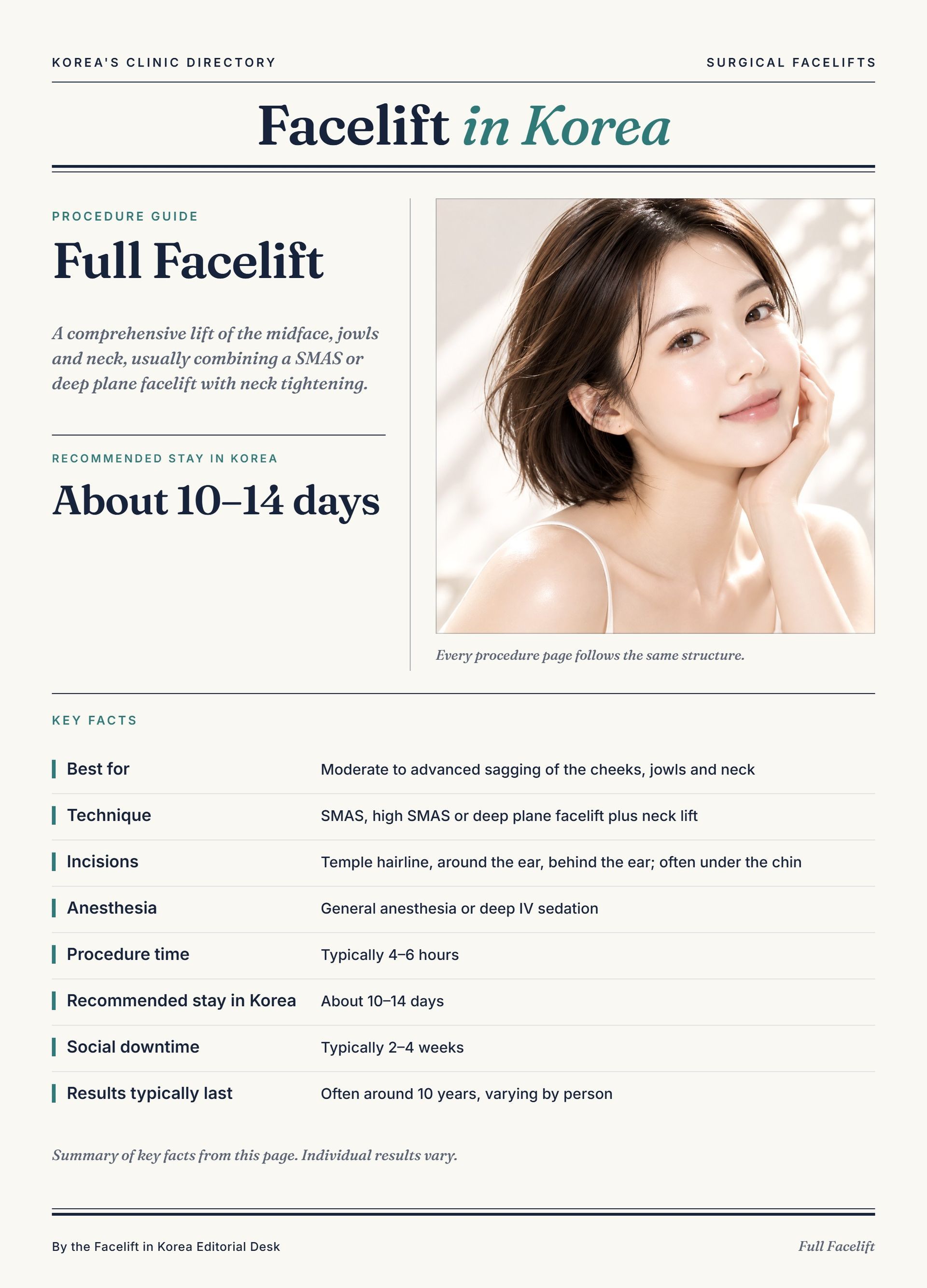
| Best for | Moderate to advanced sagging of the cheeks, jowls and neck |
|---|---|
| Technique | SMAS, high SMAS or deep plane facelift plus neck lift |
| Incisions | Temple hairline, around the ear, behind the ear; often under the chin |
| Anesthesia | General anesthesia or deep IV sedation |
| Procedure time | Typically 4–6 hours |
| Recommended stay in Korea | About 10–14 days |
| Social downtime | Typically 2–4 weeks |
| Results typically last | Often around 10 years, varying by person |
| Price guide | Facelift cost in Korea overview |
Read next
Reader questions
Frequently asked questions
What is included in a full facelift?
Usually a deep layer lift of the cheeks and jowls, a neck lift, and skin redraping. Some surgeons add fat grafting. Always ask for an itemized list, as clinics define the term differently.
How long does a full facelift last?
Results commonly last around 10 years. You will continue to age, but most people still look younger than they would have without surgery.
Is a full facelift painful?
Most patients describe tightness and discomfort rather than sharp pain. It is usually well controlled with prescribed pain relief in the first few days.
How long do I need to stay in Seoul after a full facelift?
Most clinics recommend about 10–14 days for stitch removal and a follow-up check before flying.
Can I combine a full facelift with eyelid surgery?
Yes, this is common in Seoul. Combining adds operating time and swelling, so discuss whether it is safe and sensible for you.
Next steps
Planning a facelift in Korea?
Compare clinics, check surgeon credentials and estimate your full trip budget before you book a consultation.
Facelift in Korea is an independent information directory. We do not perform procedures, and listings are not endorsements. This page is general information, not medical advice.