


Home › Surgical Facelifts › Nano-Fat Facial Rejuvenation
Surgical Facelifts
Nano-Fat Facial Rejuvenation in Seoul, Korea
By the Facelift in Korea Editorial Desk · Independent · How we report
The short answer
Quick answer: Nano-fat is your own fat that has been mechanically emulsified and filtered into a liquid. It contains very few intact fat cells, so it adds little volume. Instead, it is injected superficially to try to improve skin texture, fine lines, scars and under-eye darkness. In Seoul it is often done with other fat grafting, and downtime is usually about one week.
What is nano-fat?
Nano-fat is a preparation of your own fat that has been processed until it becomes a fine liquid. After harvesting fat by gentle liposuction, the surgeon passes it repeatedly between two syringes to break it up, then filters it to remove connective tissue. The final liquid can pass through a very fine needle.
Unlike standard fat grafting, nano-fat contains few living fat cells. It is not used to add volume. Instead, it is believed to contain other cells and growth factors from the fat tissue, including part of the stromal vascular fraction (SVF), which may help improve skin quality. Research in this area is ongoing, and results vary.
What is nano-fat used for?
- Fine lines and crepey skin under the eyes
- Dark circles linked to thin skin rather than pigment
- Fine lines around the mouth
- Dull, uneven skin texture
- Some types of acne or surgical scars
It is often combined with standard facial fat transfer: larger fat particles add volume deeper, while nano-fat is placed closer to the surface for skin quality.
Who might consider nano-fat?
People interested in nano-fat often have thin, crepey skin under the eyes or fine lines that have not improved with skincare. It may appeal to those who prefer to use their own tissue instead of synthetic products. It is not suitable for treating sagging, deep folds or significant volume loss on its own. Those concerns usually need lifting or standard fat grafting.
How does it compare with skin boosters and other injectables?
In Seoul, many non-surgical treatments also target skin quality, such as polynucleotide injections, hyaluronic acid skin boosters and collagen stimulators. These are less invasive, since no fat harvest is needed, and are commonly repeated in a series. Nano-fat requires a small liposuction but is usually done once or twice. Results from both approaches are gradual. Our pages on skin boosters and Rejuran Healer explain these alternatives.
What does the procedure involve?
A small amount of fat is harvested, usually from the abdomen or thighs, under local anesthesia. The fat is emulsified and filtered in the treatment room. The nano-fat is then injected with a fine needle or cannula into the skin layer of the target areas. Some practitioners also apply it with microneedling. The procedure typically takes about an hour, depending on whether it is combined with other treatments.
What is recovery like?
Expect mild swelling, redness and small bruises at the injection sites for several days. The donor site may feel sore and bruised. Most people can return to normal activities within about a week. Changes in skin texture, if they occur, tend to appear gradually over weeks to months. Some practitioners recommend more than one session for a noticeable effect.
What are the risks?
Nano-fat is generally considered low risk when performed carefully. Possible issues include bruising, swelling, temporary lumps, infection, uneven results and donor-site irregularities. Because nano-fat adds little volume, overfilling is uncommon. The main limitation is that results are variable and not guaranteed. Be cautious of claims that nano-fat can "regenerate" skin dramatically. Ask what the practitioner has seen in patients with skin like yours, and look at photos taken in the same lighting months later.
Nano-fat in Korea: what international patients should know
In Seoul, nano-fat is offered by plastic surgery clinics and some dermatology clinics. It is often marketed alongside stem-cell or regenerative treatments. Korean regulations limit how cell-based therapies can be processed, so ask exactly how the fat is prepared and whether any cell culturing is involved. See stem-cell enriched fat grafting for related context.
Ask what results the clinic realistically expects for your skin type, how many sessions are recommended and whether nano-fat is included in a fat grafting package. If under-eye darkness is mainly caused by pigment, a dermatologist may suggest other treatments. For a broader decision guide, read surgical vs non-surgical facelift.
This page is general information, not medical advice. Decisions about surgery should be made with a qualified, board-certified plastic surgeon after an in-person examination.
Key facts
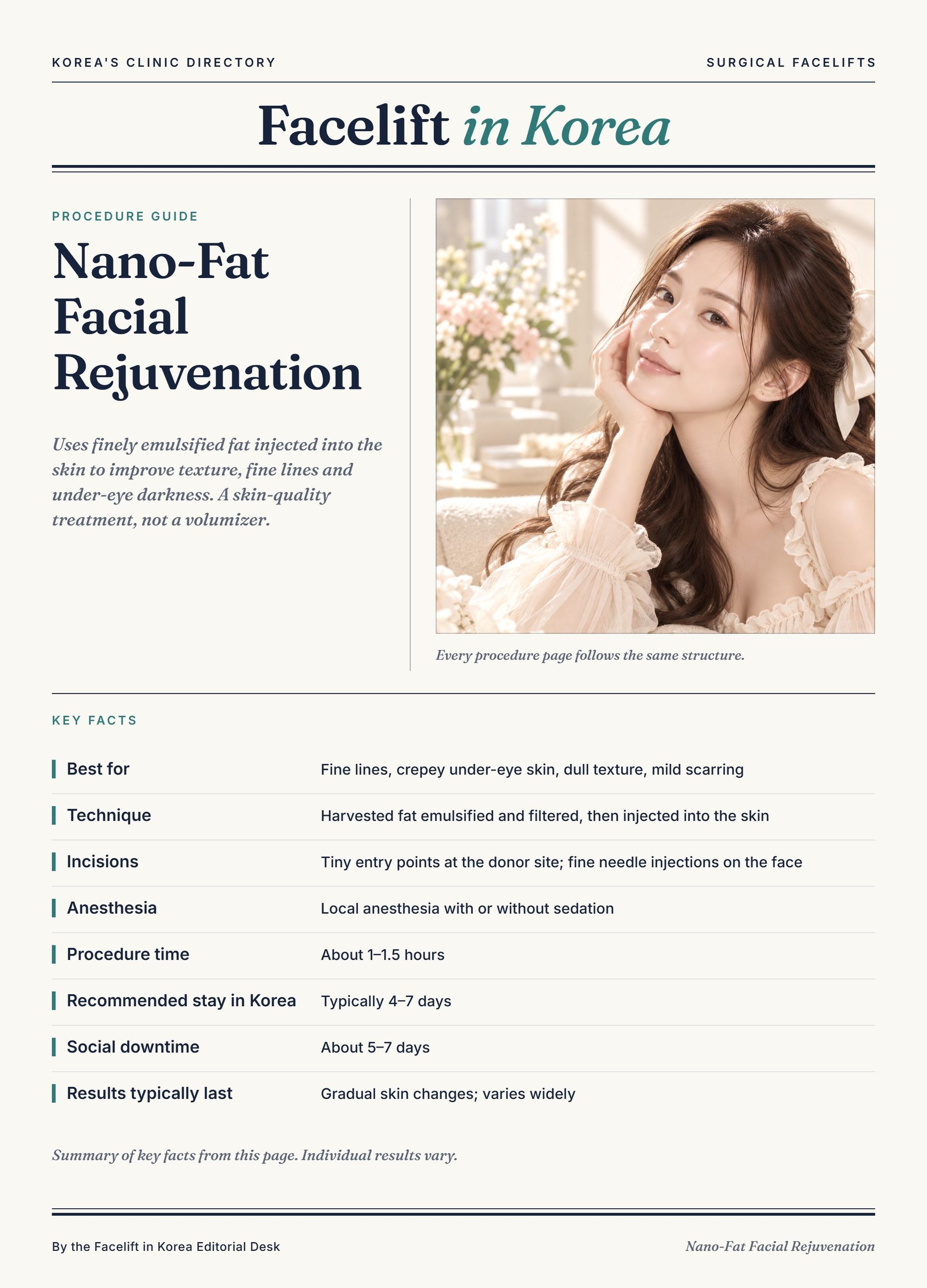
| Best for | Fine lines, crepey under-eye skin, dull texture, mild scarring |
|---|---|
| Technique | Harvested fat emulsified and filtered, then injected into the skin |
| Incisions | Tiny entry points at the donor site; fine needle injections on the face |
| Anesthesia | Local anesthesia with or without sedation |
| Procedure time | About 1–1.5 hours |
| Recommended stay in Korea | Typically 4–7 days |
| Social downtime | About 5–7 days |
| Results typically last | Gradual skin changes; varies widely |
| Price guide | Facial fat grafting cost in Korea |
Read next
Reader questions
Frequently asked questions
Does nano-fat add volume?
Very little. Most fat cells are broken down during processing, so nano-fat is used for skin quality rather than volume.
How long does it take to see nano-fat results?
Any change in skin texture usually appears gradually over several weeks to months. Results vary between people.
Can nano-fat treat dark circles?
It may help dark circles caused by thin skin. It is less helpful for darkness caused by pigmentation or hollowing.
Is nano-fat the same as stem-cell therapy?
No. Nano-fat contains some cells from fat tissue, but it is a simple mechanical preparation, not a cultured stem-cell treatment.
How many nano-fat sessions are needed?
Some people have one session, while others have two or more. Your practitioner should explain the expected plan.
Next steps
Planning a facelift in Korea?
Compare clinics, check surgeon credentials and estimate your full trip budget before you book a consultation.
Facelift in Korea is an independent information directory. We do not perform procedures, and listings are not endorsements. This page is general information, not medical advice.