


Home › Surgical Facelifts › Facelift in Your 50s
Surgical Facelifts
Facelift in Your 50s: Options in Seoul, Korea
By the Facelift in Korea Editorial Desk · Independent · How we report

The short answer
Quick answer: The 50s are the most common decade for a first facelift. Jowls, neck laxity and midface descent usually become clear, and skin thins after menopause. Most people at this stage get more benefit from a SMAS or deep plane facelift with neck lift than from non-surgical treatment alone. In Seoul, plan about 10–14 days in Korea.
What facial changes are common in your 50s?
For many people, the 50s bring a clear shift from mild to moderate facial aging. Common changes include:
- Distinct jowls that break the line of the jaw
- Loose neck skin and more visible neck bands
- Cheeks that have moved down, deepening the nasolabial folds
- Marionette lines from the corners of the mouth
- Thinner, drier skin with more fine lines
For women, menopause often speeds up skin changes because falling estrogen reduces collagen. Men tend to have thicker skin but may develop heavier jowls and neck laxity. Bone changes also begin to matter: gradual loss of bone around the eye sockets, cheeks and jaw reduces support for the soft tissue above.
How does this look in different faces?
Surgeons in Seoul frequently describe a pattern among East Asian patients in this decade: a flatter cheek area means descent shows mainly as heavy nasolabial folds and fullness beside the mouth, rather than deep hollows under the eyes. Thicker skin tends to hold up against fine wrinkles but feels heavier to lift. A wider jaw angle or strong chewing muscles can make jowls look broader. Many Korean patients in their 50s have also had years of thread lifts, energy devices or filler. These patterns do not apply to everyone, and surgeons should plan from your own anatomy.
Why is the 50s the most common decade for a first facelift?
By this stage, sagging is usually visible at rest and non-surgical treatments give smaller improvements. At the same time, most people are still in good health and their skin retains enough elasticity for a natural result. Many surgeons see the 50s as a practical balance between the degree of change and the body's healing capacity. The best age for a facelift guide explores this in more depth.
Which techniques suit people in their 50s?
Most surgeons recommend a lift that addresses the deeper layers:
- SMAS facelift: tightens the supportive layer for the jowls and lower face.
- Deep plane facelift: releases ligaments for a broader lift of the midface, jowls and neck.
- Neck lift: usually combined, as the neck often ages alongside the jaw.
- Fat grafting: restores volume lost from the cheeks, temples or under the eyes.
A mini facelift may still suit people with good skin and mainly jowl changes, but it is less often enough on its own in this decade. The mini vs full facelift comparison explains the trade-offs.
Should eyelid surgery or a brow lift be added?
Many people in their 50s notice heavy upper eyelids and lower eyelid bags at the same time as lower-face sagging. Combining procedures can create a balanced result and use one recovery period. However, it adds operating time and swelling. Your surgeon should assess whether the brow, eyelids or both need treatment. The combining procedures guide explains how surgeons decide.
What health factors matter at this age?
Before surgery, surgeons usually check:
- Blood pressure, since high blood pressure increases the risk of bleeding after a facelift
- Blood sugar control, which affects healing
- Medications such as blood thinners, hormone therapy and certain supplements
- Smoking or vaping, which greatly increase healing problems
Be open about your health history. The medications to stop before a facelift guide covers common items to review with your doctor.
What is recovery like?
Recovery follows the standard facelift path. Most people have stitches removed by around day 10–14, feel comfortable in public with light makeup by about week 3, and see the settled result at three to six months. Healing can be a little slower than in younger patients, so a few extra days of rest are wise.
Facelifts in your 50s in Seoul: what international patients should know
Many international patients in their 50s travel to Seoul for a first facelift, often combined with eyelid surgery. Some points to consider:
- Bring your medical records. Recent blood tests, an ECG and a list of medications help the anesthesia team plan safely.
- Plan the full stay. About 10–14 days is typical. If combining procedures, lean toward 14.
- Expect natural goals. Seoul surgeons often aim for a refreshed rather than dramatically changed look.
- Arrange home follow-up. Identify a local doctor who can check you if needed after you return.
This page is general information, not medical advice. Decisions about surgery should be made with a qualified, board-certified plastic surgeon after an in-person examination.
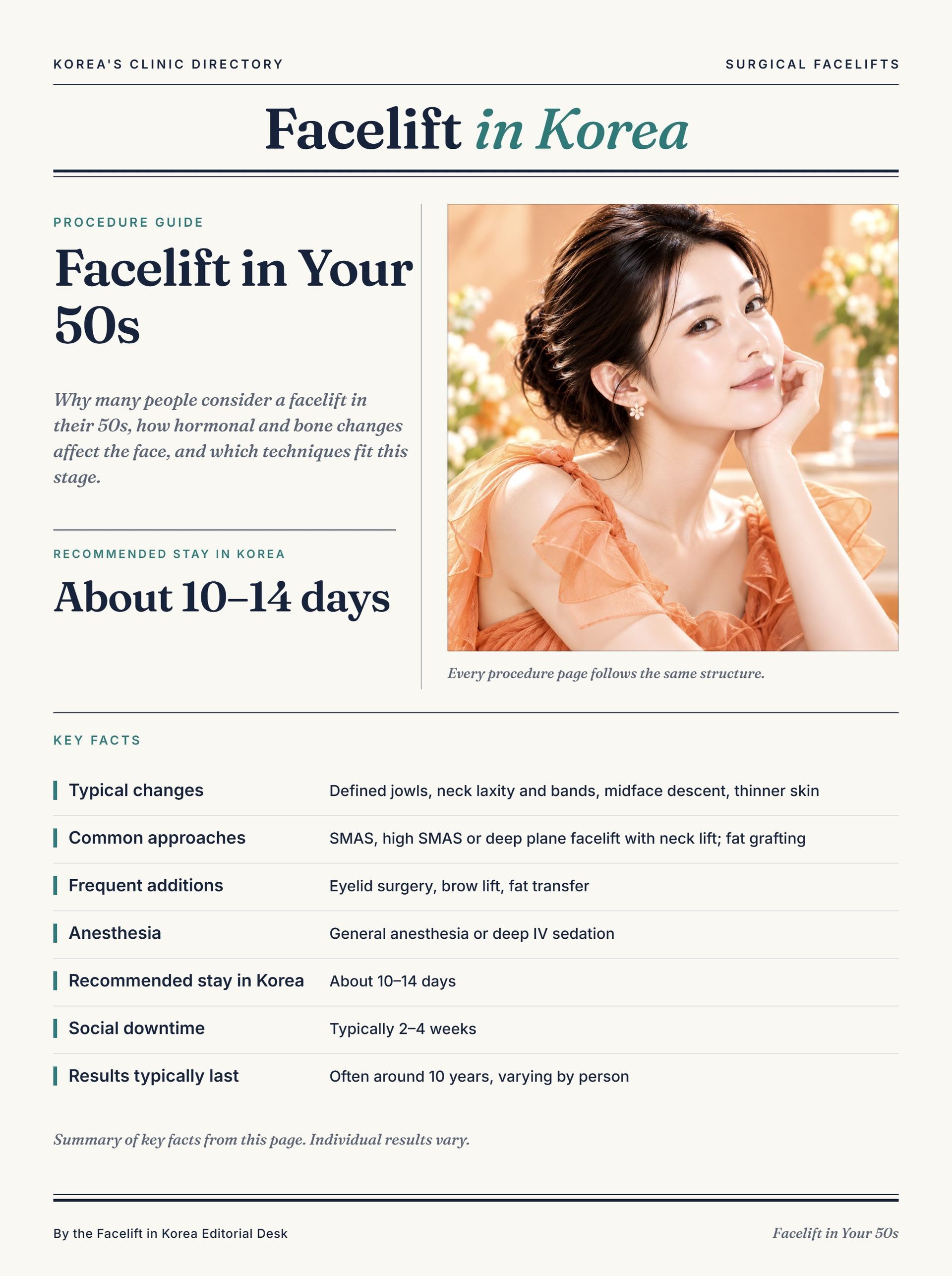
Key facts
| Typical changes | Defined jowls, neck laxity and bands, midface descent, thinner skin |
|---|---|
| Common approaches | SMAS, high SMAS or deep plane facelift with neck lift; fat grafting |
| Frequent additions | Eyelid surgery, brow lift, fat transfer |
| Anesthesia | General anesthesia or deep IV sedation |
| Recommended stay in Korea | About 10–14 days |
| Social downtime | Typically 2–4 weeks |
| Results typically last | Often around 10 years, varying by person |
| Price guide | Facelift cost in Korea overview |
Read next
Reader questions
Frequently asked questions
Is 50s the best age for a facelift?
It is the most common decade for a first facelift because sagging is usually clear while skin still heals well. The best age is individual, though.
Which facelift is best for someone in their 50s?
Most people in their 50s benefit from a SMAS or deep plane facelift combined with a neck lift. The best technique depends on your anatomy and your surgeon's experience.
Does menopause affect facelift results?
Menopause can thin the skin and speed collagen loss, but it does not prevent a good result. Skin care and sun protection help maintain results.
Can I combine eyelid surgery with a facelift in my 50s?
Yes, this is very common. It adds some operating time and swelling, so discuss whether it suits your health and goals.
How long should I stay in Seoul?
Most clinics recommend about 10–14 days, especially if procedures are combined.
Next steps
Planning a facelift in Korea?
Compare clinics, check surgeon credentials and estimate your full trip budget before you book a consultation.
Facelift in Korea is an independent information directory. We do not perform procedures, and listings are not endorsements. This page is general information, not medical advice.