


Home › Surgical Facelifts › Facelift in Your 60s
Surgical Facelifts
Facelift in Your 60s: Options in Seoul, Korea
By the Facelift in Korea Editorial Desk · Independent · How we report

The short answer
Quick answer: In your 60s, sagging of the jowls, neck and midface is usually more advanced, and skin is thinner. A deep plane or SMAS facelift with a neck lift, often combined with fat grafting, is commonly recommended. Good general health matters more than age. Careful medical screening and a slightly longer recovery are wise. Plan about 14 days in Korea.
What changes do surgeons see in the 60s?
By the 60s, most faces show a combination of sagging, volume loss and skin changes:
- Heavier jowls and a less defined jawline
- Loose neck skin, often with prominent bands (sometimes called a turkey neck)
- Deep nasolabial folds and marionette lines
- Thinner skin with fine wrinkles and sun damage
- Hollowing in the temples, cheeks and around the eyes as fat and bone diminish
This means a lift alone may not fully restore a youthful shape. Many surgeons combine lifting with volume restoration and, where appropriate, skin treatments.
How does facial structure affect aging in the 60s?
By the 60s, the effect of bone loss around the eye sockets, cheeks and jaw becomes more visible in everyone. In faces with naturally low cheek projection, which is common among East Asian patients, this can make the midface look flatter and the lower face heavier. Some Korean patients now in their 60s had jaw or cheekbone reduction when younger; that earlier surgery changes how soft tissue is supported and should be shared with the surgeon. These are patterns rather than rules, and assessment should be individual.
Is it safe to have a facelift in your 60s?
For healthy people, yes. Many surgeons note that physiological health matters more than age. Facelifts are commonly performed on people in their 60s with good outcomes. Risks do rise with conditions such as high blood pressure, heart disease, diabetes or blood-thinning medication. A thorough pre-operative assessment is essential. This usually includes blood tests, an ECG and, in some cases, a review by an internal medicine doctor.
Which techniques are usually recommended?
- Deep plane facelift: often favored for advanced midface and jowl descent because it moves deeper tissue as a unit.
- SMAS or high SMAS facelift: also widely used, depending on surgeon preference and anatomy.
- Neck lift: usually essential at this age. Some patients need a deep neck lift.
- Fat grafting: to restore lost volume in the cheeks, temples and around the mouth.
- Eyelid or brow surgery: often added for balance.
Short-scar or mini lifts are less commonly suitable at this stage, because there is usually more skin to remove than a short incision allows.
What about skin quality?
A facelift repositions tissue but does not change skin texture. Fine lines, pigmentation and crepey skin may remain. Surgeons may suggest laser resurfacing, chemical peels or skin boosters a few months after surgery to improve texture. Sun protection is important to protect the result.
What is recovery like in your 60s?
Recovery may be somewhat slower than in younger patients:
- Bruising and swelling can take a little longer to fade
- Most people need around 3–4 weeks before feeling socially comfortable
- Numbness around the ears and cheeks may persist for several months
- Gentle walking from the first days helps circulation
Having a companion for the first few days is strongly recommended. The day-by-day recovery guide outlines what to expect.
How long will results last?
Results often last many years, but the face continues to age. Most people still look younger than they would have without surgery a decade later. The how long facelift results last guide explains the factors involved.
Facelifts in your 60s in Seoul: what international patients should know
Many older international patients choose Seoul for its experienced surgeons and organized medical systems. To travel safely:
- Send medical records early. Share your history, medications and recent tests before booking so the clinic can confirm you are a safe candidate.
- Ask about overnight monitoring. An overnight stay at the clinic or an affiliated hospital is sensible for longer operations.
- Allow time to recover before flying. Long flights increase the risk of blood clots. About 14 days in Seoul is a reasonable plan. See the guide to flying home after a facelift.
- Travel with support. A family member or friend can help with daily needs and appointments.
- Check insurance. Consider travel insurance that covers complications from elective surgery.
This page is general information, not medical advice. Decisions about surgery should be made with a qualified, board-certified plastic surgeon after an in-person examination.
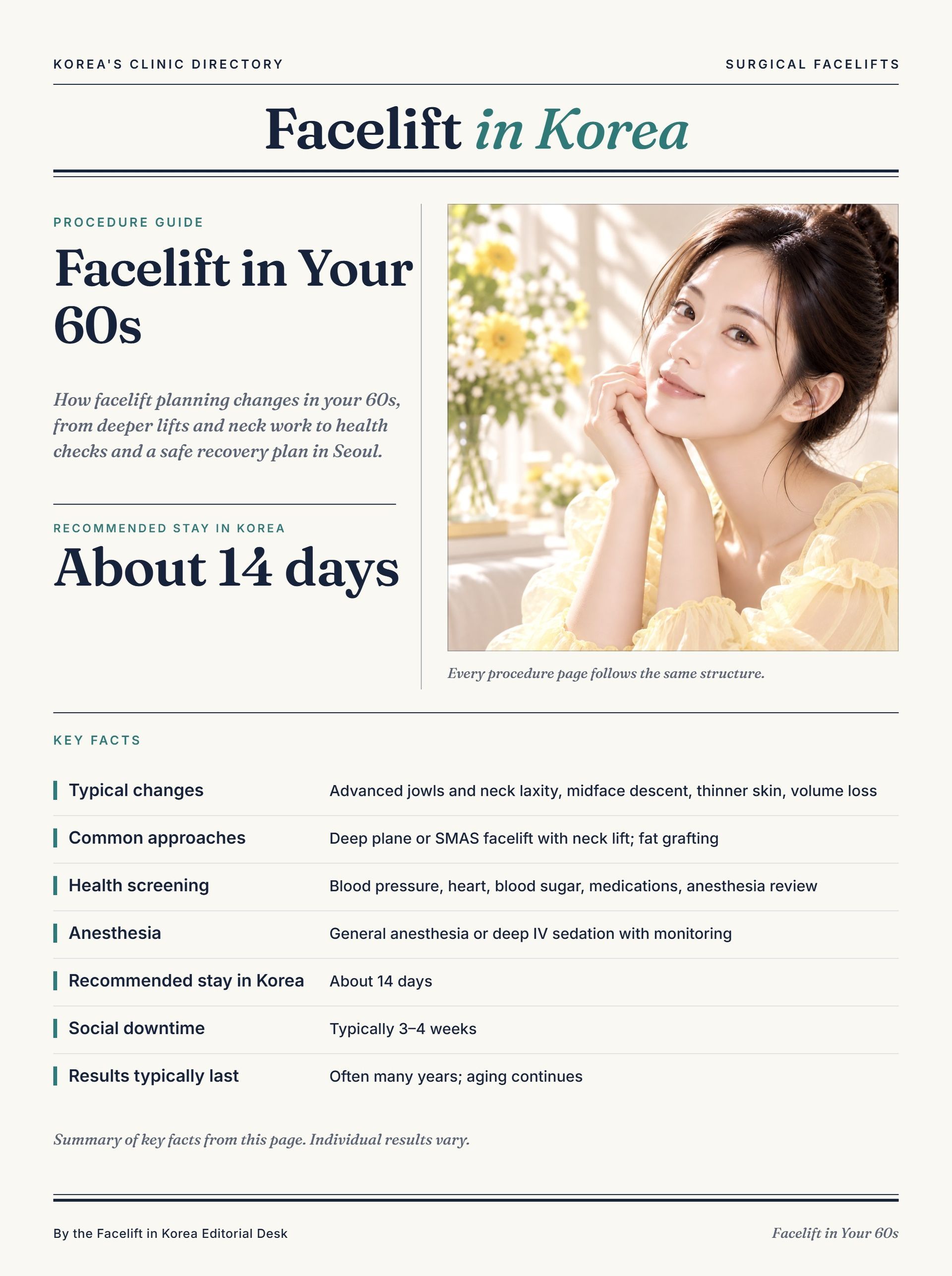
Key facts
| Typical changes | Advanced jowls and neck laxity, midface descent, thinner skin, volume loss |
|---|---|
| Common approaches | Deep plane or SMAS facelift with neck lift; fat grafting |
| Health screening | Blood pressure, heart, blood sugar, medications, anesthesia review |
| Anesthesia | General anesthesia or deep IV sedation with monitoring |
| Recommended stay in Korea | About 14 days |
| Social downtime | Typically 3–4 weeks |
| Results typically last | Often many years; aging continues |
| Price guide | Facelift cost in Korea overview |
Read next
Reader questions
Frequently asked questions
Is 60 too old for a facelift?
No. Many people have facelifts in their 60s with good results. Your general health and medical assessment matter more than your age.
What type of facelift is best in your 60s?
A deep plane or SMAS facelift with a neck lift is commonly recommended, often with fat grafting. The choice depends on your anatomy and the surgeon's experience.
Is recovery longer in your 60s?
It can be a little slower. Most people need around 3–4 weeks before feeling comfortable socially, and full settling takes several months.
Will a facelift fix wrinkles?
A facelift lifts sagging tissue but does not change fine wrinkles or skin texture. Laser, peels or skin treatments can be added later.
How long should I stay in Korea after a facelift in my 60s?
About 14 days is a reasonable plan, allowing for stitch removal, follow-up and a safer flight home.
Next steps
Planning a facelift in Korea?
Compare clinics, check surgeon credentials and estimate your full trip budget before you book a consultation.
Facelift in Korea is an independent information directory. We do not perform procedures, and listings are not endorsements. This page is general information, not medical advice.