


Home › Comparisons › Deep Plane vs SMAS Facelift
Comparison
Deep Plane vs SMAS Facelift: Which Is Right for You in Korea?
By the Facelift in Korea Editorial Desk · Independent · How we report
The short answer
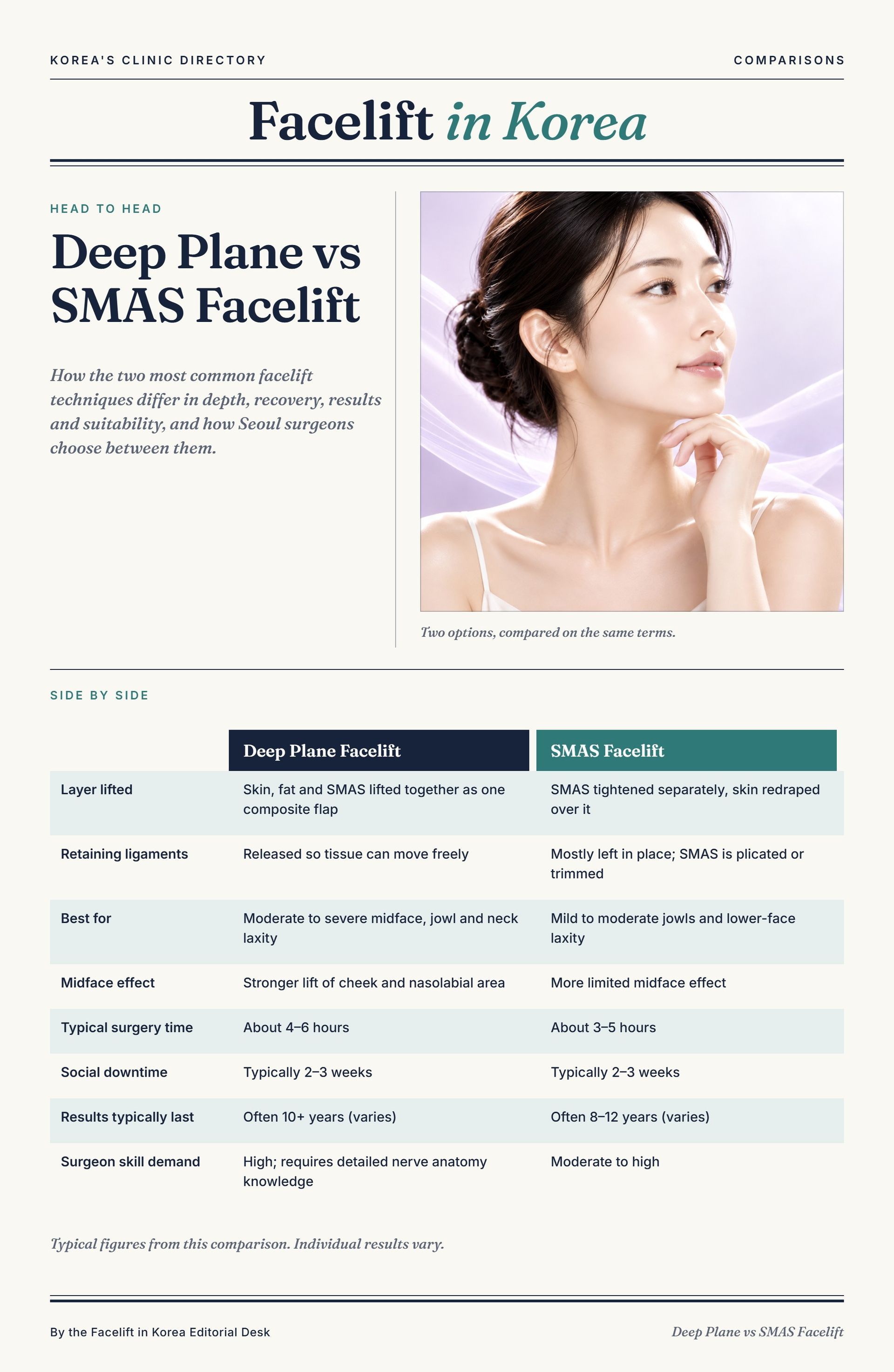
Quick answer: A deep plane facelift releases the retaining ligaments and lifts skin, fat and the SMAS as one unit. A SMAS facelift tightens the SMAS layer by folding or trimming it without fully releasing those ligaments. Choose deep plane if you have heavy midface and jowl descent and want a longer-lasting lift. Choose SMAS if your sagging is moderate and you prefer a well-established, slightly less extensive operation.
Side by side

| Deep Plane Facelift | SMAS Facelift | |
|---|---|---|
| Layer lifted | Skin, fat and SMAS lifted together as one composite flap | SMAS tightened separately, skin redraped over it |
| Retaining ligaments | Released so tissue can move freely | Mostly left in place; SMAS is plicated or trimmed |
| Best for | Moderate to severe midface, jowl and neck laxity | Mild to moderate jowls and lower-face laxity |
| Midface effect | Stronger lift of cheek and nasolabial area | More limited midface effect |
| Typical surgery time | About 4–6 hours | About 3–5 hours |
| Social downtime | Typically 2–3 weeks | Typically 2–3 weeks |
| Results typically last | Often 10+ years (varies) | Often 8–12 years (varies) |
| Surgeon skill demand | High; requires detailed nerve anatomy knowledge | Moderate to high |
| Price guide | Deep plane cost in Korea | SMAS cost in Korea |
What is the core difference between deep plane and SMAS facelifts?
Both operations work on the SMAS, the fibrous layer under the skin and fat that supports the face. The difference is how deep the surgeon goes and what is released.
In a SMAS facelift, the surgeon lifts the skin, then tightens the SMAS by folding it (plication) or removing a strip and stitching the edges (SMASectomy). The retaining ligaments, which anchor soft tissue to bone, mostly stay attached. The skin is then redraped and trimmed.
In a deep plane facelift, the surgeon enters the space below the SMAS and releases key retaining ligaments. Skin, fat and SMAS then move together as one flap. Because the tissue is freed, it can be repositioned with less tension on the skin.
Which technique gives a stronger lift?
Many surgeons say deep plane surgery gives more movement in the midface, the cheek fat and the nasolabial area. This is because ligaments that hold the cheek down are released. SMAS techniques are very effective for jowls and the jawline but tend to have a more limited effect higher in the cheek.
That does not mean deep plane is always better. A skilled SMAS facelift can give an excellent, natural result in the right face. The best technique depends on your anatomy, skin quality and goals, and on the method your surgeon performs most often.
Is recovery different?
Recovery is broadly similar. Most patients have visible swelling and bruising for about two weeks, and feel comfortable in public after two to three weeks. Some surgeons report that deep plane patients have less skin tension and therefore a smoother early appearance, while others note slightly longer swelling. Individual healing varies far more than the technique does. See the facelift recovery timeline for a week-by-week view.
Are the risks different?
Both share the usual facelift risks: hematoma, infection, scarring, numbness and, rarely, facial nerve injury. Deep plane dissection works closer to facial nerve branches, so it demands detailed anatomical skill. In experienced hands, published complication rates are generally reported as comparable. Read more in facelift risks and complications.
Who is a better candidate for each?
- Deep plane may suit you if you have heavy jowls, a descended midface, deep nasolabial folds, or you want a long-lasting result from a single operation.
- SMAS may suit you if your laxity is mainly along the jawline and neck, your midface is still well supported, or you prefer a well-established technique with a long track record.
- Either may need extras such as a neck lift, fat grafting or eyelid surgery for a complete result.
How do Seoul clinics present these techniques?
In Seoul, "deep plane" has become a popular marketing term, and many Gangnam clinics advertise it. International patients should know that the label alone tells you little. Some clinics use it for a true sub-SMAS release with ligament division; others use it loosely. Ask your surgeon which ligaments are released, which layer is lifted, and how many of these operations they perform each year.
Korean surgeons also often tailor facelifts to East Asian facial structure, which tends to have a wider midface, heavier soft tissue and a stronger tendency to scar. This can influence the choice of technique and incision. If you are comparing quotes, the price difference between the two is usually modest; check the cost pages before deciding. The guide on choosing a facelift surgeon in Korea lists the questions to ask.
What should I ask at my consultation?
- Which layer will you lift, and will you release the retaining ligaments?
- Why do you recommend this technique for my face rather than the other?
- How long do you expect my result to last, and what touch-ups are typical?
- Who performs every step of the operation, and who handles aftercare?
This page is general information, not medical advice. Decisions about surgery should be made with a qualified, board-certified plastic surgeon after an in-person examination.
Reader questions
Frequently asked questions
Is a deep plane facelift better than a SMAS facelift?
Not automatically. Deep plane surgery usually gives more midface movement, while SMAS surgery is excellent for jowls and the jawline. The better choice depends on your anatomy and on which technique your surgeon performs most often and most safely.
Does a deep plane facelift last longer?
Many surgeons believe it lasts somewhat longer because tissue is repositioned with less skin tension. Real longevity depends on age, skin quality, weight stability and lifestyle. Both techniques typically last many years.
Is recovery longer after a deep plane facelift?
Recovery is usually similar, with most patients socially comfortable after two to three weeks. Some patients swell for longer, but individual healing varies more than the technique does.
Is a deep plane facelift riskier?
Deep plane dissection works closer to facial nerve branches, so surgeon experience matters a great deal. In experienced hands, overall complication rates are generally reported as similar to SMAS techniques.
Are deep plane facelifts common in Korea?
Yes. Many Seoul clinics advertise deep plane facelifts, but the term is used loosely. Ask exactly which ligaments are released and which layer is lifted to understand what you are being offered.
Next steps
Planning a facelift in Korea?
Compare clinics, check surgeon credentials and estimate your full trip budget before you book a consultation.
Facelift in Korea is an independent information directory. We do not perform procedures, and listings are not endorsements. This page is general information, not medical advice.