


Home › Surgical Facelifts › Facelift After Major Weight Loss
Surgical Facelifts
Facelift After Major Weight Loss in Seoul, Korea
By the Facelift in Korea Editorial Desk · Independent · How we report

The short answer
Quick answer: After major weight loss, the face and neck can show loose skin, deep folds and hollow cheeks, sometimes called "Ozempic face" when linked to GLP-1 medications. A facelift with neck lift can remove excess skin and reposition tissue, often combined with fat grafting to restore volume. Most surgeons advise waiting until weight has been stable for six to twelve months. Plan about 14 days in Korea.
How does major weight loss change the face?
Fat in the face helps support the skin and gives softness to the cheeks, temples and jawline. When a person loses a large amount of weight, facial fat shrinks along with body fat. Skin that was stretched may not shrink back fully, especially in people over 40 or after rapid loss. Common changes include:
- Loose skin along the jawline and neck
- Deeper nasolabial folds and marionette lines
- Hollow cheeks and temples
- A tired or older appearance than before the weight loss
These changes have become more widely discussed with the rise of GLP-1 medications such as semaglutide and tirzepatide. The phrase "Ozempic face" is informal, but it describes a real pattern of facial deflation after fast weight loss.
The pattern differs between faces. People with fuller cheeks and a flatter midface, a structure common in many East Asian faces, often notice heaviness and loose skin at the jaw and neck first. People with thinner skin and prominent cheekbones may notice hollow temples and cheeks more. A surgeon will look at which change dominates before planning.
When is the right time for a facelift after weight loss?
Most surgeons recommend waiting until your weight has been stable for about six to twelve months. This matters because:
- Further loss after surgery can loosen the result
- Regaining weight can change facial shape and stretch the skin again
- Nutrition needs to be good for healing, which can be a concern after bariatric surgery or very restrictive dieting
If you are still on a GLP-1 medication, discuss your plans openly. Some anesthesia teams ask patients to pause these drugs before surgery because they slow stomach emptying, which can affect anesthesia safety. Never stop a medication without your prescribing doctor's advice.
Which surgical approaches are used?
Because weight loss causes both loose skin and volume loss, a combined plan is common:
- Facelift: a deep plane or SMAS facelift to lift the cheeks and jowls and remove excess skin.
- Neck lift: often essential, as the neck may have the most loose skin. Some patients also need platysma tightening.
- Fat grafting: facial fat transfer restores volume to hollow cheeks, temples and under the eyes. Some patients have less spare fat after weight loss, which can limit how much is available.
- Fillers or biostimulators: an alternative or supplement when fat is limited.
Lifting alone can make a deflated face look tight and thin. Restoring some volume is often what makes the result look healthy. The facelift vs fat grafting comparison explains how the two work together.
Can non-surgical treatments help?
For mild changes, non-surgical options may be enough, at least at first:
- Biostimulators such as Sculptra gradually rebuild volume by encouraging collagen
- Hyaluronic acid fillers restore volume in specific areas
- Energy devices may improve mild skin laxity
When skin excess is significant, these cannot remove it, and surgery is usually needed for a clear improvement. See facial volume loss for more options.
What is recovery like?
Recovery is similar to a standard facelift with neck lift, with some added swelling from fat grafting. Expect stitches out around day 7–14, social comfort at around two to four weeks, and the final result at three to six months. Some grafted fat will be reabsorbed in the first few months, so surgeons often add a little extra. Good protein intake supports healing; discuss nutrition with your doctor, especially after bariatric surgery.
Facelifts after weight loss in Seoul: what international patients should know
Seoul clinics are seeing growing interest from patients after GLP-1 treatment, and fat grafting is a well-developed specialty in Korea. Practical points:
- Share your full history. Include how much weight you lost, over what period, any bariatric surgery and all current medications.
- Ask about fat supply. If you are now very lean, ask whether there is enough fat for grafting or whether fillers would be used.
- Bring recent blood tests. Iron, protein and vitamin levels can matter after major weight loss.
- Plan about 14 days in Seoul. Allow time for checks before flying.
This page is general information, not medical advice. Decisions about surgery should be made with a qualified, board-certified plastic surgeon after an in-person examination.
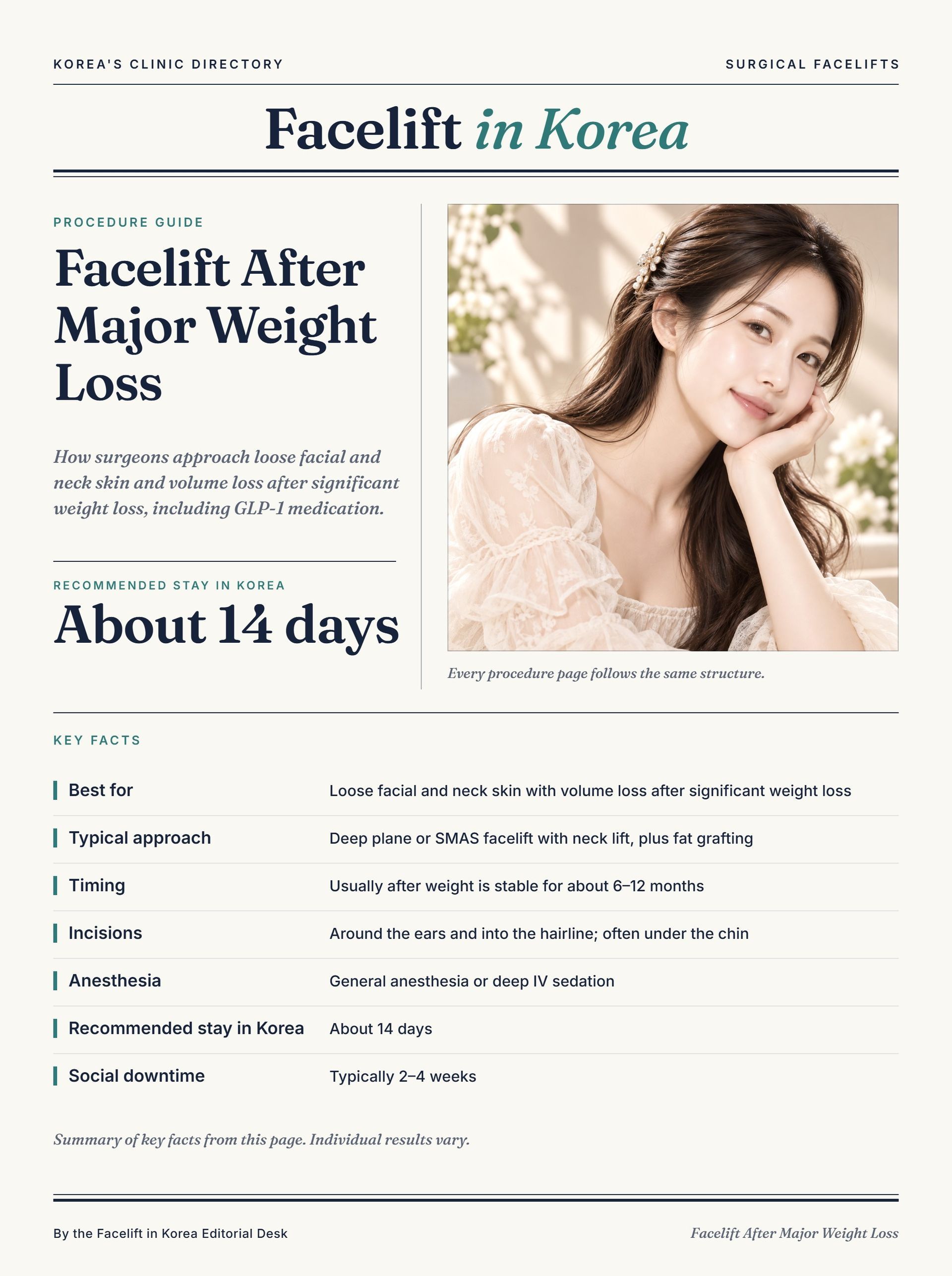
Key facts
| Best for | Loose facial and neck skin with volume loss after significant weight loss |
|---|---|
| Typical approach | Deep plane or SMAS facelift with neck lift, plus fat grafting |
| Timing | Usually after weight is stable for about 6–12 months |
| Incisions | Around the ears and into the hairline; often under the chin |
| Anesthesia | General anesthesia or deep IV sedation |
| Recommended stay in Korea | About 14 days |
| Social downtime | Typically 2–4 weeks |
| Price guide | Facial fat grafting cost in Korea |
Read next
Reader questions
Frequently asked questions
What is Ozempic face, and can a facelift fix it?
"Ozempic face" is an informal term for facial deflation and sagging after rapid weight loss on GLP-1 medications. A facelift can remove loose skin and lift tissue, and fat grafting or fillers can restore volume.
How long should I wait after weight loss before a facelift?
Most surgeons recommend waiting until your weight has been stable for about six to twelve months, so the result is not affected by further changes.
Do I need to stop GLP-1 medication before a facelift?
Many anesthesia teams ask patients to pause these drugs for a period before surgery because they slow stomach emptying. Follow your surgeon's and prescribing doctor's advice.
Will I have enough fat for fat grafting after losing weight?
Usually only a small amount is needed for the face, so most people have enough. Very lean patients may need fillers instead or as well.
Can I combine a facelift with body contouring in Seoul?
Some patients do, but combining face and body surgery adds operating time and risk. Many surgeons prefer to stage them.
Next steps
Planning a facelift in Korea?
Compare clinics, check surgeon credentials and estimate your full trip budget before you book a consultation.
Facelift in Korea is an independent information directory. We do not perform procedures, and listings are not endorsements. This page is general information, not medical advice.