


Home › Non-Surgical Lifting › RF Skin Tightening (Thermage-type)
Non-Surgical Lifting
RF Skin Tightening in Seoul, Korea (Thermage-Type Treatments)
By the Facelift in Korea Editorial Desk · Independent · How we report
The short answer
Quick answer: RF skin tightening uses radiofrequency energy to heat the dermis and the fibrous tissue beneath it. The heat contracts existing collagen and triggers new collagen over two to six months. It suits mild skin laxity and crepey texture, not heavy jowls. Most people need one session a year, with little or no downtime.
What is RF skin tightening?
Radiofrequency (RF) skin tightening is a non-invasive treatment that uses electrical energy to heat tissue. A handpiece touches the skin and delivers RF current into the dermis, the thick layer of skin that holds collagen. The goal is controlled heating, not burning.
When collagen is heated to the right range, the fibers contract. Over the following months, the body also lays down new collagen as part of a healing response. The result is skin that feels firmer and looks smoother. It is a modest change, and it builds slowly.
"Thermage-type" is a common shorthand in Korea for monopolar RF devices that deliver deep, even heat in a single session. You can read a plain definition of the energy itself in our radiofrequency glossary entry.
How does monopolar RF differ from bipolar RF?
The difference is the path the current takes.
- Monopolar RF sends energy from one electrode on the face to a return pad on the body. Heat reaches deeper, so one treatment per year is the usual plan. Thermage FLX, Oligio and Volnewmer work this way.
- Bipolar RF passes current between two electrodes in the same tip. Heat stays more superficial. Sessions feel like a warm massage and are repeated weekly for a series. InMode Forma is a typical example.
- RF microneedling delivers RF through fine needles. It treats texture and scars as well as laxity, but has a few days of downtime.
RF is often compared with focused ultrasound. Our HIFU vs RF comparison explains which layer each one targets.
Who is a good candidate for RF tightening?
RF tightening works best for people in their 30s to early 50s with early, mild changes. Typical goals include:
- Slightly loose skin along the jawline or under the chin
- Fine crepey texture on the cheeks or neck
- Hooding or crinkling of the upper and lower eyelid skin
- Maintenance after a surgical facelift, to keep the skin in good condition
It is not a replacement for surgery. If you have heavy jowls, deep folds or a loose neck band, no energy device will lift tissue the way a facelift does. Read surgical vs non-surgical facelift for an honest look at that line.
People with pacemakers, metal implants in the treatment area, active skin infection or pregnancy are usually advised not to have RF.
What happens during a treatment?
A typical monopolar RF visit in Seoul takes 60 to 90 minutes. The skin is cleansed and photographed. Numbing cream is applied for 30 to 40 minutes. A temporary grid may be marked on the skin to guide even coverage.
The practitioner then moves the tip across the face, pulse by pulse. Each pulse feels like a short burst of deep heat followed by cooling. Patients can usually give feedback so the energy can be adjusted.
Afterward, the skin is pink and may feel slightly swollen. Most people go straight back to sightseeing or work. Makeup is usually fine the next day.
How is RF tightening offered in Seoul?
RF devices are part of everyday skincare in Korea. Clinics in Gangnam and Apgujeong advertise them widely, and many price them by "shots" (the number of pulses). More shots mean more coverage and usually a higher fee.
International patients should know a few things:
- Ask which device and tip will be used, and whether the tip is new and genuine. Ask to see the sealed tip if this matters to you.
- Ask who performs it. In some clinics, a doctor treats; in others, a nurse or aesthetician does it under a doctor's supervision.
- Compare shot counts, not just prices. A cheap offer may use far fewer pulses.
- RF can be done on the day you arrive or the day before you fly, as downtime is minimal.
Our guide to registered foreign-patient clinics explains how to check a clinic's legal status.
What results and risks are realistic?
Expect subtle firming, smoother texture and a slightly crisper jawline. Many people notice the change only when comparing photos taken three to six months apart. Results are not permanent, because aging continues.
Side effects are usually mild: redness, swelling and tenderness for a day or two. Rare risks include burns, blisters, small dents from fat loss, and temporary numbness. These are more likely with excessive energy or poor technique, which is why training matters more than the brand.
This page is general information, not medical advice. Decisions about surgery should be made with a qualified, board-certified plastic surgeon after an in-person examination.
Key facts
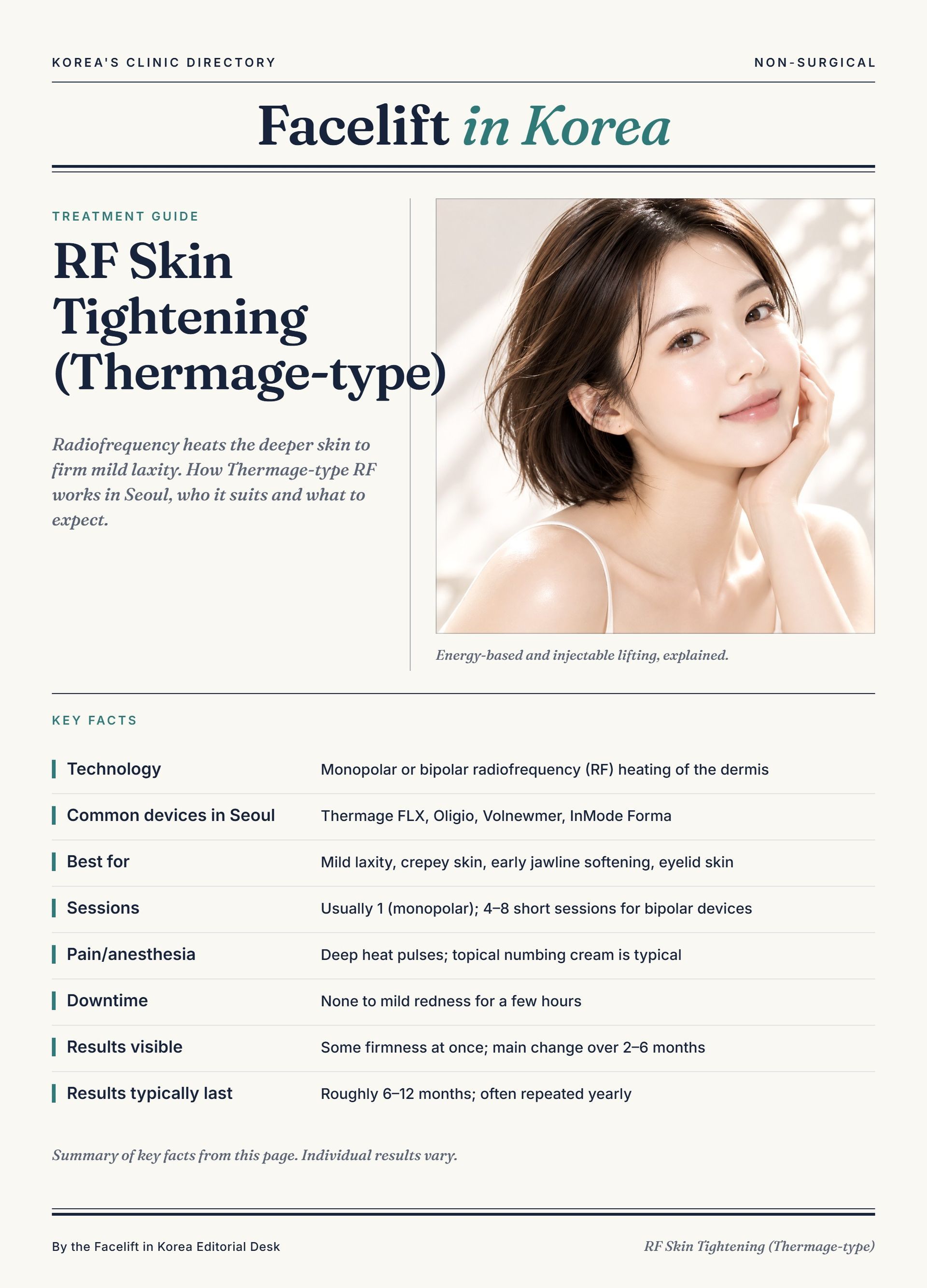
| Technology | Monopolar or bipolar radiofrequency (RF) heating of the dermis |
|---|---|
| Common devices in Seoul | Thermage FLX, Oligio, Volnewmer, InMode Forma |
| Best for | Mild laxity, crepey skin, early jawline softening, eyelid skin |
| Sessions | Usually 1 (monopolar); 4–8 short sessions for bipolar devices |
| Pain/anesthesia | Deep heat pulses; topical numbing cream is typical |
| Downtime | None to mild redness for a few hours |
| Results visible | Some firmness at once; main change over 2–6 months |
| Results typically last | Roughly 6–12 months; often repeated yearly |
| Price guide | Thermage cost in Korea |
Read next
Reader questions
Frequently asked questions
Is RF skin tightening painful?
Most people describe it as hot, prickly pulses that are uncomfortable but tolerable. Numbing cream is standard in Seoul. Newer devices add vibration or cooling to reduce discomfort.
How soon will I see results from RF tightening?
Some people see slight firming straight away. The main improvement develops over two to six months as new collagen forms. Plan photos at three and six months to judge the change.
Can RF tightening replace a facelift?
No. RF can improve mild laxity and skin quality, but it does not reposition sagging deep tissue. People with significant jowls or neck laxity usually get more from surgery.
How often should I repeat RF skin tightening?
Single-session monopolar treatments are commonly repeated every 12 months. Bipolar devices are done as a series of weekly visits and then maintained every few months.
Can I combine RF with HIFU in Korea?
Yes, many Seoul clinics combine RF and HIFU on the same day or in the same week. HIFU targets deeper support layers while RF works on the dermis. Ask the doctor to plan energy levels so the skin is not overtreated.
Next steps
Planning a facelift in Korea?
Compare clinics, check surgeon credentials and estimate your full trip budget before you book a consultation.
Facelift in Korea is an independent information directory. We do not perform procedures, and listings are not endorsements. This page is general information, not medical advice.