


Home › Non-Surgical Lifting › HIFU Lifting
Non-Surgical Lifting
HIFU Lifting in Seoul, Korea: How Focused Ultrasound Works
By the Facelift in Korea Editorial Desk · Independent · How we report
The short answer
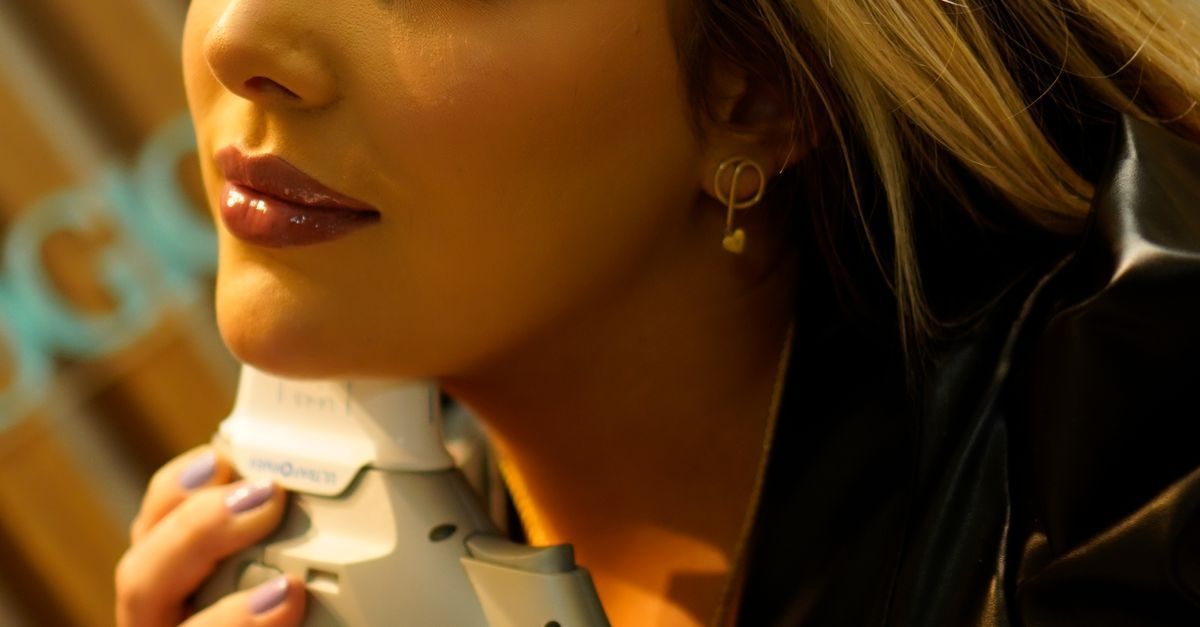
Quick answer: HIFU lifting uses focused ultrasound to create tiny heated points at set depths, including the SMAS layer that surgeons tighten in a facelift. Collagen remodels over two to three months, giving a mild lift and firmer contour. It suits early sagging. Downtime is minimal, and results usually last six to twelve months.
What is HIFU lifting?
HIFU stands for high-intensity focused ultrasound. A handheld transducer focuses ultrasound energy to a precise depth under the skin, much as a magnifying glass focuses sunlight. At the focal point, tissue heats to a level that causes tiny areas of coagulation. The skin surface in between is left largely intact.
Your body responds by remodeling collagen in those areas over the next few months. The tissue contracts slightly, which can lift and firm the face.
What makes HIFU different from most lasers and RF devices is depth. Cartridges commonly target 1.5 mm, 3.0 mm and 4.5 mm. The 4.5 mm depth reaches the SMAS, the muscle-and-fascia layer that a surgical facelift repositions. Our HIFU glossary entry gives a short definition.
Which HIFU devices are used in Korea?
Korea is one of the world's busiest HIFU markets, and several devices are made locally.
- Ultherapy (Merz Aesthetics) adds real-time ultrasound imaging, so the operator can see the layers being treated.
- Shurink is the Korean market name used by Classys, a Seoul manufacturer whose international HIFU line is called Ultraformer.
- Doublo is made by Hironic, another Korean company.
Local devices are usually priced lower per session than Ultherapy, so many Seoul patients use them for regular "maintenance" lifting. See Shurink vs Ultherapy for a side-by-side view.
Who is a good candidate for HIFU?
HIFU works best for people with good skin quality and mild to moderate laxity. Typical goals include:
- A softer jawline or early jowls
- Mild drooping of the outer brow
- A little looseness under the chin
- Keeping results longer after a facelift
It is less helpful for very thin faces, since heating can reduce fat further and make hollows more obvious. It also cannot remove heavy loose skin. If your main concern is deep folds or a hanging neck, see the jowl lifting page for surgical and non-surgical options side by side.
What does a HIFU session feel like?
Each pulse produces a deep, prickly heat that can feel sharp over bony areas such as the jawline and temples. Comfort varies a lot between people and devices.
In Seoul, clinics usually apply numbing cream for 30 to 40 minutes. Some offer oral pain relief. A full-face session takes 30 to 90 minutes depending on the number of lines.
After treatment the skin may be slightly pink and tender. Some people feel the jaw is sore when chewing for a few days. Mild swelling is common, especially at the jawline. Most go back to normal activity the same day.
How is HIFU priced and offered in Seoul?
Seoul clinics nearly always quote HIFU by the number of "shots" or "lines." For example, a package may include several hundred lines across the face and neck. Real prices vary widely, so compare like with like.
Tips for international patients:
- Ask which cartridge depths will be used, and on which areas.
- Ask whether a doctor performs the treatment or supervises it.
- Ask whether the cartridge is genuine and new. Refilled or counterfeit cartridges are a known concern in the market.
- HIFU fits easily into a short trip. If you are also having surgery, ask your surgeon about timing, as energy devices are usually avoided on recently operated skin.
What are the risks and limits?
HIFU is generally considered low risk in trained hands. Common effects are redness, swelling, tenderness and occasional bruising. Less common are temporary numbness, raised welts and small burns. Rarely, nerve irritation can cause temporary weakness. Unwanted fat loss can make a thin face look more gaunt.
Results are moderate. Many patients see a natural improvement in contour; some see little change. No study can promise a specific lift for an individual. Judge the result at three months, not three days.
What can HIFU be combined with?
HIFU treats deep support layers, so it pairs well with treatments that work elsewhere. Common Seoul combinations include RF for the skin surface, skin boosters for hydration and texture, and small amounts of filler where volume has been lost. Some clinics also add a few threads for a more visible lift. Ask for a written plan that lists every product and device, and space the visits so swelling can settle between steps.
This page is general information, not medical advice. Decisions about surgery should be made with a qualified, board-certified plastic surgeon after an in-person examination.
Key facts
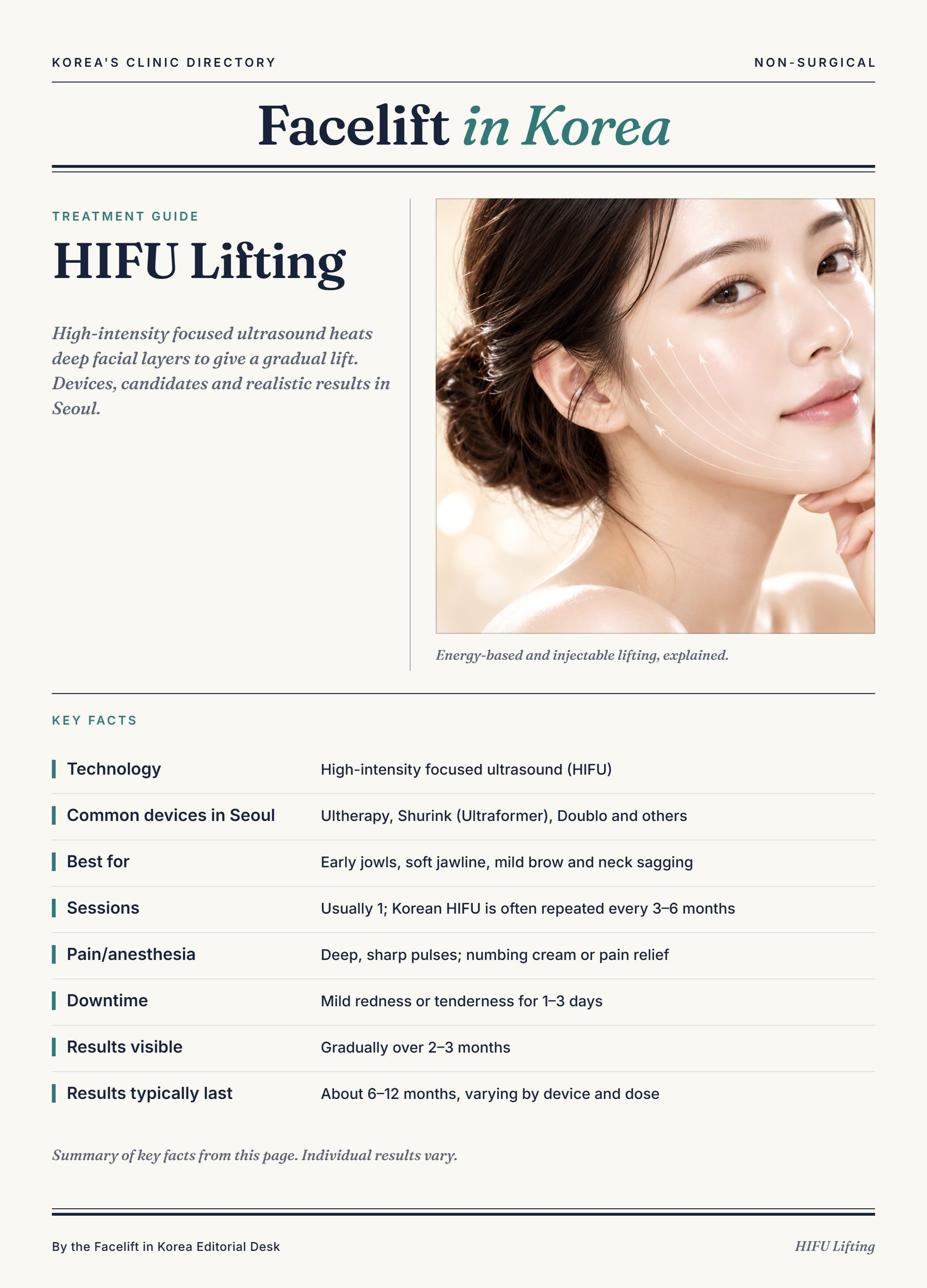
| Technology | High-intensity focused ultrasound (HIFU) |
|---|---|
| Common devices in Seoul | Ultherapy, Shurink (Ultraformer), Doublo and others |
| Best for | Early jowls, soft jawline, mild brow and neck sagging |
| Sessions | Usually 1; Korean HIFU is often repeated every 3–6 months |
| Pain/anesthesia | Deep, sharp pulses; numbing cream or pain relief |
| Downtime | Mild redness or tenderness for 1–3 days |
| Results visible | Gradually over 2–3 months |
| Results typically last | About 6–12 months, varying by device and dose |
| Price guide | Non-surgical lifting cost in Korea |
Read next
Reader questions
Frequently asked questions
How long does HIFU lifting last?
For most people, results last roughly six to twelve months. Ultherapy is often repeated yearly, while Korean HIFU devices are commonly repeated every three to six months. Aging continues, so results fade gradually.
Is HIFU better than RF?
They do different jobs. HIFU reaches the deeper SMAS layer for lifting, while RF heats the dermis more broadly for tightening and texture. Many Seoul clinics combine the two.
Does HIFU make your face thinner?
It can slightly reduce fat in some areas, especially at the deeper cartridge depths. In fuller faces this may look slimmer; in thin faces it can look hollow. Tell the doctor if you are worried about volume loss.
Can I do HIFU the day before flying home?
Yes, most people can fly the next day because downtime is minimal. Expect some tenderness and mild swelling. Avoid saunas and very hot baths for a few days.
At what age should I start HIFU?
There is no fixed age. People often start in their mid-30s to 40s when early laxity appears. It is most useful while the skin still has good elasticity.
Next steps
Planning a facelift in Korea?
Compare clinics, check surgeon credentials and estimate your full trip budget before you book a consultation.
Facelift in Korea is an independent information directory. We do not perform procedures, and listings are not endorsements. This page is general information, not medical advice.