


Home › Non-Surgical Lifting › MINT Lift (PDO Threads)
Non-Surgical Lifting
MINT Lift in Seoul, Korea: Barbed PDO Thread Lifting
By the Facelift in Korea Editorial Desk · Independent · How we report
The short answer
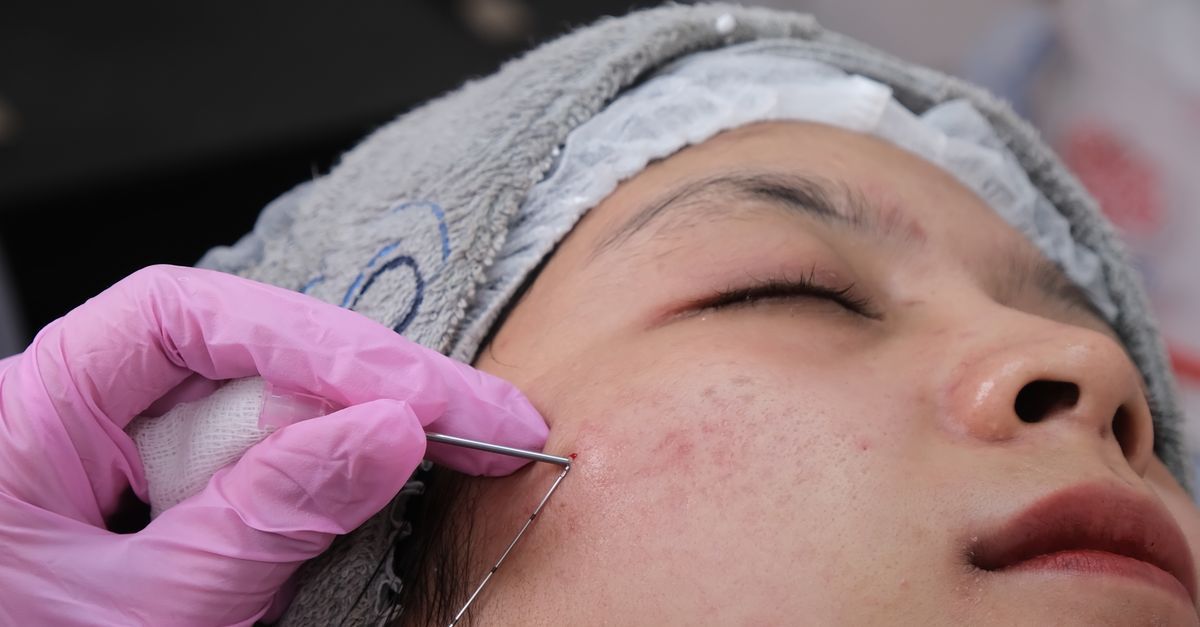
Quick answer: A MINT lift uses MINT threads, barbed dissolvable PDO (polydioxanone) sutures made by HansBiomed in Seoul. Threads are placed under the skin with a needle or cannula to lift the midface, jowls or brow, and they stimulate collagen as they dissolve. Recovery takes a few days to a week, and results typically last around a year.
What is a MINT lift?
MINT is a brand of lifting thread made by HansBiomed, a medical device company based in Seoul. The threads are made of PDO (polydioxanone), the same absorbable material used in surgical sutures for decades. Each MINT thread has small barbs along its length. The barbs grip the soft tissue under the skin, so the thread can hold it in a lifted position.
Over the following months the PDO slowly dissolves. As it breaks down, the body forms a light layer of collagen around the thread track. That is why thread lifts are described as giving both an immediate lift and a gradual firming effect.
In the US, the manufacturer states that MINT holds FDA 510(k) clearances; as with any device, clearance relates to specific uses, so ask your doctor what it covers.
How does MINT differ from basic PDO threads?
"PDO threads" is a broad category. Smooth "mono" threads have no barbs and are used mainly for skin quality. Barbed or "cog" threads, including MINT, are used for lifting.
MINT's barbs are made by pressing the thread into shape rather than cutting it. The manufacturer says this keeps the thread stronger. Whether that leads to a better result for you depends far more on the doctor's planning and technique than on the brand. Our MINT vs standard PDO threads comparison goes into more detail, and the general PDO thread lift page covers the wider category.
Who is a good candidate for a MINT lift?
A thread lift suits people with mild to moderate sagging and reasonable skin thickness. Common requests include:
- Lifting soft cheeks that have started to slide downward
- Sharpening an early jowl or a blurred jawline
- Raising the tail of the brow slightly
- A short-term lift before an event, with little time off
It is less suitable for heavy, loose skin, a very thin face, or significant neck laxity. In those cases, threads may give a small, short-lived change or create visible ridges. A consultation should be honest about this. See facelift vs thread lift to understand where the line usually falls.
What happens during the procedure?
The face is marked while you sit up, so the doctor can plan the direction of lift. Local anesthetic is injected at the entry points and along the planned paths. Some clinics in Seoul add light IV sedation.
Threads are inserted through a few tiny entry points, usually near the hairline or in front of the ear. A blunt cannula or needle guides each thread under the skin. The doctor then adjusts the tissue over the barbs and trims the ends. The procedure usually takes 30 to 60 minutes. There are no stitches to remove.
What should international patients know in Seoul?
Thread lifting is extremely common in Seoul, and many clinics advertise it alongside HIFU and filler. A few points matter for visitors:
- Stay at least five to seven days if you can. Early swelling, asymmetry or a thread that needs adjustment are easier to manage in person.
- Confirm the exact product and the number of threads. Prices are often quoted per thread or per side.
- Ask who performs the procedure and whether follow-up is included.
- Avoid wide mouth opening, dental work and facial massage for a few weeks, which can be awkward when you are traveling.
What are the risks and recovery?
Swelling, bruising and a tight feeling are common for several days. Small dimples or puckering near entry points often settle within one to two weeks. Many people feel a pulling sensation when smiling or chewing at first.
Less common problems include infection, a thread end poking through the skin, visible lines, persistent asymmetry, and nerve irritation. Threads can sometimes be removed if they cause trouble, especially early on.
For the first two to three weeks, doctors commonly advise sleeping on your back, avoiding saunas and intense exercise, and eating soft food if chewing feels tight.
This page is general information, not medical advice. Decisions about surgery should be made with a qualified, board-certified plastic surgeon after an in-person examination.
Key facts
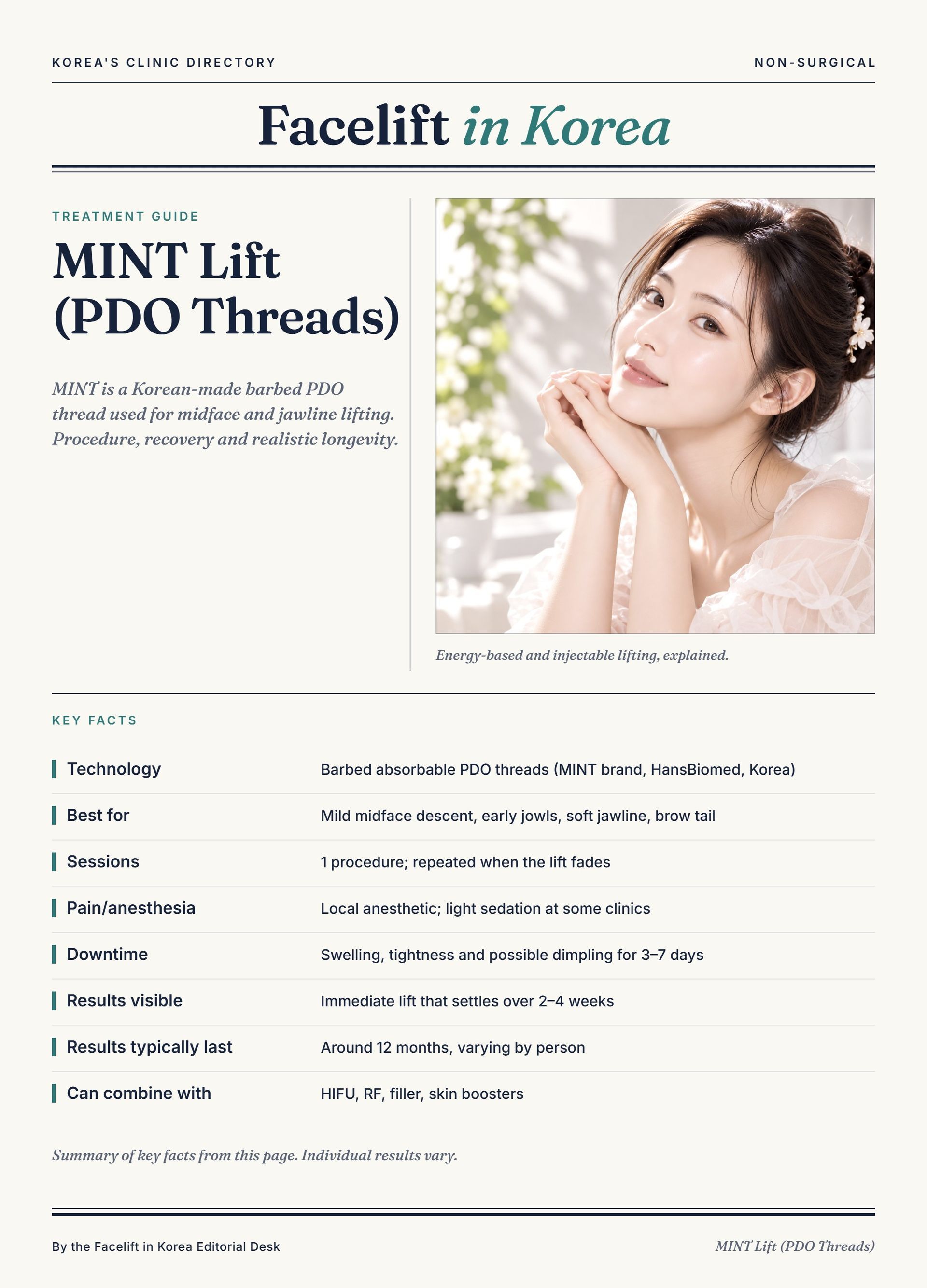
| Technology | Barbed absorbable PDO threads (MINT brand, HansBiomed, Korea) |
|---|---|
| Best for | Mild midface descent, early jowls, soft jawline, brow tail |
| Sessions | 1 procedure; repeated when the lift fades |
| Pain/anesthesia | Local anesthetic; light sedation at some clinics |
| Downtime | Swelling, tightness and possible dimpling for 3–7 days |
| Results visible | Immediate lift that settles over 2–4 weeks |
| Results typically last | Around 12 months, varying by person |
| Can combine with | HIFU, RF, filler, skin boosters |
| Price guide | Thread lift cost in Korea |
Read next
Reader questions
Frequently asked questions
How long does a MINT lift last?
The lift typically lasts around 12 months, though this varies by person, number of threads and how much laxity there was to begin with. The PDO dissolves over several months while collagen around the thread tracks helps maintain some firmness.
Does a MINT thread lift hurt?
Local anesthetic is used, so most people feel pressure and pulling rather than sharp pain. Soreness and tightness are common for a few days afterward. Simple pain relievers are usually enough.
When can I fly after a thread lift?
Many people fly two to five days after a thread lift. Swelling and tenderness may still be present. Ask your doctor before booking, especially if a long-haul flight is involved.
Can MINT threads be removed?
Barbed threads can sometimes be removed, particularly in the first weeks after placement. Removal becomes harder as tissue forms around the thread. Most minor irregularities settle without removal.
Is a thread lift the same as a mini facelift?
No. A mini facelift is surgery that lifts and secures deeper tissue and removes skin. A thread lift suspends tissue with dissolvable threads and does not remove skin, so its effect is smaller and temporary.
Next steps
Planning a facelift in Korea?
Compare clinics, check surgeon credentials and estimate your full trip budget before you book a consultation.
Facelift in Korea is an independent information directory. We do not perform procedures, and listings are not endorsements. This page is general information, not medical advice.