


Home › Comparisons › Facelift in Korea vs USA
Comparison
Facelift in Korea vs USA: Weighing Cost, Convenience and Care
By the Facelift in Korea Editorial Desk · Independent · How we report

The short answer
Quick answer: The USA offers convenient local aftercare, American Board of Plastic Surgery certification and familiar legal protections, usually at a higher price. Korea offers experienced facial surgeons, a soft natural aesthetic and generally lower surgical fees, but requires long travel and remote follow-up. Choose the USA if easy aftercare and local legal recourse matter most. Choose Korea if you value Seoul surgeons' facial expertise and can plan a two-week trip.
Side by side
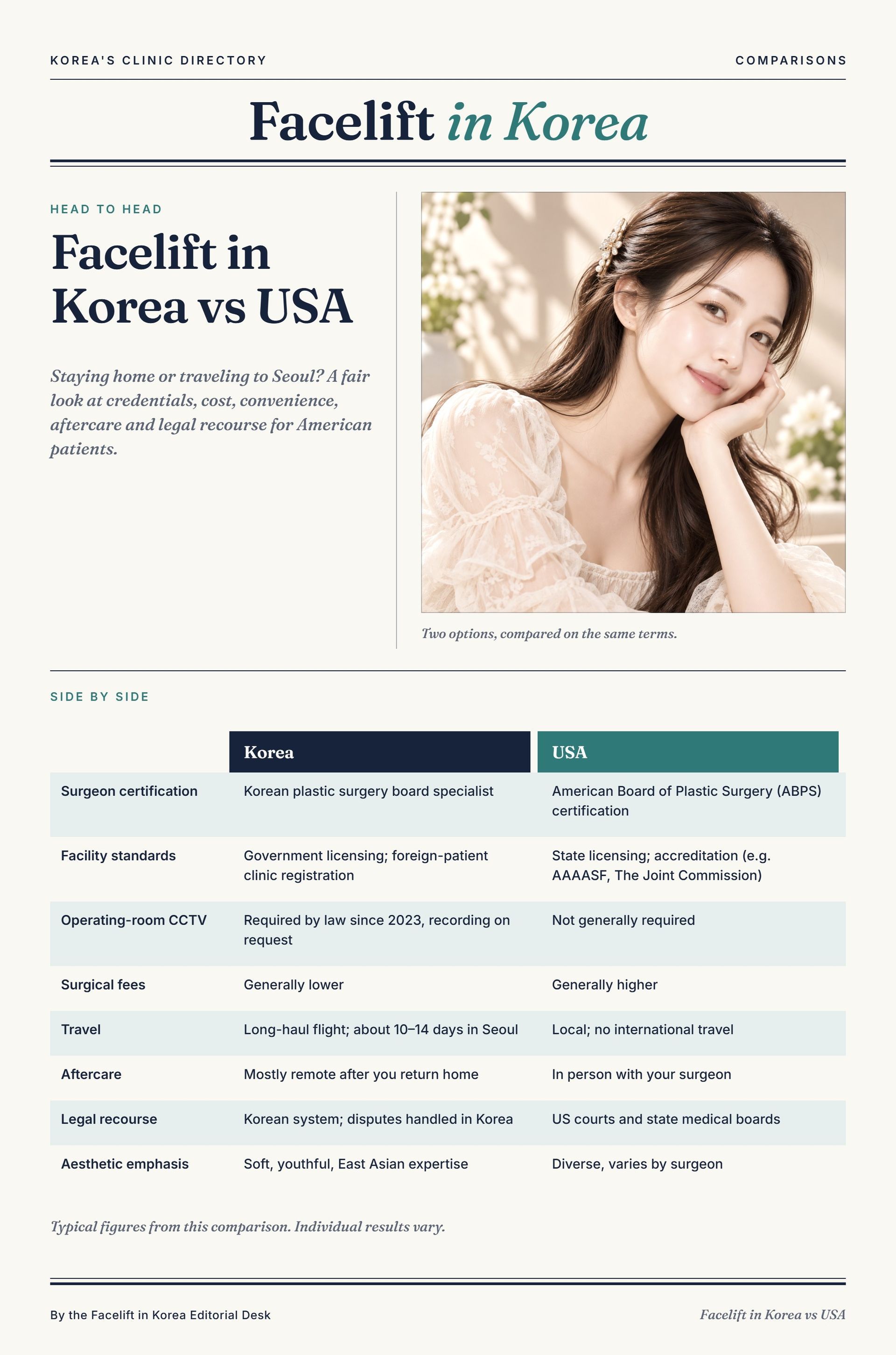
| Korea | USA | |
|---|---|---|
| Surgeon certification | Korean plastic surgery board specialist | American Board of Plastic Surgery (ABPS) certification |
| Facility standards | Government licensing; foreign-patient clinic registration | State licensing; accreditation (e.g. AAAASF, The Joint Commission) |
| Operating-room CCTV | Required by law since 2023, recording on request | Not generally required |
| Surgical fees | Generally lower | Generally higher |
| Travel | Long-haul flight; about 10–14 days in Seoul | Local; no international travel |
| Aftercare | Mostly remote after you return home | In person with your surgeon |
| Legal recourse | Korean system; disputes handled in Korea | US courts and state medical boards |
| Aesthetic emphasis | Soft, youthful, East Asian expertise | Diverse, varies by surgeon |
| Price guide | Facelift cost: Korea vs USA | Facelift cost: Korea vs USA |
Why do Americans consider a facelift in Korea?
Some American patients travel to Seoul because surgical fees are generally lower, because they admire the soft, natural results associated with Korean surgeons, or because they have family or cultural ties to Korea. Asian American patients in particular may seek surgeons who work with East Asian facial anatomy every day. Others simply want to combine treatment with time away from home.
What are the advantages of staying in the USA?
American patients have access to highly trained surgeons certified by the American Board of Plastic Surgery. US facilities are licensed by states and often accredited by recognized bodies. The biggest practical benefit is aftercare: you can see your surgeon in person for every follow-up, and any complication can be handled locally. Legal recourse through US courts and state medical boards is also familiar and accessible.
What are the advantages of Korea?
Korea has a large number of experienced facial plastic surgeons, especially in Seoul, and a strong focus on natural-looking facial rejuvenation. Many clinics combine facelifts with fat grafting and eyelid surgery for a balanced result. Surgical fees are generally lower than in major US cities, though travel and accommodation add to the total. Compare totals on the Korea vs USA cost page.
What safeguards does Korea have for foreign patients?
Korea regulates medical tourism under a national law on attracting international patients. Clinics that market to foreign patients must register with the government, and the Korea Health Industry Development Institute (KHIDI) supports this system. Since September 2023, Korean law has required CCTV cameras in operating rooms where patients are under general anesthesia or sedation, with recording available on the patient's request. Plastic surgery specialists complete board certification overseen by the Korean Society of Plastic and Reconstructive Surgeons. See how to verify a board-certified surgeon in Korea and ghost surgery and how to avoid it.
What are the trade-offs of traveling?
- Time: plan about ten to fourteen days in Seoul for a facelift. See how long to stay in Korea.
- Flying: long flights soon after surgery increase the risk of blood clots and discomfort. Follow your surgeon's advice. See flying home after a facelift.
- Aftercare: most follow-up after you return is remote. Find a local doctor who is willing to see you if needed.
- Insurance: standard US health insurance usually does not cover cosmetic surgery or its complications abroad. Consider specialist travel insurance.
- Disputes: if something goes wrong, the process is handled under Korean law.
Who might be better suited to each option?
The USA may suit you if you have a complex medical history, want in-person aftercare, prefer local legal recourse or cannot take two weeks away. Korea may suit you if you are healthy, value Korean surgeons' facial expertise, can plan an extended trip and are comfortable with remote follow-up.
How do I choose safely?
- In the USA, verify ABPS certification and facility accreditation.
- In Korea, verify the surgeon's specialist board status and the clinic's foreign-patient registration.
- Meet or video-consult with the operating surgeon.
- Ask for a written, itemized quote and revision policy.
- Plan aftercare before you book.
The guide for patients from the United States covers entry, flights and planning in more detail.
What should American patients know about booking in Seoul?
US citizens can usually enter Korea with a K-ETA or under visa-free arrangements; check current rules before booking. Many Seoul clinics offer video consultations in English and send a written treatment plan before you travel. Since January 2026, the tourist VAT refund on cosmetic surgery is no longer available, so confirm whether your quote includes VAT. Ask for your operative notes and medication list in English to share with your doctor at home. Plan at least one free day before surgery to rest after the long flight.
What should I ask before deciding?
- Who will perform my surgery, and can I meet them before the day of surgery?
- What exactly is included in the quote, and what costs extra?
- How will follow-up work after I return to the USA?
- What is your policy if I need a revision?
This page is general information, not medical advice. Decisions about surgery should be made with a qualified, board-certified plastic surgeon after an in-person examination.
Reader questions
Frequently asked questions
Is a facelift cheaper in Korea than in the USA?
Surgical fees in Korea are generally lower than in major US cities. Once flights, accommodation and time off are included, the savings vary. Compare the total trip cost.
Are Korean plastic surgeons as qualified as American surgeons?
Korea has a rigorous plastic surgery specialist training and board system, and many surgeons are highly experienced. Qualifications vary by individual, so verify each surgeon in either country.
What happens if I have a complication after returning to the USA?
You may need to see a local doctor or surgeon. Arrange this before you travel, and ask your Korean clinic how they handle remote follow-up and complications.
Does US health insurance cover a facelift abroad?
Usually not. Cosmetic surgery and its complications are generally excluded from standard health insurance. Specialist travel insurance may cover some complications.
How long should Americans stay in Korea for a facelift?
Most surgeons recommend about ten to fourteen days before the long flight home.
Next steps
Planning a facelift in Korea?
Compare clinics, check surgeon credentials and estimate your full trip budget before you book a consultation.
Facelift in Korea is an independent information directory. We do not perform procedures, and listings are not endorsements. This page is general information, not medical advice.