


Home › Comparisons › Facelift vs Thread Lift
Comparison
Facelift vs Thread Lift: Which Lifting Option Suits You?
By the Facelift in Korea Editorial Desk · Independent · How we report
The short answer
Quick answer: A facelift surgically repositions the deeper facial layers and removes excess skin, giving a strong result that typically lasts many years. A thread lift uses absorbable barbed threads inserted under the skin to give a modest, temporary lift with little downtime. Choose a facelift if you have moderate to severe sagging or loose skin. Choose a thread lift if your sagging is mild and you want a short recovery.
Side by side

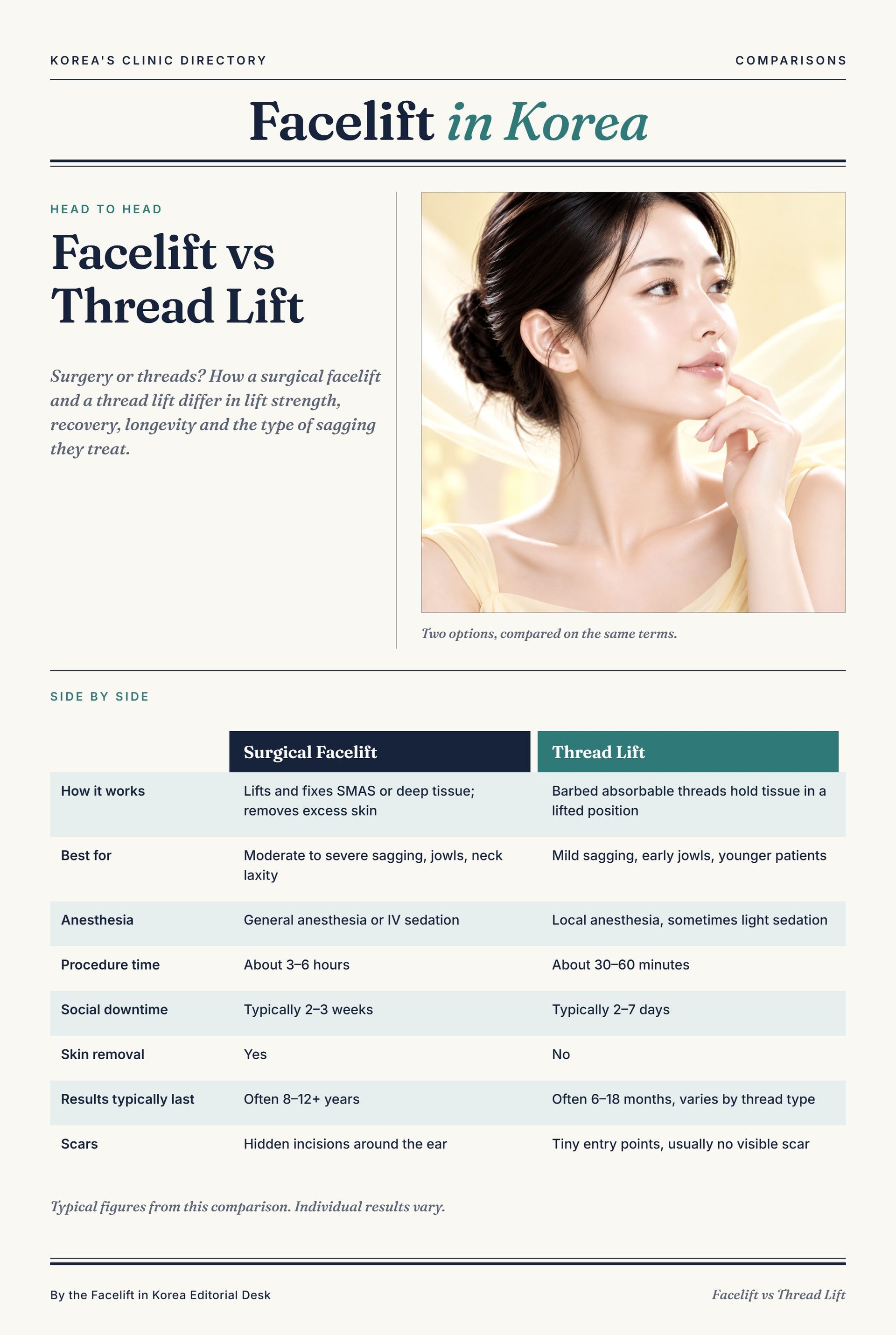
| Surgical Facelift | Thread Lift | |
|---|---|---|
| How it works | Lifts and fixes SMAS or deep tissue; removes excess skin | Barbed absorbable threads hold tissue in a lifted position |
| Best for | Moderate to severe sagging, jowls, neck laxity | Mild sagging, early jowls, younger patients |
| Anesthesia | General anesthesia or IV sedation | Local anesthesia, sometimes light sedation |
| Procedure time | About 3–6 hours | About 30–60 minutes |
| Social downtime | Typically 2–3 weeks | Typically 2–7 days |
| Skin removal | Yes | No |
| Results typically last | Often 8–12+ years | Often 6–18 months, varies by thread type |
| Scars | Hidden incisions around the ear | Tiny entry points, usually no visible scar |
| Price guide | Facelift cost overview | Thread lift cost in Korea |
How does a facelift work?
A surgical facelift lifts the deeper support layer of the face, called the SMAS, and fixes it higher with stitches. The surgeon then redrapes the skin and removes the excess. Techniques range from a mini facelift to a deep plane lift. Because tissue is physically repositioned and loose skin is removed, a facelift can treat heavy jowls and neck laxity that non-surgical methods cannot.
How does a thread lift work?
A thread lift places thin threads under the skin through small needle entry points. The threads carry tiny barbs or cones that grip the tissue so it can be pulled upward. Most threads are made of PDO or similar absorbable materials and dissolve over several months. As they dissolve, they trigger some collagen production around the thread path.
Threads do not remove skin. They reposition tissue to a modest degree and rely on the skin to adapt.
Which gives a better result?
For moderate or severe sagging, a facelift gives a much stronger and longer-lasting result. Threads cannot lift heavy tissue for long, and if too much tension is applied, they can cause dimpling or visible pulling. For mild sagging in younger patients, threads can give a pleasing, subtle lift with very little downtime.
- Consider a facelift if you have deep jowls, loose neck skin, a blurred jawline, or thread lifts no longer give you the effect you want.
- Consider a thread lift if you have early laxity, good skin quality, limited time for recovery, or you want to delay surgery.
What are the risks of each?
Facelift risks include hematoma, infection, scarring, numbness and, rarely, facial nerve injury. See facelift risks and complications. Thread lift risks are usually minor but include bruising, asymmetry, dimpling, thread visibility or extrusion, and infection. Many thread problems resolve as swelling settles; some need the thread removed.
Do previous thread lifts affect a later facelift?
Usually not significantly, but repeated thread lifts can leave fibrous tissue along the thread paths. Surgeons can normally work through this. Tell your surgeon how many thread lifts you have had and when.
What is special about thread lifts in Korea?
Korea is a major producer of lifting threads, and Seoul clinics offer a wide range of brands, including the Korean-made MINT threads and various cog threads. Thread lifts are often marketed as a "lunchtime" facelift and are frequently combined with HIFU or RF treatments in one visit.
International patients should ask which thread brand and how many threads will be used, because pricing is often per thread. Ask who will perform the procedure; in some clinics it may be a doctor who is not a plastic surgeon. For surgery, check the surgeon's specialist credentials. The guide on surgical vs non-surgical facelifts explains how to decide.
How do the costs compare over time?
A thread lift costs much less per session, but it often needs repeating every year or so to maintain the effect. A facelift is a larger single investment that lasts many years. When comparing, consider the total cost over five to ten years and the travel cost of repeat visits.
What should I ask before choosing?
- Is my degree of sagging suitable for threads, or would surgery give a more satisfying result?
- Which thread type will you use, how many, and where will they be placed?
- How long do you expect the effect to last for someone with my skin?
- If I choose surgery, which technique do you recommend and why?
- What happens if a thread becomes visible or the result looks uneven?
An honest provider will tell you when threads are unlikely to meet your goals. Be wary of anyone who promises a facelift-like result from threads alone. If you are unsure, it is reasonable to get two opinions, one from a plastic surgeon who performs both procedures, before deciding.
This page is general information, not medical advice. Decisions about surgery should be made with a qualified, board-certified plastic surgeon after an in-person examination.
Reader questions
Frequently asked questions
Can a thread lift replace a facelift?
Not for moderate or severe sagging. Threads give a modest lift for mild laxity, but they cannot remove loose skin or hold heavy tissue for long the way a facelift can.
How long does a thread lift last?
Most patients notice the effect for around six to eighteen months, depending on the thread type, the number of threads and their skin. Some collagen stimulation may continue after the threads dissolve.
Is a thread lift painful?
It is usually done under local anesthesia, so most people feel pressure and tugging rather than pain. Soreness and tightness for a few days afterward are common.
Can I have a facelift after thread lifts?
Yes. Previous threads usually do not prevent a facelift, though they may leave some scar tissue. Tell your surgeon about all previous thread procedures.
Which is better value, a facelift or a thread lift?
A thread lift is cheaper per session but often needs repeating. A facelift costs more upfront but lasts many years, so it can be better value for people with significant sagging.
Next steps
Planning a facelift in Korea?
Compare clinics, check surgeon credentials and estimate your full trip budget before you book a consultation.
Facelift in Korea is an independent information directory. We do not perform procedures, and listings are not endorsements. This page is general information, not medical advice.