


Home › Comparisons › HIFU vs RF Lifting
Comparison
HIFU vs RF Lifting: How Ultrasound and Radiofrequency Compare
By the Facelift in Korea Editorial Desk · Independent · How we report
The short answer
Quick answer: HIFU (high-intensity focused ultrasound) focuses energy into small deep points, reaching the SMAS layer to lift early sagging. RF (radiofrequency) heats the skin more broadly to tighten and improve texture. Choose HIFU if your main concern is a softening jawline or mild jowls. Choose RF if your skin feels loose, thin or crepey. Combining both is common in Korea.
Side by side
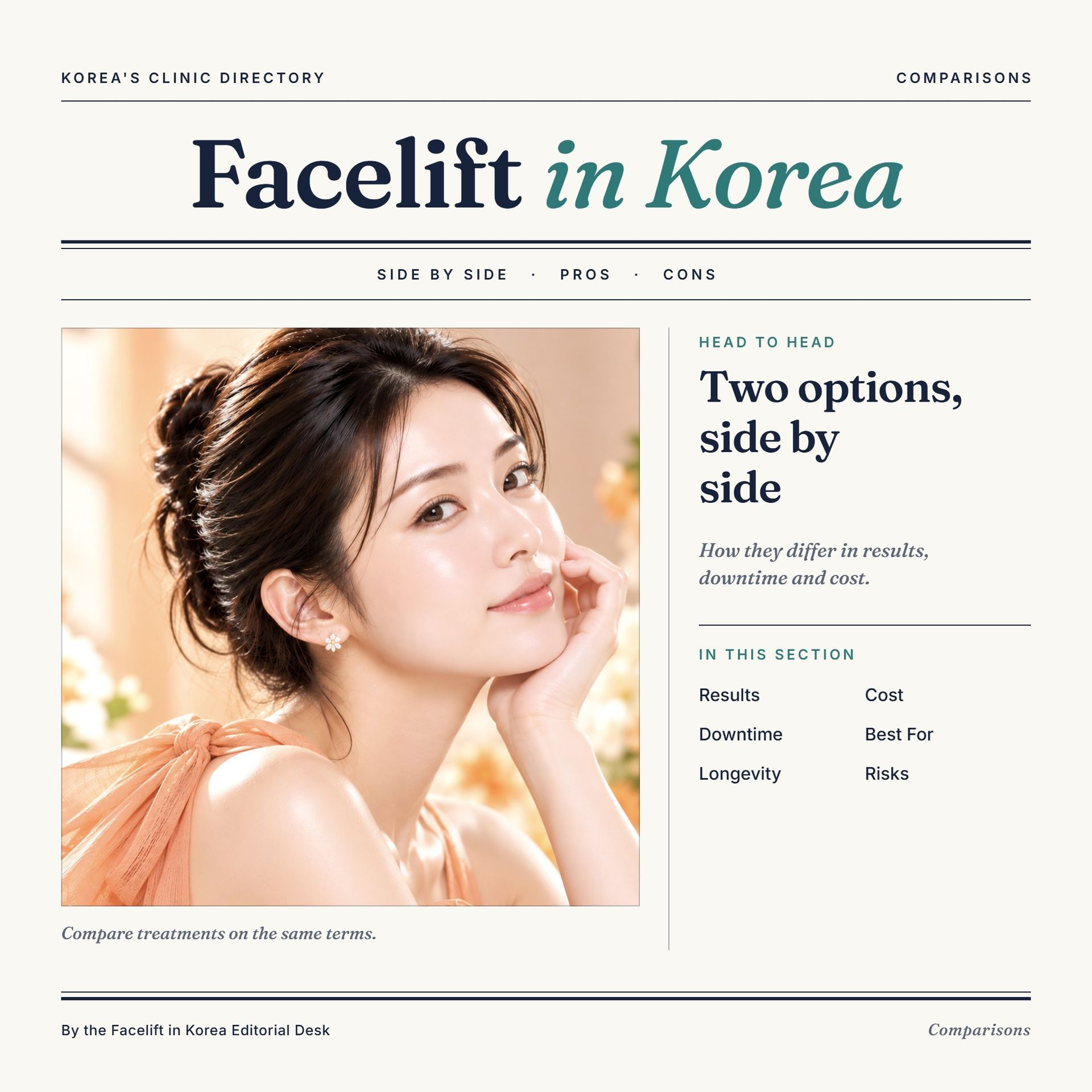
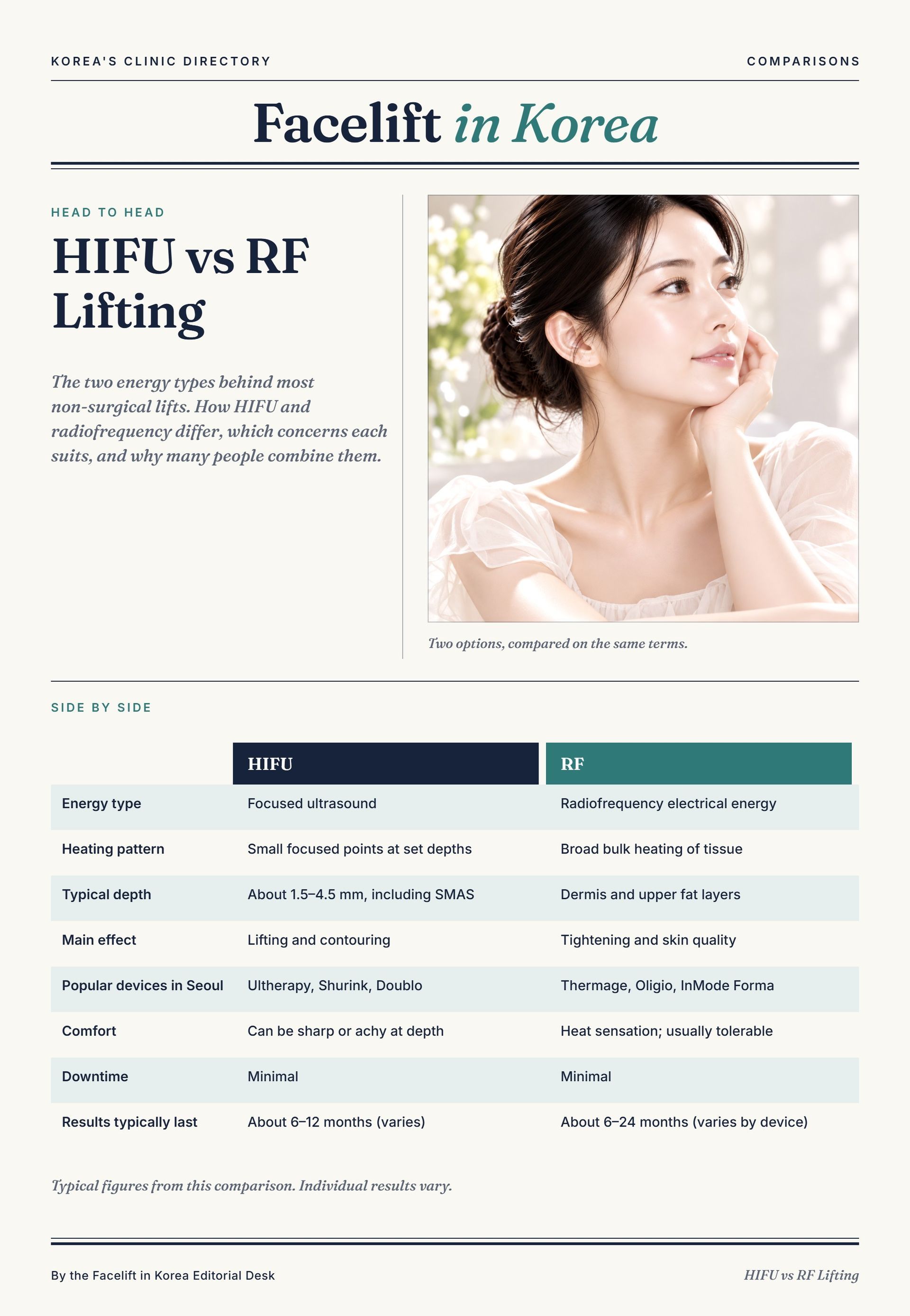
| HIFU | RF | |
|---|---|---|
| Energy type | Focused ultrasound | Radiofrequency electrical energy |
| Heating pattern | Small focused points at set depths | Broad bulk heating of tissue |
| Typical depth | About 1.5–4.5 mm, including SMAS | Dermis and upper fat layers |
| Main effect | Lifting and contouring | Tightening and skin quality |
| Popular devices in Seoul | Ultherapy, Shurink, Doublo | Thermage, Oligio, InMode Forma |
| Comfort | Can be sharp or achy at depth | Heat sensation; usually tolerable |
| Downtime | Minimal | Minimal |
| Results typically last | About 6–12 months (varies) | About 6–24 months (varies by device) |
| Price guide | Non-surgical lifting cost | Non-surgical lifting cost |
What is HIFU?
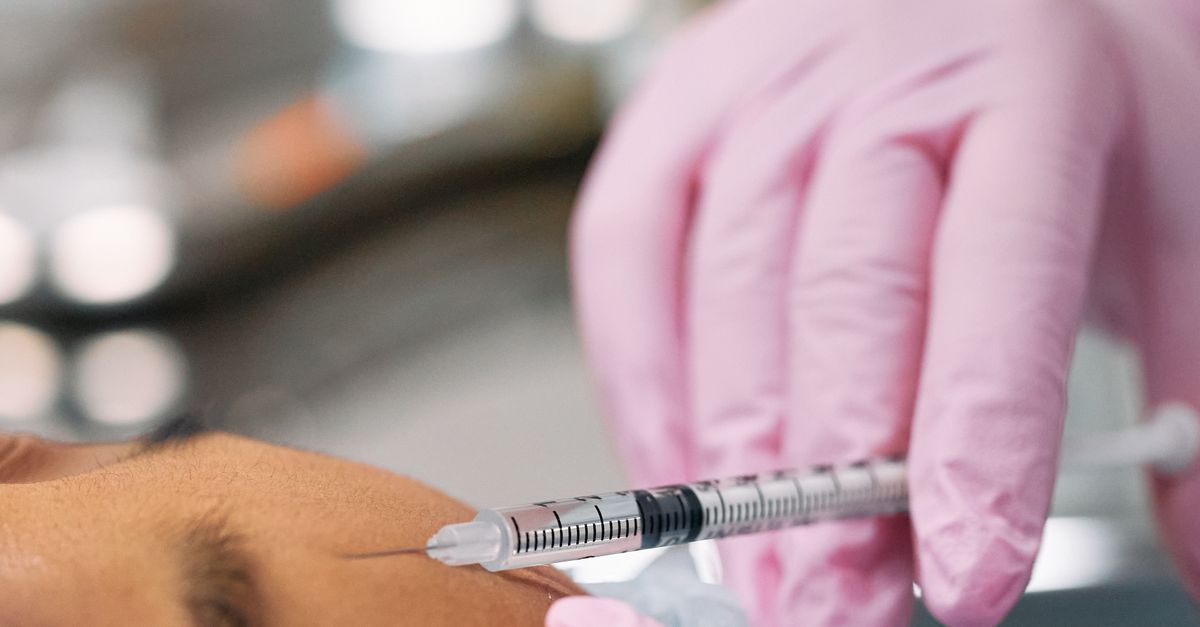
HIFU lifting uses focused ultrasound. A handpiece concentrates energy into tiny points at chosen depths, often down to the SMAS layer. Each point heats briefly, causing micro-injury that prompts new collagen. Because it reaches the same layer surgeons lift in a facelift, HIFU is mainly used for a lifting and contouring effect.
What is RF lifting?
RF skin tightening uses radiofrequency energy. Rather than focusing on points, RF heats a broader volume of skin and the upper fat layer. Heat causes collagen fibers to contract and stimulates new collagen. RF devices may be monopolar, bipolar or multipolar, and some, such as RF microneedling, deliver energy through fine needles.
Which works better for my concern?
- Early sagging, soft jawline, mild jowls: HIFU is usually the first choice.
- Crepey, thin or loose skin, fine lines: RF is usually the first choice.
- Both: many patients have a mix of laxity and poor skin quality. A combined plan treats both layers.
- Heavy jowls or a loose neck: neither is a substitute for surgery. See surgical vs non-surgical facelifts.
Are there safety differences?
Both are generally considered low risk when performed correctly. HIFU can cause temporary swelling, tenderness, numbness or, rarely, nerve irritation if delivered too close to nerves. RF can cause redness, swelling and, rarely, burns or fat loss if settings are too high. The skill of the operator and genuine consumables matter more than the energy type.
Some people with very thin or hollow faces worry that energy treatments might reduce facial fat. Discuss this with your provider; settings and depth can be adjusted, and volume may be addressed with other treatments.
What should I know about HIFU and RF in Seoul?
Korea has a large domestic device industry. Alongside imported brands such as Ultherapy and Thermage, Seoul clinics use Korean devices such as Shurink, Doublo and Oligio. Korean devices are often cheaper per session, which is one reason Seoul is popular for maintenance lifting.
Clinics usually price by shots or lines. Before booking, ask the device name and generation, the number of shots per area, whether a doctor performs or supervises the treatment, and whether consumables are new and genuine. Package deals that bundle several devices can be good value, but make sure each treatment is needed.
How often are treatments repeated?
HIFU is commonly repeated every six to twelve months, depending on the device. RF schedules vary widely: some devices are used once every year or two, while RF microneedling is often done as a short course. Your provider should give a schedule based on how your skin responds.
Who should consider surgery instead?
Energy-based lifting has limits. If you have heavy jowls, deep folds, significant neck laxity or loose skin that hangs, a surgical procedure is usually more effective and better value over time. Many patients in their 50s and 60s try several energy treatments before deciding on surgery; a frank consultation can save time and money. See facelift vs thread lift for how surgery compares with other minimally invasive options.
What should I ask before booking HIFU or RF?
- Which device do you recommend for my concern, and why?
- How many shots or lines will be delivered, and to which areas?
- Will a doctor perform or supervise the treatment?
- Are the consumables new and genuine?
- What result is realistic, and when should I see it?
- How long should I wait before having fillers, threads or other treatments?
Most HIFU and RF treatments have little downtime, so they fit easily into a short stay in Seoul. You can usually fly home within a day or two, but avoid booking treatments on the day you travel. Keep a note of the device, settings and shot count so a provider at home can plan any follow-up treatment safely.
This page is general information, not medical advice. Decisions about surgery should be made with a qualified, board-certified plastic surgeon after an in-person examination.
Reader questions
Frequently asked questions
Is HIFU or RF better for sagging?
HIFU is usually better for early sagging because it reaches deeper tissue, including the SMAS. RF is usually better for tightening loose or crepey skin.
Can HIFU and RF be done on the same day?
Yes, many clinics in Korea combine them in one session. Your provider should check that the combined energy is appropriate for your skin.
Does HIFU or RF cause fat loss?
Fat loss is uncommon when treatments are performed correctly, but it is a reported risk with high settings. Tell your provider if you already have hollow cheeks or thin facial fat.
Which lasts longer, HIFU or RF?
It depends on the device. HIFU effects are often described as lasting six to twelve months, and some RF devices are repeated every one to two years.
Are Korean HIFU and RF devices as good as imported brands?
Korean devices such as Shurink and Oligio are widely used and generally well regarded in Korea. Results depend more on the treatment plan, shot count and operator than on brand alone.
Next steps
Planning a facelift in Korea?
Compare clinics, check surgeon credentials and estimate your full trip budget before you book a consultation.
Facelift in Korea is an independent information directory. We do not perform procedures, and listings are not endorsements. This page is general information, not medical advice.