


Home › Comparisons › Ultherapy vs Thermage
Comparison
Ultherapy vs Thermage: Ultrasound vs Radiofrequency Lifting
By the Facelift in Korea Editorial Desk · Independent · How we report
The short answer
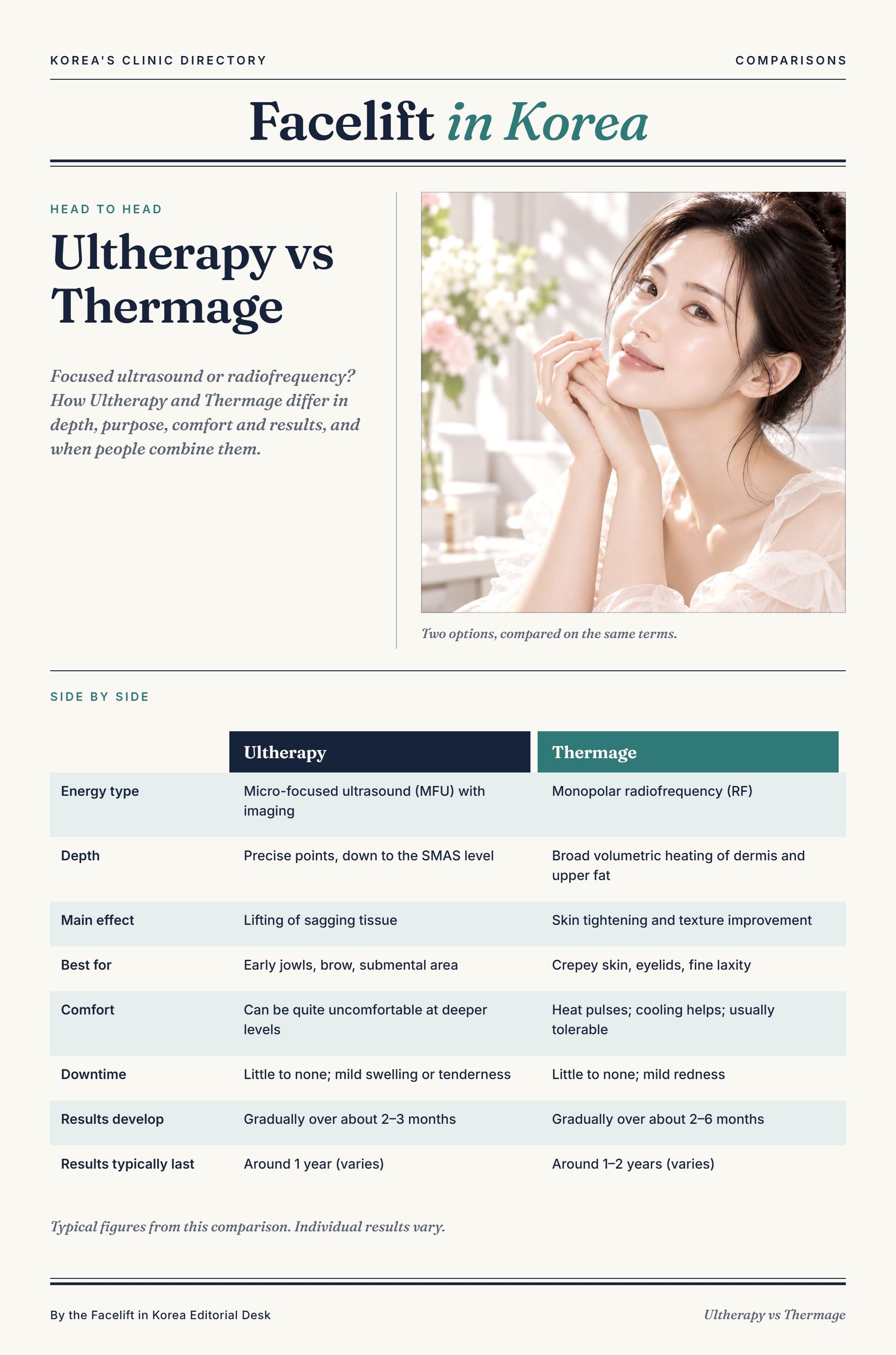
Quick answer: Ultherapy uses micro-focused ultrasound to heat deep points, including the SMAS layer, to lift and firm sagging tissue. Thermage uses monopolar radiofrequency to heat the skin more broadly, tightening and smoothing it. Choose Ultherapy if your main concern is early sagging along the jawline, brow or under the chin. Choose Thermage if your concern is loose, crepey or thinning skin texture. Many patients combine both.
Side by side
| Ultherapy | Thermage | |
|---|---|---|
| Energy type | Micro-focused ultrasound (MFU) with imaging | Monopolar radiofrequency (RF) |
| Depth | Precise points, down to the SMAS level | Broad volumetric heating of dermis and upper fat |
| Main effect | Lifting of sagging tissue | Skin tightening and texture improvement |
| Best for | Early jowls, brow, submental area | Crepey skin, eyelids, fine laxity |
| Comfort | Can be quite uncomfortable at deeper levels | Heat pulses; cooling helps; usually tolerable |
| Downtime | Little to none; mild swelling or tenderness | Little to none; mild redness |
| Results develop | Gradually over about 2–3 months | Gradually over about 2–6 months |
| Results typically last | Around 1 year (varies) | Around 1–2 years (varies) |
| Price guide | Ultherapy cost in Korea | Thermage cost in Korea |
How does Ultherapy work?
Ultherapy is a branded micro-focused ultrasound device. It delivers ultrasound energy to tiny points at set depths below the skin, including the SMAS layer that surgeons lift during a facelift. The heat causes controlled micro-injury, and the body responds by producing new collagen. A built-in ultrasound image lets the operator see the tissue layers while treating.
Ultherapy is a type of HIFU treatment. Its strength is lifting: it is often used for early jowls, a soft jawline, under the chin and a slightly heavy brow.
How does Thermage work?
Thermage uses monopolar radiofrequency energy. Instead of focusing on points, it heats a broader volume of the dermis and upper fat layers. This causes existing collagen to contract and stimulates new collagen over the following months. A cooling system protects the skin surface.
Thermage is mainly a tightening and smoothing treatment. It is popular for crepey skin, fine laxity across the cheeks, and the delicate skin around the eyes, where a dedicated eye tip is used.
Which is better for sagging and which for skin quality?
- Ultherapy tends to be chosen when tissue is starting to drop and you want a lifting effect.
- Thermage tends to be chosen when skin looks thin, loose or crepey and you want firmer, smoother skin.
- Combination: many Seoul clinics combine them, using Ultherapy for depth and Thermage for the surface. Ask whether a combined plan suits your face and budget.
Neither treatment replaces surgery. For heavy jowls or a loose neck, a surgical lift gives far stronger results. See surgical vs non-surgical facelifts.
What does each feel like?
Both cause heat sensations. Ultherapy can be quite uncomfortable when deeper levels are treated, especially over bone. Clinics may offer numbing cream or pain relief. Thermage feels like short bursts of heat followed by cooling. Most patients return to normal activities the same day after either treatment.
What should I know about Ultherapy and Thermage in Korea?
Both devices are widely available in Seoul, often alongside Korean-made alternatives such as Shurink(HIFU) and Oligio (RF). Pricing is usually by the number of lines or shots, so two quotes for "Ultherapy" can mean very different treatments.
International patients should ask for the exact number of shots, the device generation and confirmation that genuine cartridges or tips are used. Ask who performs the treatment, whether a doctor sets the plan, and whether the treated areas are marked. Very cheap offers sometimes mean fewer shots or non-genuine consumables. Results build over months, so you do not need to stay in Korea long after treatment.
How often should each be repeated?
Ultherapy is commonly repeated about once a year. Thermage is often repeated every one to two years. Your provider can suggest a schedule based on how your skin responds.
Who is not a good candidate for either?
Energy-based lifting works best for mild laxity and good overall health. It is less suitable if you have heavy jowls or a very loose neck, active skin infection or inflammation in the area, certain implanted electronic devices (relevant to RF), or unrealistic expectations of a surgical-style result. Pregnant patients are usually advised to wait. Tell your provider about fillers, threads and previous energy treatments, because these can affect planning.
What should I ask before booking?
- Which device and which generation will you use, and how many shots or lines per area?
- Are the cartridges or tips new and genuine?
- Will a doctor perform the treatment or supervise it?
- What result is realistic for my face, and when should I expect to see it?
- Would a different device, or a combination, suit my concern better?
Comparing answers to these questions is more useful than comparing headline prices. For pricing context, see the non-surgical lifting cost guide.
This page is general information, not medical advice. Decisions about surgery should be made with a qualified, board-certified plastic surgeon after an in-person examination.
Reader questions
Frequently asked questions
Is Ultherapy or Thermage better for jowls?
Ultherapy is usually preferred for early jowls because it targets deeper tissue for a lifting effect. Thermage mainly tightens skin. Heavier jowls typically need surgery.
Can I do Ultherapy and Thermage together?
Yes. Many clinics combine them on the same day or in sequence because they work at different depths. Ask your provider whether a combination suits your skin and goals.
Which is more painful, Ultherapy or Thermage?
Ultherapy is often described as more uncomfortable, especially at deeper settings over bone. Thermage feels like short heat pulses with cooling. Pain tolerance varies between people.
How soon will I see results?
Some tightening may be visible soon after, but the main results develop over two to six months as new collagen forms.
Is Ultherapy cheaper in Korea?
Prices in Seoul are often lower than in many Western countries, but they vary with the number of shots and the clinic. Compare the exact shot count rather than the headline price.
Next steps
Planning a facelift in Korea?
Compare clinics, check surgeon credentials and estimate your full trip budget before you book a consultation.
Facelift in Korea is an independent information directory. We do not perform procedures, and listings are not endorsements. This page is general information, not medical advice.