


Home › Non-Surgical Lifting › Shurink (Korean HIFU)
Non-Surgical Lifting
Shurink in Seoul, Korea: The Korean HIFU Lift Explained
By the Facelift in Korea Editorial Desk · Independent · How we report

The short answer
Quick answer: Shurink is a high-intensity focused ultrasound (HIFU) device made by Classys, a Seoul company. The same technology is sold internationally under the Ultraformer name. It heats tiny points at set depths to firm skin and the SMAS layer. Sessions are relatively comfortable and affordable, so many Korean patients repeat it every three to six months.
What is Shurink?
Shurink is the Korean brand name for a family of HIFU lifting devices made by Classys, an aesthetic device company based in Seoul. Outside Korea, the company sells closely related systems under the Ultraformer name. Recent models in Korea are marketed as Shurink Universe, and abroad as Ultraformer MPT.
Like all HIFU, Shurink focuses ultrasound energy to a precise depth. It creates small thermal points in the dermis and in the deeper SMAS layer, leaving the skin surface largely untouched. Collagen then remodels and contracts over the following weeks.
How is Shurink different from Ultherapy?
Both are focused ultrasound devices, but they differ in practical ways.
- Imaging: Ultherapy shows a live ultrasound image during treatment; Shurink does not use the same visualization.
- Delivery: Newer Shurink models offer a "multi-point" mode that spreads energy as separate dots, which the maker says improves comfort.
- Cost and frequency: Shurink sessions usually cost less, so Korean patients often treat it as maintenance every few months. Ultherapy is more often a once-a-year treatment.
- Cartridges: Shurink offers several depths, including shallow ones for the skin and deeper ones for the SMAS and fat under the chin.
For a fuller side-by-side, see Shurink vs Ultherapy.
Who is a good candidate for Shurink?
Shurink suits people who want a light, regular lifting routine rather than a single big change. Typical candidates:
- Are in their 30s to 50s with early laxity
- Want a slightly sharper jawline or less fullness under the chin
- Prefer a lower-cost treatment they can repeat
- Want to keep a facelift result looking fresh
People with very thin faces should be cautious, as HIFU can reduce fat and deepen hollows. Those with heavy skin excess will usually see little benefit; surgery or a combined plan is more realistic. The double chin lifting page compares options for the under-chin area.
What happens during a Shurink session?
A session is quick. After cleansing, many clinics apply numbing cream for 20 to 40 minutes. The practitioner then marks treatment zones, applies gel and moves the cartridge across each area, firing lines or dots of energy.
Most people feel warmth and short prickling pulses, stronger over bone. A lower-face treatment may take 15 to 30 minutes; full face and neck take longer. Afterward the skin can look slightly flushed. Makeup can usually go on the same day or the next morning.
How is Shurink offered in Seoul?
Shurink is one of the most widely used lifting devices in Korea. You will see it on price boards in Gangnam, Sinsa and Myeongdong, usually quoted per "shot" (for example, 100, 300 or 600 shots).
What international patients should check:
- Genuine device and cartridge. Ask whether the cartridge is new and authentic.
- Shot count per area. Very cheap offers may spread few shots across the face.
- Who treats. Ask whether a doctor performs it or supervises staff.
- Combination packages. Shurink is often bundled with RF, skin boosters or botulinum toxin. Ask what each item adds.
Because downtime is minimal, Shurink is easy to fit into a short stay or the last day of a trip.
What are the side effects and limits?
Common effects include redness, mild swelling, tenderness and a sore jaw when chewing for a day or two. Less common are bruising, temporary numbness and small welts. Burns and nerve irritation are rare but possible, especially with high energy or poor technique.
Results are modest and temporary. Many people notice a fresher contour; some see little change. Repeated sessions help maintain the effect, but they will not replace a facelift when sagging is significant.
How do I judge whether Shurink worked?
Because changes are gradual, fair comparison matters. Ask the clinic to take standardized photos before treatment, with the same lighting, angle and neutral expression. Take your own set at home too. Compare again at four to eight weeks, and at three months.
Look at specific areas rather than the whole face: the line of the jaw from the side, the fold under the chin, and the cheek contour at a three-quarter angle. If you see little change after two or three sessions, it may be time to consider a different approach, such as threads, RF or a surgical consultation, rather than more shots.
This page is general information, not medical advice. Decisions about surgery should be made with a qualified, board-certified plastic surgeon after an in-person examination.
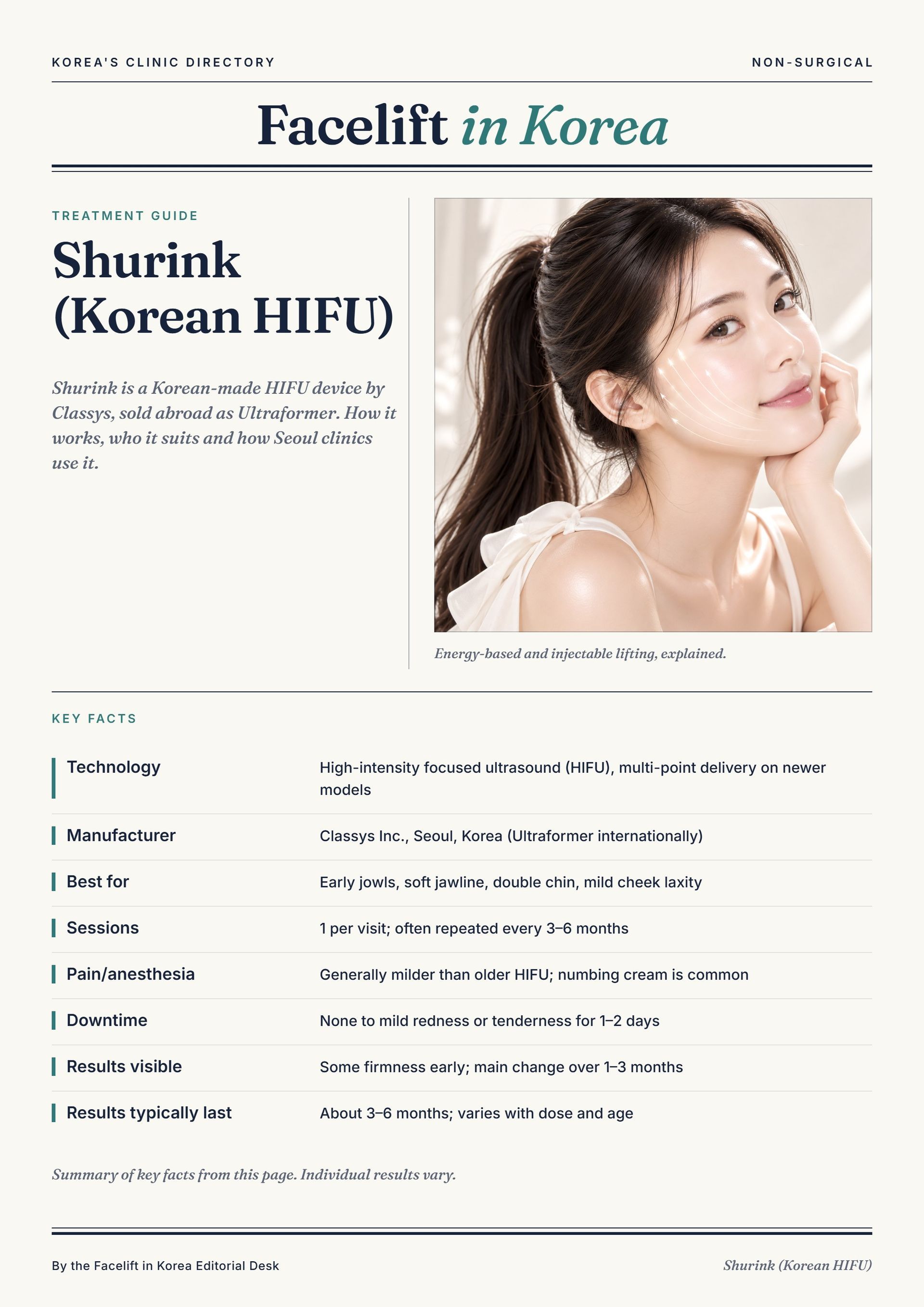
Key facts
| Technology | High-intensity focused ultrasound (HIFU), multi-point delivery on newer models |
|---|---|
| Manufacturer | Classys Inc., Seoul, Korea (Ultraformer internationally) |
| Best for | Early jowls, soft jawline, double chin, mild cheek laxity |
| Sessions | 1 per visit; often repeated every 3–6 months |
| Pain/anesthesia | Generally milder than older HIFU; numbing cream is common |
| Downtime | None to mild redness or tenderness for 1–2 days |
| Results visible | Some firmness early; main change over 1–3 months |
| Results typically last | About 3–6 months; varies with dose and age |
| Price guide | Shurink cost in Korea |
Read next
Reader questions
Frequently asked questions
Is Shurink the same as Ultraformer?
Shurink is the Korean market name used by Classys, and Ultraformer is the name the same company uses for its HIFU line in many other countries. Model names and specifications can differ by market, so ask the clinic which model it uses.
How often can I get Shurink?
Many Seoul clinics suggest repeating Shurink every three to six months, depending on age, skin and the number of shots. Your doctor should space sessions so the tissue has time to remodel.
Does Shurink hurt?
Most people describe warm, prickly pulses that are uncomfortable over bone but tolerable. Newer multi-point modes are designed to feel milder. Numbing cream is commonly used.
Can Shurink reduce a double chin?
Deeper cartridges can heat fat under the chin, and some people see a slimmer under-chin area. Results vary. For larger fat volumes, liposuction or other options may work better.
Is Shurink cheaper than Ultherapy in Korea?
Yes, Shurink sessions are typically priced lower than Ultherapy in Seoul. That is one reason many patients use it for regular maintenance. Check our cost pages for indicative ranges.
Next steps
Planning a facelift in Korea?
Compare clinics, check surgeon credentials and estimate your full trip budget before you book a consultation.
Facelift in Korea is an independent information directory. We do not perform procedures, and listings are not endorsements. This page is general information, not medical advice.