


Home › Non-Surgical Lifting › Ultherapy
Non-Surgical Lifting
Ultherapy in Seoul, Korea: Ultrasound Lifting Guide
By the Facelift in Korea Editorial Desk · Independent · How we report

The short answer
Quick answer: Ultherapy is a microfocused ultrasound treatment with real-time imaging, made by Merz Aesthetics. It heats tissue at set depths, including the SMAS, to trigger collagen remodeling. In the US it is FDA-cleared to lift the brow, lift tissue under the chin and neck, and improve décolleté lines. Results develop over two to three months.
What is Ultherapy?
Ultherapy is a brand of focused ultrasound treatment owned by Merz Aesthetics. It was first developed by Ulthera, Inc. in the United States. It belongs to the broader family of HIFU lifting treatments.
The key feature is visualization. The handpiece shows an ultrasound image of the layers under the skin, so the practitioner can check that the transducer is coupled correctly and see roughly where energy will land. Energy is then delivered as rows of tiny heated points at fixed depths. The deepest standard transducer reaches the SMAS layer.
Merz also sells a newer system called Ultherapy PRIME. Clinics may use either.
What is Ultherapy cleared for?
In the United States, Ultherapy is FDA-cleared as a non-invasive treatment to:
- Lift the eyebrow
- Lift lax tissue under the chin and on the neck
- Improve lines and wrinkles on the décolleté (upper chest)
Doctors in many countries also use it on the cheeks and jawline as part of a full-face plan. Regulatory approvals differ by country, and clearance describes approved uses, not a guaranteed result. Your doctor should explain what is and is not an approved indication.
Who is a good candidate for Ultherapy?
Ultherapy suits people with mild to moderate laxity who want a gradual, natural change with no surgery. Typical candidates:
- Are in their mid-30s to late 50s
- Have early jowls, a softening jawline or mild brow heaviness
- Still have reasonable skin elasticity and some facial fat
- Want to maintain the results of an earlier facelift
It is less effective for heavy skin excess, deep folds or a pronounced neck band. Very thin faces may look more hollow if too much energy is used on fat-poor areas. If you are unsure, compare options on the jowl lifting page.
What happens during a treatment?
The skin is cleaned and photographed. Numbing cream is usually applied. Some clinics also give oral pain relief.
The practitioner applies gel, places the transducer, checks the image, and fires a line of pulses. Each line feels like a deep, hot prick, often strongest along the jawline and near bone. A full face and neck treatment commonly takes 60 to 90 minutes.
Afterward, the skin may look slightly pink. Tenderness, mild swelling and occasional bruising can last a few days. You can usually return to normal activity at once.
How is Ultherapy offered in Seoul?
Ultherapy is widely available in Seoul, often next to Korean-made HIFU devices that cost less per session. Most clinics quote by the number of "lines" (shots), with packages for the lower face, full face and neck.
Points to check as an international patient:
- Ask whether the device is genuine Ultherapy, and whether new, original transducers are used. Some clinics show the transducer counter.
- Ask how many lines go to each area, and at which depths.
- Ask who treats. Many Korean clinics have doctors perform it; others delegate to trained staff.
- Compare against Korean alternatives on our Shurink vs Ultherapy and Ultherapy vs Thermage pages.
How long do results last, and what are the risks?
Collagen remodeling continues for about two to three months, so the final result is seen around then. Many people repeat treatment roughly once a year. Results vary: some notice a clear lift, others a subtle one, and a few little change.
Common effects are redness, swelling, tingling and tenderness. Less common are bruising, temporary numbness and raised welts. Rarely, nerve irritation may cause brief muscle weakness, and small burns can occur.
How should I prepare for Ultherapy?
Preparation is simple, but a few steps help:
- Arrive without makeup on the treatment area, or plan to remove it at the clinic.
- Tell the doctor about any fillers, threads or implants in your face, and about medications that raise bruising risk.
- Ask for clear photos before treatment so you can compare fairly at three months.
- If you are in Korea for surgery as well, ask the surgeon whether Ultherapy should come before or after, and how many weeks apart.
Afterward, avoid saunas, hot baths and intense exercise for a day or two, and use sunscreen. There is no special diet or garment.
This page is general information, not medical advice. Decisions about surgery should be made with a qualified, board-certified plastic surgeon after an in-person examination.
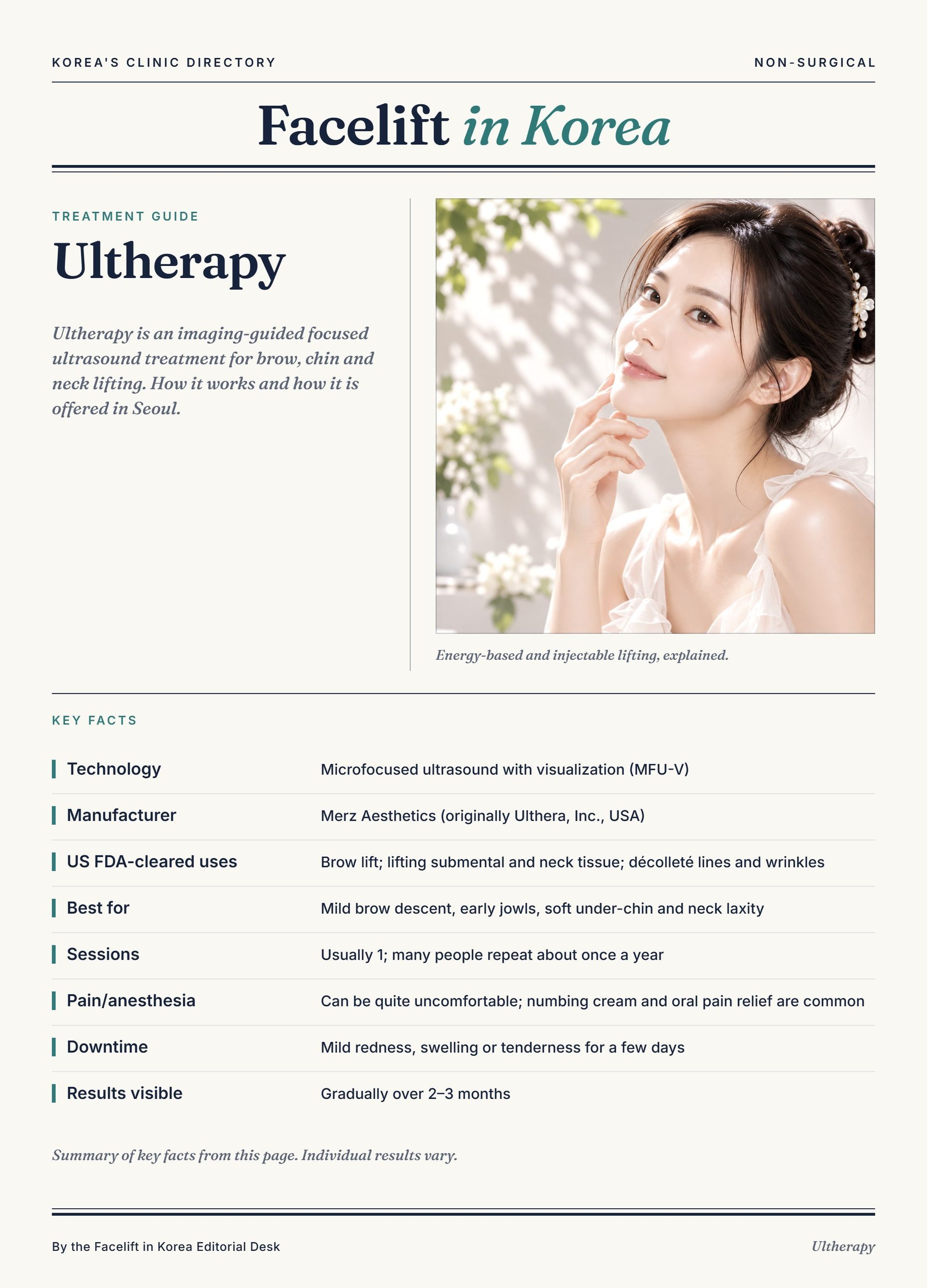
Key facts
| Technology | Microfocused ultrasound with visualization (MFU-V) |
|---|---|
| Manufacturer | Merz Aesthetics (originally Ulthera, Inc., USA) |
| US FDA-cleared uses | Brow lift; lifting submental and neck tissue; décolleté lines and wrinkles |
| Best for | Mild brow descent, early jowls, soft under-chin and neck laxity |
| Sessions | Usually 1; many people repeat about once a year |
| Pain/anesthesia | Can be quite uncomfortable; numbing cream and oral pain relief are common |
| Downtime | Mild redness, swelling or tenderness for a few days |
| Results visible | Gradually over 2–3 months |
| Price guide | Ultherapy cost in Korea |
Read next
Reader questions
Frequently asked questions
Is Ultherapy painful?
Ultherapy is one of the more uncomfortable non-surgical lifting treatments. Most people feel deep, hot pulses, especially over bone. Numbing cream and oral pain relief are commonly used, and newer systems aim to improve comfort.
How many Ultherapy sessions do I need?
Most people need one session. Some doctors recommend a second session for more laxity. Maintenance is commonly done about once a year.
Is Ultherapy FDA approved?
Ultherapy is FDA-cleared, not "approved," which is the usual pathway for this kind of device. In the US it is cleared for lifting the brow, lifting tissue under the chin and on the neck, and improving lines and wrinkles on the décolleté.
Is Ultherapy in Korea the same as in the US?
The genuine device is the same Merz system. What can differ is the number of lines used, the operator and the price. Ask whether genuine, new transducers are used.
Can I combine Ultherapy with Thermage?
Yes. Some clinics in Seoul pair Ultherapy for deeper lifting with Thermage for skin tightening. Your doctor should plan the energy levels to avoid overtreatment.
Next steps
Planning a facelift in Korea?
Compare clinics, check surgeon credentials and estimate your full trip budget before you book a consultation.
Facelift in Korea is an independent information directory. We do not perform procedures, and listings are not endorsements. This page is general information, not medical advice.