


Home › Comparisons › Facelift vs Facial Fat Grafting
Comparison
Facelift vs Facial Fat Grafting: Lifting, Volume or Both?
By the Facelift in Korea Editorial Desk · Independent · How we report

The short answer
Quick answer: A facelift lifts sagging tissue and removes excess skin, treating jowls, folds and neck laxity. Facial fat grafting restores lost volume by moving your own fat into hollow areas such as the temples, cheeks and under the eyes. Choose a facelift if your main concern is sagging. Choose fat grafting if your main concern is hollowness with little sagging. Many people over 50 benefit from both.
Side by side
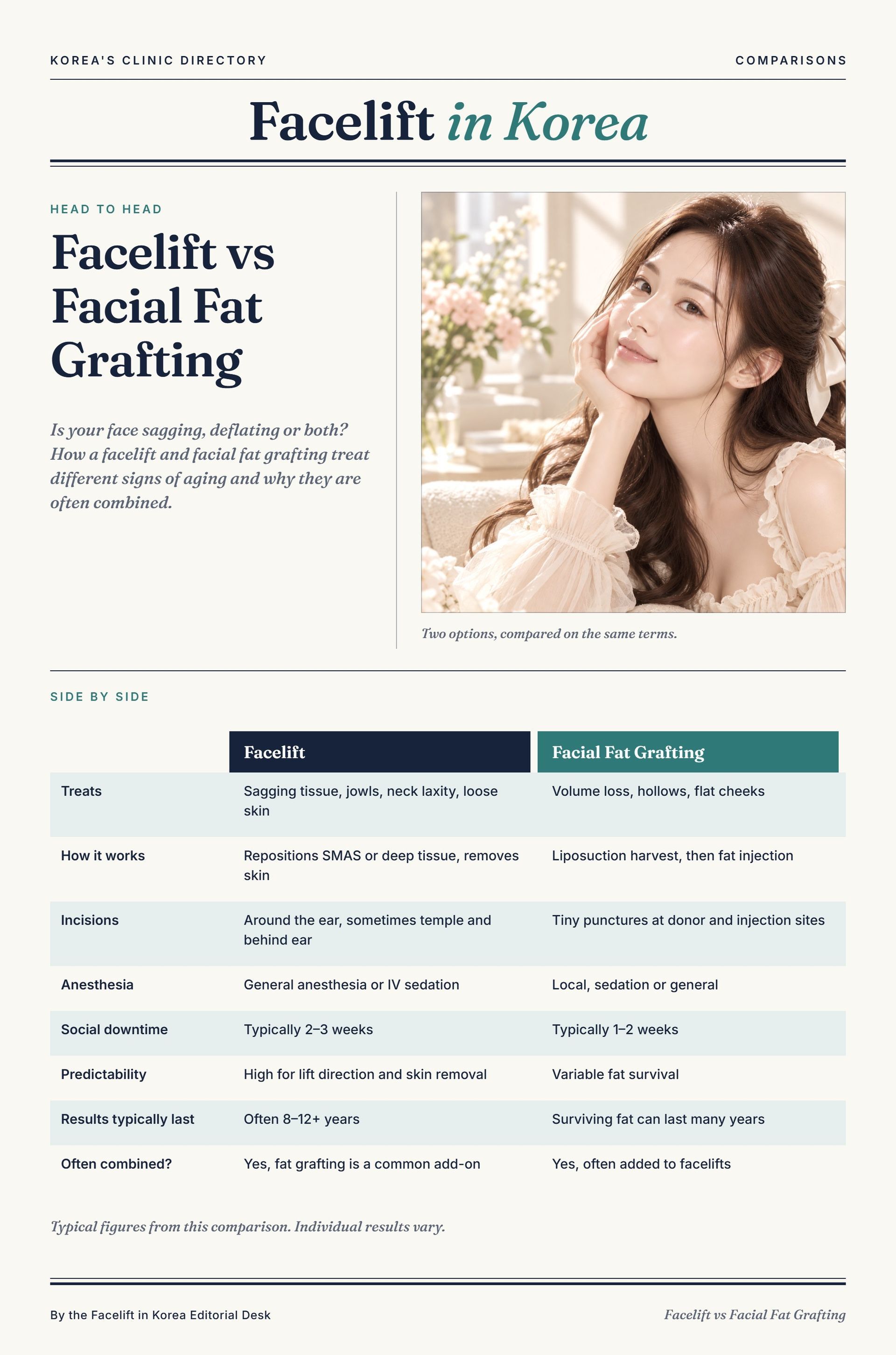
| Facelift | Facial Fat Grafting | |
|---|---|---|
| Treats | Sagging tissue, jowls, neck laxity, loose skin | Volume loss, hollows, flat cheeks |
| How it works | Repositions SMAS or deep tissue, removes skin | Liposuction harvest, then fat injection |
| Incisions | Around the ear, sometimes temple and behind ear | Tiny punctures at donor and injection sites |
| Anesthesia | General anesthesia or IV sedation | Local, sedation or general |
| Social downtime | Typically 2–3 weeks | Typically 1–2 weeks |
| Predictability | High for lift direction and skin removal | Variable fat survival |
| Results typically last | Often 8–12+ years | Surviving fat can last many years |
| Often combined? | Yes, fat grafting is a common add-on | Yes, often added to facelifts |
| Price guide | Facelift cost overview | Fat grafting cost in Korea |
Why does the face age in two ways?
Facial aging is not only about sagging. As we get older, the soft tissues descend, the skin loosens and the retaining ligaments weaken. At the same time, the face loses fat in certain areas and bone gradually changes shape. The result is a mix of sagging and deflation. A facelift treats the first. Facial fat grafting treats the second.
What can a facelift do?
A facelift lifts the deeper layer of the face, called the SMAS, and redrapes the skin. This improves jowls, a blurred jawline, deep folds around the mouth and, with a neck lift, loose neck skin. A facelift does not add volume. If your cheeks or temples are hollow, a facelift alone may leave the face looking tight but still thin.
What can fat grafting do?
Fat grafting takes fat from the abdomen, thighs or another area by gentle liposuction, processes it and injects it into the face. It can restore fullness to hollow temples, flat cheeks, under-eye hollows and the area around the mouth. Fat grafting does not lift sagging tissue significantly. In someone with heavy jowls, adding volume without lifting can make the face look heavier.
Which do I need?
- Mostly sagging: jowls, loose neck, deep folds with good facial fullness. A facelift is usually the main treatment.
- Mostly volume loss: hollow cheeks, sunken temples, gaunt look, little sagging. Fat grafting may be enough.
- Both: common after about age 50. A facelift combined with fat grafting often gives the most balanced, youthful result.
What are the benefits of combining them?
When done together, the surgeon can lift tissue into a better position and then fine-tune contour with fat. Combining avoids a second anesthesia and recovery period. Many surgeons believe a combined approach gives a softer, more natural result than lifting alone. The midface lift with fat grafting is one popular combination.
What are the risks?
Facelift risks include hematoma, infection, scarring, numbness and, rarely, facial nerve injury. Fat grafting risks include lumps, uneven absorption, overcorrection, cysts and, rarely, vascular complications. Combining them adds some swelling but does not usually change the overall risk profile significantly in experienced hands. See facelift risks and complications.
What should I know about facelifts and fat grafting in Korea?
Fat grafting is especially popular in Korea, where many patients prefer a soft, full, youthful facial contour rather than a tight look. Seoul clinics often add fat grafting to facelifts as standard, and some offer enriched techniques such as micro-fat, nano-fat or SVF-enriched grafts. These may have benefits, but evidence is still developing.
International patients should ask how much fat will be grafted and where, how much is expected to survive, whether a touch-up is included and how the combined procedure affects the length of stay. A combined facelift and fat grafting usually requires about ten to fourteen days in Seoul.
What is recovery like?
Fat grafting alone typically needs about one to two weeks before you feel socially comfortable. A facelift typically needs two to three weeks. When combined, swelling may be more noticeable at first, especially in the cheeks and under the eyes. Final results take about three to six months as swelling resolves and grafted fat settles.
What should I ask at my consultation?
- Is my main concern sagging, volume loss or both?
- Would fat grafting alone help, or do I need lifting too?
- Which areas would benefit from fat, and how much?
- What happens if some of the fat does not survive?
Can I have fat grafting first and a facelift later?
Yes. Some younger patients start with fat grafting to restore volume and have a facelift years later when sagging becomes more noticeable. Previous fat grafting usually does not prevent a facelift. Let your surgeon know where fat was grafted and when, as this can help with planning. Equally, people who have a facelift first can add fat grafting later if hollowness develops.
This page is general information, not medical advice. Decisions about surgery should be made with a qualified, board-certified plastic surgeon after an in-person examination.
Reader questions
Frequently asked questions
Can fat grafting replace a facelift?
Not if you have significant sagging. Fat grafting restores volume but does not lift jowls or remove loose skin. It can be enough for people whose main concern is hollowness.
Should I combine a facelift with fat grafting?
Many patients over 50 have both sagging and volume loss, and combining the two often gives a more balanced result. Your surgeon can assess whether you need both.
How long does facial fat grafting last?
Fat that survives the first few months can last many years. Some fat is always reabsorbed, so a touch-up may be needed.
Does fat grafting make recovery longer after a facelift?
It can add some swelling, especially in the cheeks and under the eyes, but it usually does not change the overall recovery time significantly.
Is facelift with fat grafting common in Korea?
Yes. Many Seoul clinics combine them because the Korean aesthetic often favors a soft, youthful contour rather than a tight look.
Next steps
Planning a facelift in Korea?
Compare clinics, check surgeon credentials and estimate your full trip budget before you book a consultation.
Facelift in Korea is an independent information directory. We do not perform procedures, and listings are not endorsements. This page is general information, not medical advice.