


Home › Comparisons › Facelift in Korea vs Japan
Comparison
Facelift in Korea vs Japan: Comparing Two East Asian Options
By the Facelift in Korea Editorial Desk · Independent · How we report
The short answer
Quick answer: Korea and Japan both have advanced medical systems and skilled facial surgeons. Korea has a very large, competitive cosmetic surgery market with extensive foreign-patient services in Seoul. Japan has a more understated aesthetic culture and fewer clinics organized around medical tourism. Choose Korea if you want wide choice and international patient support. Choose Japan if you prefer a quieter setting and already have access to a Japanese clinic or interpreter.
Side by side
| Korea | Japan | |
|---|---|---|
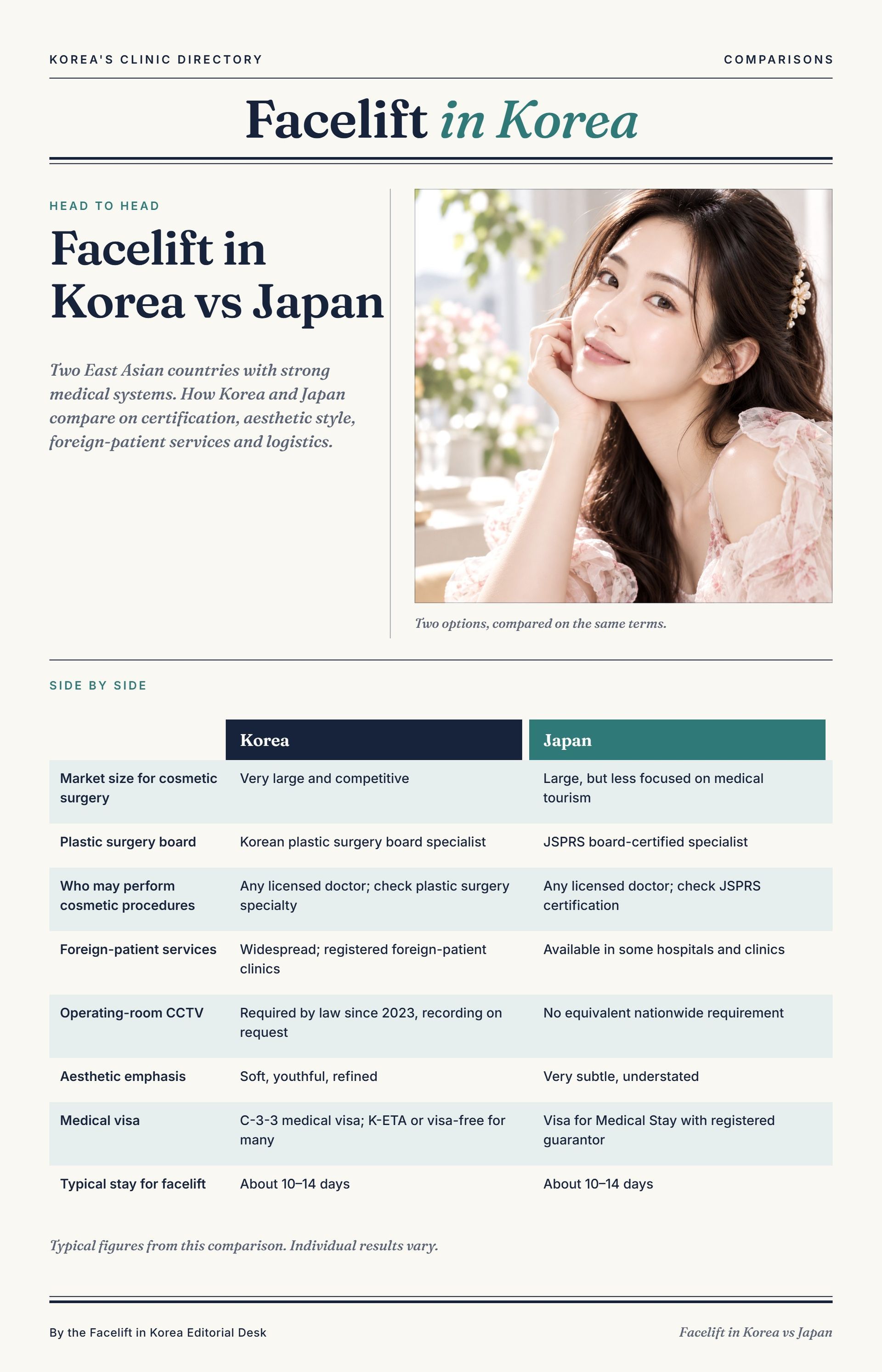
| Market size for cosmetic surgery | Very large and competitive | Large, but less focused on medical tourism |
| Plastic surgery board | Korean plastic surgery board specialist | JSPRS board-certified specialist |
| Who may perform cosmetic procedures | Any licensed doctor; check plastic surgery specialty | Any licensed doctor; check JSPRS certification |
| Foreign-patient services | Widespread; registered foreign-patient clinics | Available in some hospitals and clinics |
| Operating-room CCTV | Required by law since 2023, recording on request | No equivalent nationwide requirement |
| Aesthetic emphasis | Soft, youthful, refined | Very subtle, understated |
| Medical visa | C-3-3 medical visa; K-ETA or visa-free for many | Visa for Medical Stay with registered guarantor |
| Typical stay for facelift | About 10–14 days | About 10–14 days |
| Price guide | Facelift cost in Korea | Ask clinics for itemized quotes |
Why compare Korea and Japan?
Korea and Japan are close neighbors with advanced healthcare systems and long traditions of aesthetic medicine. Both have surgeons experienced with East Asian facial anatomy. For patients from Asia, Australia and North America, both are realistic options. They differ mainly in market size, foreign-patient infrastructure and aesthetic culture.
How do aesthetic styles differ?
Both countries generally favor natural results. Korean surgeons often aim for a soft, refreshed and youthful look, frequently adding fat grafting for volume. Japanese aesthetic culture tends to be even more understated, and many patients prefer very subtle change. Both approaches differ from the more dramatic results sometimes associated with other markets. See the natural Korean facelift aesthetic.
How do qualifications work?
In Japan, plastic surgery board certification is granted by the Japan Society of Plastic and Reconstructive Surgery (JSPRS) after years of specialist training and examinations, with renewal every five years. As in many countries, Japanese law allows any licensed doctor to offer cosmetic procedures. Recent reports describe a trend of young doctors moving into aesthetic clinics soon after their basic training. Patients should therefore check whether a surgeon holds plastic surgery board certification.
What safeguards does Korea have for foreign patients?
Korea regulates medical tourism under a national law on attracting international patients. Clinics that market to foreign patients must register with the government, and the Korea Health Industry Development Institute (KHIDI) supports this system. Since September 2023, Korean law has required CCTV cameras in operating rooms where patients are under general anesthesia or sedation, with recording available on the patient's request. Plastic surgery specialists complete board certification overseen by the Korean Society of Plastic and Reconstructive Surgeons. See how to verify a board-certified surgeon in Korea and ghost surgery and how to avoid it.
How do services for international patients compare?
Korea's cosmetic surgery market is built around international patients in a way that Japan's generally is not. Many Seoul clinics have coordinators who speak English, Chinese, Japanese and other languages, and they are used to remote consultations and planning trips. Japan has excellent hospitals and some clinics with multilingual staff, but fewer cosmetic clinics advertise to medical tourists. Japan offers a Visa for Medical Stay, which requires a registered guarantor such as an accredited medical coordinator. Many visitors can also enter visa-free for short stays. Check the rules for your nationality.
How do logistics compare?
- Flights: both are short flights from much of East and Southeast Asia and similar distances from North America and Australia.
- Language: English is more commonly offered by Seoul cosmetic clinics. See medical interpreters in Korea.
- Recovery stays: both have safe, comfortable cities with good public transport and serviced apartments.
What about cost?
Prices vary widely in both countries depending on the surgeon, technique and clinic. Ask for an itemized quote covering surgery, anesthesia, facility fees, follow-up and revision policy. For Korea, see the facelift cost overview. Japanese patients considering Korea can find more detail in the guide for patients from Japan.
How do I choose safely in either country?
- Verify plastic surgery board certification (Korean plastic surgery specialist status in Korea, JSPRS in Japan).
- Consult directly with the operating surgeon.
- Ask whether a professional interpreter will be present.
- Get a written treatment plan and itemized quote.
- Plan follow-up care after returning home.
What should I know if I choose Seoul?
Most Seoul facelift clinics are in Gangnam, with many hotels and serviced apartments nearby. Many clinics have Japanese- and English-speaking coordinators, but ask whether a professional medical interpreter will join the consultation with the surgeon. Since January 2026, Korea no longer offers the tourist VAT refund on cosmetic surgery, so check whether quotes include VAT. Request your operative notes and medication list in writing to share with your doctor at home. See booking a facelift in Korea step by step.
This page is general information, not medical advice. Decisions about surgery should be made with a qualified, board-certified plastic surgeon after an in-person examination.
Reader questions
Frequently asked questions
Is Korea or Japan better for a facelift?
Both have skilled surgeons and advanced medical systems. Korea offers a larger choice of clinics and more foreign-patient services, while Japan is known for a very subtle aesthetic. Choose based on the individual surgeon.
How do I check a plastic surgeon in Japan?
Ask whether the surgeon is board certified by the Japan Society of Plastic and Reconstructive Surgery (JSPRS). Any licensed doctor can legally offer cosmetic procedures, so certification is an important check.
Do Japanese patients travel to Korea for facelifts?
Yes. Korea is a popular destination for Japanese patients because of short flights, a large choice of clinics and Japanese-speaking coordinators at many Seoul clinics.
Do I need a medical visa for surgery in Japan or Korea?
Many nationalities can enter both countries visa-free for short stays. Both also offer medical visas for longer treatment stays. Check current rules for your passport.
How long should I stay for a facelift in Korea or Japan?
Most surgeons recommend about ten to fourteen days so stitches can be removed and early recovery checked before flying home.
Next steps
Planning a facelift in Korea?
Compare clinics, check surgeon credentials and estimate your full trip budget before you book a consultation.
Facelift in Korea is an independent information directory. We do not perform procedures, and listings are not endorsements. This page is general information, not medical advice.